The Real Reason Landing Page Funnels Fail (It's Not What You Think)
You redesigned the landing page. Improved the copy. Tightened the call-to-action. Simplified the form. The conversion rate barely budged.
So you tested a different headline. Then a different color for the button. Then a completely different layout. Still stuck.
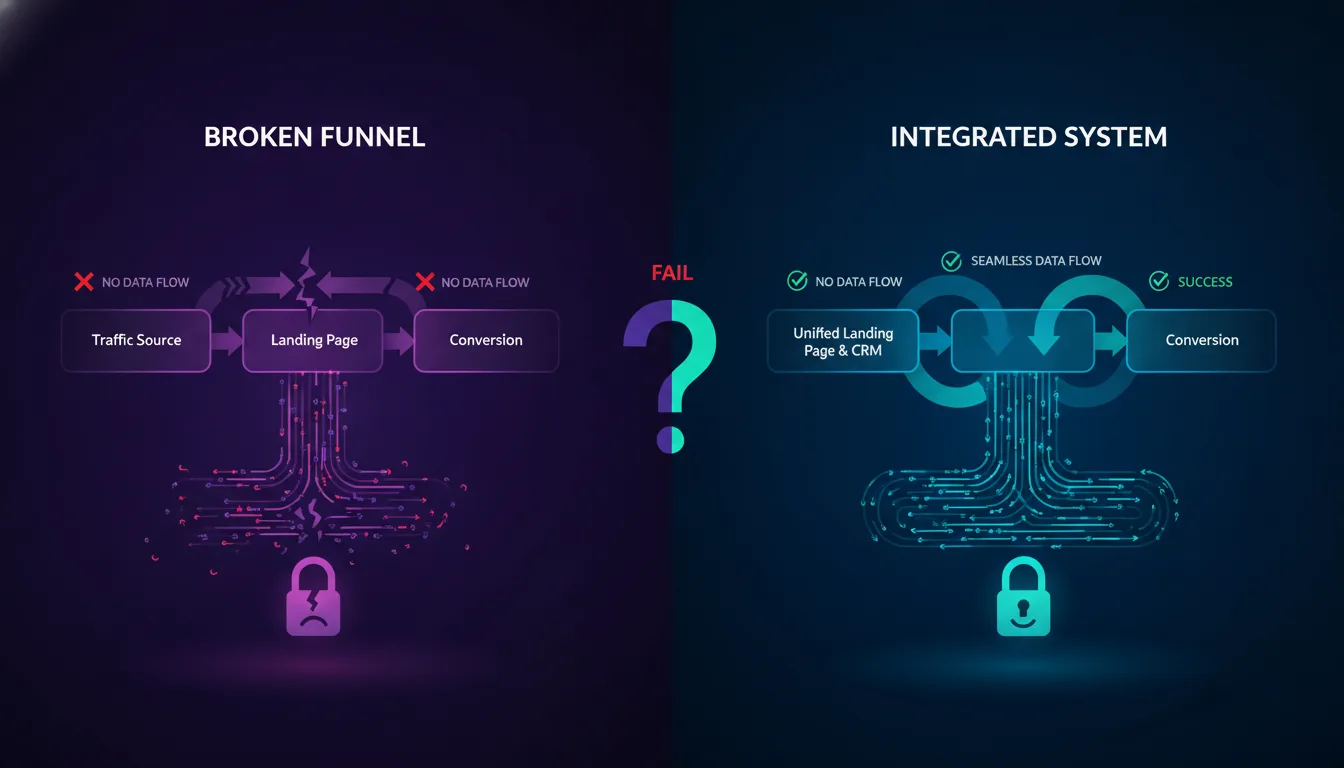
Here's what most businesses miss: landing page design is rarely the bottleneck. The bottleneck is the system underneath.
Key Takeaway: Landing page funnel failures rarely stem from design. They stem from system architecture — how the funnel connects to ad targeting, how tracking flows back to inform bidding, how post-click experience feeds into email automation, and whether every assumption is tested. Fix the system, and design improvements compound.
According to Unbounce's 2025 Landing Page Benchmark Report, the average landing page conversion rate across all industries is just 2.35% — but top performers in the same industries convert at 5–12%. The difference is not marginally better design. It is fundamentally different architecture. Top performers treat landing pages as integrated systems, not standalone projects.
This post breaks down the six most common landing page funnel mistakes — the structural failures that design tweaks cannot fix — and shows you how to build a system that actually compounds performance over time.
How Many of These 6 Mistakes Is Your Business Making Right Now?

Most growth-stage businesses are making 4–6 of these simultaneously. The frustrating part: they are making them not because they are negligent, but because landing page funnels are typically built in isolation from the rest of the marketing stack.
Mistake | What It Looks Like | What It Costs You |
|---|---|---|
1. Treating landing pages as standalone projects | Separate vendor/freelancer. No integration with ad platforms or email systems. No feedback loop. | No visibility into which ad angles drive which conversions. No segmentation for post-purchase email. Dead-end metrics. |
2. Ignoring post-click experience optimization | Focus shifts from "get clicks" to "get form fills." Page speed, mobile experience, and copy messaging are afterthoughts. | High ad spend driving clicks to slow or confusing pages. Abandonment spikes hidden in "bounce rate" noise. |
3. Tracking only form submissions, not behavior | You measure "form fills." You do not measure scroll depth, time on page, field abandonment, or interaction patterns. | Cannot diagnose why 67% of visitors leave before the form. Cannot optimize the experience only 30% ever see. |
4. Disconnecting ad targeting from funnel data | Ads are managed separately. Funnel data (who converts, at what stage, from what source) does not feed back to inform bidding or audience building. | Continuing to bid on non-converting audiences. Missing expansion opportunities from high-converting segments. |
5. No structured A/B testing framework | Testing is ad-hoc. "We tried a different headline once." Statistical rigor is missing. Changes are not always documented. | You cannot build on what works because you did not document why it worked. Each test is isolated, no compounding. |
6. Building from templates instead of systems | Landing pages are cloned from templates or competitors. Customization is surface-level. No underlying structure. | Short-term lift (maybe). Long-term learning: none. The next page looks identical. Same mistakes repeated at scale. |
Myths vs. Reality: What Actually Moves the Conversion Needle

The industry consensus on landing pages is often backwards. Here is what is actually true:
Common Belief | What's Actually True |
|---|---|
MYTH: "Landing page design is the conversion bottleneck." | REALITY: System architecture is. According to WordStream's 2025 PPC data, 68% of low-converting funnels have poor tracking setup (not design). Design matters, but only once you can measure what matters. |
MYTH: "A better post-click experience automatically means more conversions." | REALITY: Only if you are measuring the right behaviors. HubSpot research shows that 43% of landing page optimization efforts focus on the wrong metrics. You need complete behavioral data before you can optimize it. |
MYTH: "You don't need to A/B test — agencies and best practices know what works." | REALITY: Every assumption requires testing or hard data. Instapage's conversion analysis shows that 31% of "best practice" changes actually decrease performance in real-world scenarios. Your data beats industry consensus every time. |
MYTH: "More traffic to a landing page = more conversions." | REALITY: Only if the page is optimized for the traffic source. Instapage data confirms that low-quality traffic to an unoptimized page decreases overall conversion rate despite increasing absolute volume. Quality + targeting + optimization = conversion growth. |
The pattern is clear: the businesses that win on landing page conversion are not the ones with the fanciest designs. They are the ones with the most complete data and the most disciplined optimization approach.
Mistake #1: Treating Landing Pages as Standalone Projects

This is the most common mistake. A business decides it needs a new landing page, so it hires a freelancer or agency. The freelancer builds a beautiful page. It converts reasonably well — maybe 3–4%. The business declares success and moves on.
But here's what actually happened: the page was optimized for a general audience, not for the specific audiences driving your ads.
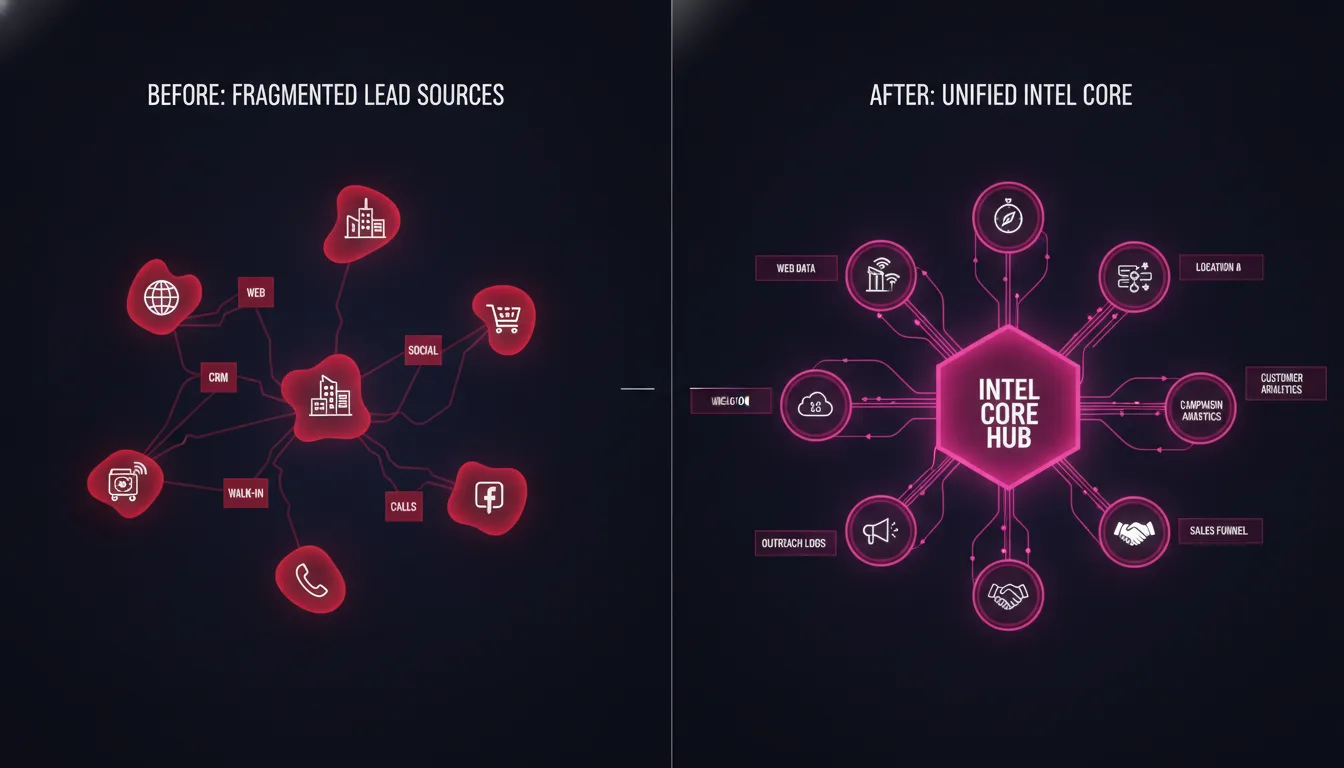
When a landing page is built in isolation, it cannot be optimized for the audiences that matter most. You do not know which traffic sources convert highest. You do not know which audience segments engage differently. You cannot build email sequences segmented by funnel behavior. The page sits alone, accepting traffic from wherever it comes, converting whoever happens to be receptive.
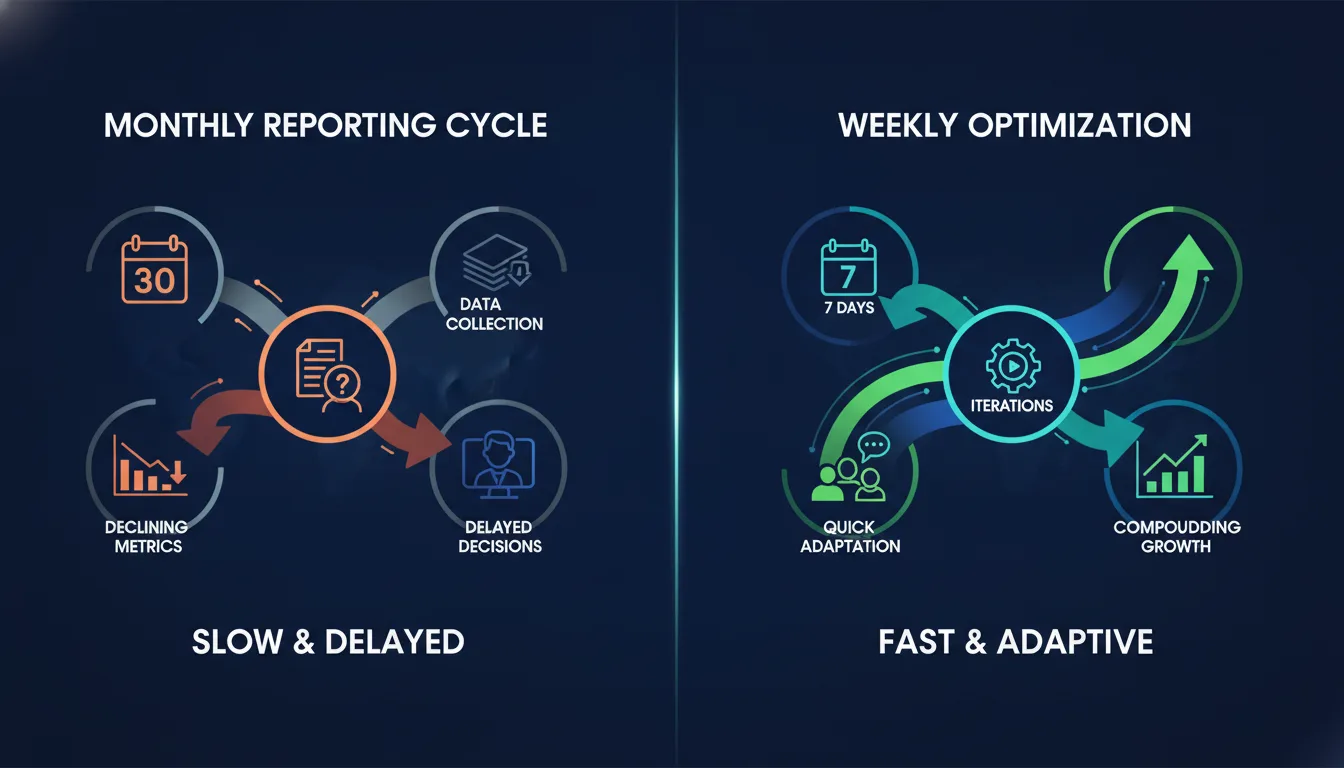
What systems-based brands do differently: They build landing pages as components of an integrated funnel. The page receives traffic from known campaigns. Behavior on the page is tracked comprehensively. Form submission data is connected to the traffic source and audience segment. This data flows back into the ad platform to inform future bidding and audience building. The page is not a standalone asset — it is a node in a closed-loop system.
The result: within 90 days, they have data on which ad angles drive which customer types. By six months, conversion optimization is driven by signal, not guesswork.
Mistake #2: Ignoring Post-Click Experience Optimization
Most businesses focus on "getting clicks" and treat everything after the click as secondary. The ad copy promises speed. The landing page loads in 4 seconds. Good enough.
But research from HubSpot on conversion behavior shows that 53% of visitors abandon pages that take longer than 3 seconds to load — and every additional second of delay costs 7% more abandonment. That is not a design problem. That is a measurement and infrastructure problem.
The post-click experience includes: Page load speed (server-side rendering, image optimization, CDN usage), mobile responsiveness and interaction cost (can a thumb tap the CTA from the bottom of the screen?), messaging alignment (does the page headline match the ad promise?), form friction (how many fields before the first conversion event?), and clarity of next steps (what happens after submission?).
All of this compounds. A page that loads fast, aligns messaging, and provides clear next steps converts 2–3x higher than one that does not. But you cannot optimize what you do not measure — and most businesses measure only form fills, not behavior.
Mistake #3: Tracking Only Form Submissions, Not Behavior
The default landing page metric is simple: "How many form fills did we get?" It is countable, easy to report, and incomplete.
Consider this scenario: 1,000 visitors arrive. 300 scroll below the fold. 150 reach the form. 45 start filling it out. 12 submit. Your "conversion rate" is 1.2%. But what you really need to know is: Why do 67% of visitors leave before seeing the form at all?
That answer requires tracking beyond form submission:
Scroll depth: How far down the page do visitors read before leaving? At what point does drop-off accelerate?
Time on page: Are visitors spending 10 seconds (skimming) or 2 minutes (reading)?
Element interaction: Which buttons, links, or sections do visitors interact with?
Form abandonment: Which field causes form-starters to bail? Is it the email field? The phone number? Too many fields?
Funnel stage completion: What percentage reach each stage (viewed offer → scrolled → interacted → started form → submitted)?
Without this data, you are redesigning blindly. With it, you can identify the exact stage where visitors drop off and address it.
How to implement: Use GA4 event tracking to log page_view, scroll (at 25%, 50%, 75%, 100%), button_click, form_start, form_field_interaction, and form_submit. Document which events matter for your business. Then optimize each stage, not just the final one.
Mistake #4: Disconnecting Ad Targeting from Funnel Data
A common structure: the PPC agency manages Google Ads. A separate person manages the landing page. They do not talk.
The result: the PPC team keeps bidding on the keywords and audiences that generate the most clicks. The landing page team optimizes for the visitors they are already getting, not for what the ad team should change.
Meanwhile, signal is being left on the table. You are bidding on keywords that drive clicks but not conversions. You are neglecting keywords that drive low volume but high-converting visitors. You are building lookalike audiences based on form fills, not based on the revenue-generating customers that landed on the page.
Systems-based approach: Funnel data flows back to the ad platform. You measure not just "clicks" but "which ad angles convert." You build audiences not from generic form-fill lists, but from high-converting traffic sources and visitor behaviors. You increase bid on underutilized high-conversion keywords. You decrease bid on low-conversion high-volume keywords, even if they generate "cheap clicks."
This requires integration: landing page tracking → conversion pixel → ad platform (Google Ads, Meta Ads) → audience segments exported back to the landing page platform for behavioral segmentation.
Mistake #5: No Structured A/B Testing Framework
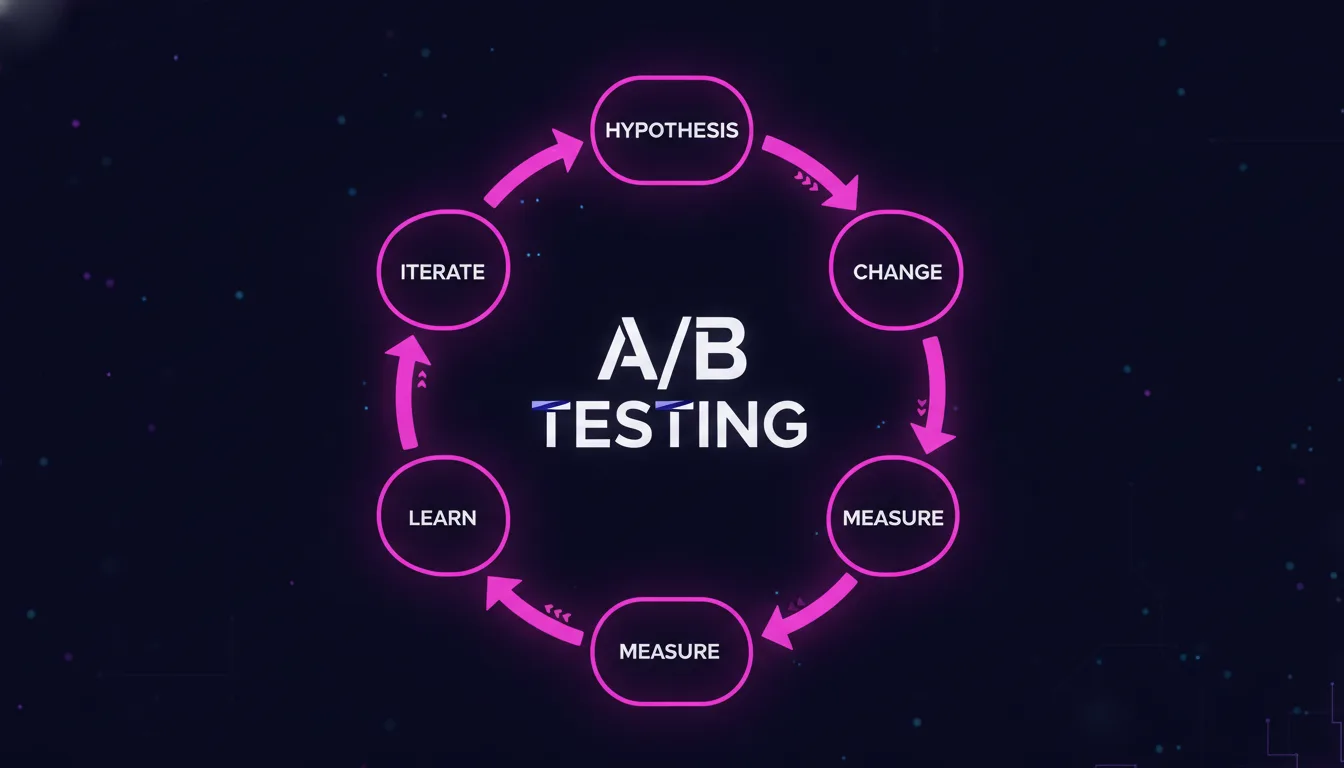
Most businesses test landing pages ad-hoc. "Let's try a red button instead of blue." Someone changes it. A few weeks later, conversion rate either went up or down. No one documents why.
This approach costs you compound learning. Each test is isolated. You do not build on what works because you did not scientifically prove it worked.
A structured testing framework includes:
Hypothesis: "We hypothesize that form fields ordered [email first, phone second] will increase completion rate vs. [phone first, email second] because email is a lower-commitment ask."
Test design: 50/50 traffic split for 1 week (minimum 400 conversions per variant for statistical validity).
Success metric: Form completion rate increases 5%+ OR conversion cost decreases 5%+.
Documentation: Win or lose, log the hypothesis, change, results, and next test.
Iteration: Build on wins. Test the next variable.

High-performing brands run 2–3 tests per page per month. Over 12 months, that is 24–36 documented, validated improvements. Compound 10% improvements over 12 months and you are looking at a 3–4x improvement in conversion efficiency.
Common testing mistakes to avoid:
Testing too many variables at once (you cannot learn from the results).
Running tests for too short a duration (you miss weekly or day-of-week variance).
Declaring a winner with too few conversions (statistical noise will mislead you).
Not considering external factors (a test running during a promotion vs. a control running without one gives false positives).
Mistake #6: Building from Templates Instead of System-Based Frameworks
Template-based landing page builders (Unbounce, Instapage, Leadpages) are efficient for quick launches. They are not efficient for compounding performance.
Why? Because templates optimize for generics. Every template page looks similar to every other template page. If your funnel strategy relies on templates, you are starting with the same architecture that thousands of other brands are using. You cannot differentiate. You cannot build institutional knowledge specific to your business.
System-based approach: Use templates for rapid setup, but customize them around your actual data. Your highest-converting landing page variant becomes the new baseline template, not a one-off experiment. Your best-performing copy approaches are documented and reused. Your testing framework is baked into the page infrastructure, not added as an afterthought.
This means: you own the source. You document decisions. You test methodically. You compound learning.
Over 18 months, a template-based approach might lift conversion rate 15–20%. A system-based approach with disciplined testing compounds to 60–80%+ improvement.
What Actually Works: The Integrated Landing Page Funnel
Here is what a system-based landing page funnel looks like:
Traffic sources are documented and segmented: You know which Google Ads campaigns, audiences, and keywords are sending traffic. You know which Meta ad sets and audiences are driving visitors. This data is logged with every session.
Landing page behavior is comprehensively tracked: Every interaction — scroll, click, form start, form field interaction — is logged as an event in GA4 and sent to your data warehouse. You know drop-off points.
Form submissions are connected to cohorts: When someone submits the form, you record not just "form fill" but also "traffic source," "audience segment," "behavioral pattern," and "time on page." This becomes a cohort for email segmentation.
Funnel data flows back to the ad platform: Conversion data is sent back to Google Ads and Meta Ads via conversion pixels and APIs. This tells the algorithm which campaigns and audiences to double down on.
A/B testing is built into the funnel: Testing happens continuously. Each variant is logged. Results inform the next iteration.
Email automation responds to funnel stage and behavior: Visitors who reached the form but did not submit get a different email sequence (reminders, social proof, objection handling) than those who did not see the form.
This is managed marketing infrastructure applied to landing page funnels. It is not agency services. It is not a template. It is a system where every stage compounds the value of the previous stage.
The cost to implement this approach? Typically $2,500–$5,500+/mo for a growth-stage brand. The savings from eliminating fragmentation and improving conversion efficiency? Often 30–50% reduction in customer acquisition cost within 90 days.
What You Should Measure: Isolated vs. Integrated Approach

Here is what most businesses measure (isolated approach) vs. what they should measure (integrated approach):
Metric | Isolated Approach | Integrated Approach |
|---|---|---|
Conversion rate | Form fills / landing page visitors | Revenue customers / landing page visitors |
Cost per conversion | Ad spend / form fills | Ad spend / paying customers (actual ROI) |
Traffic quality | Bounce rate, avg. session duration | Scroll depth, form start rate, time to first interaction, audience segment |
Funnel completion | N/A — usually not tracked | % landing, % below-fold, % form-visible, % form-start, % submission, % email-click, % purchase |
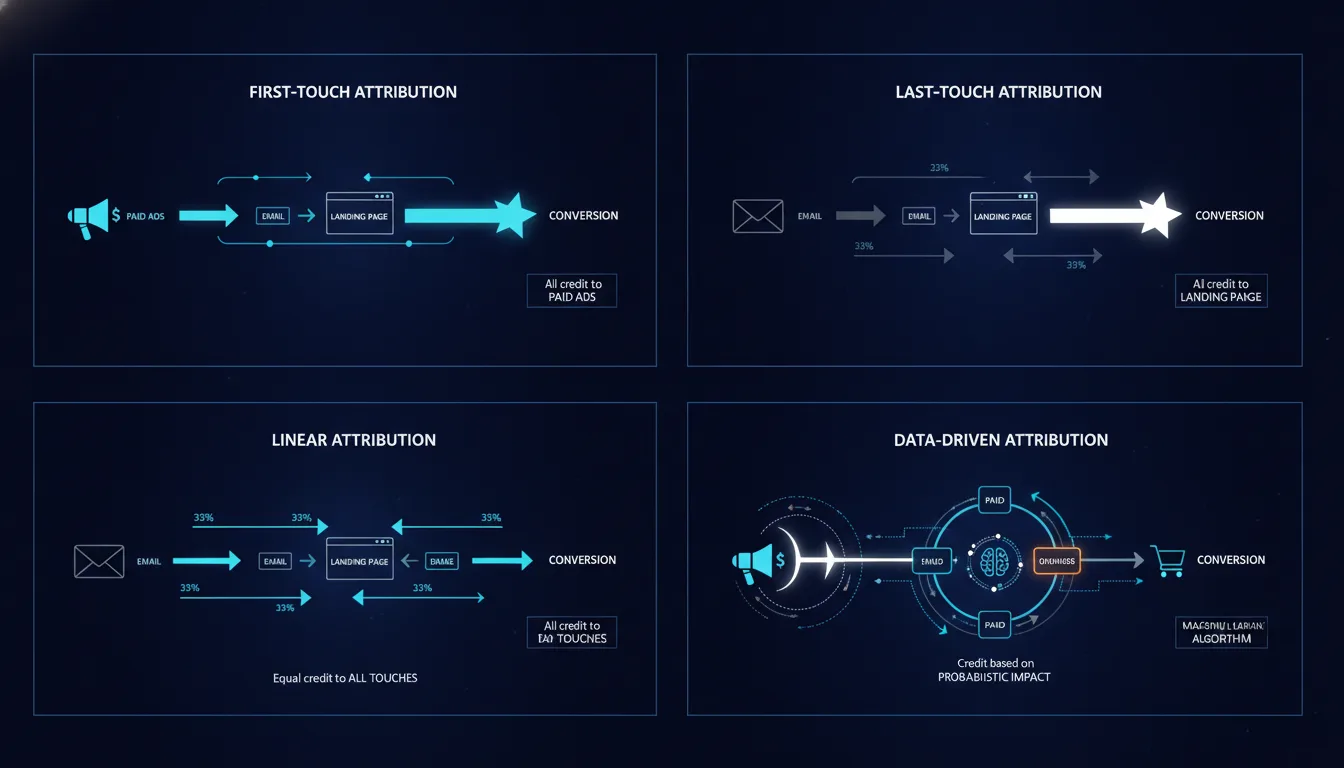
Attribution | Last-click only (which ad drove the form?) | Multi-touch (which ad + which page behavior + which email + which CRM state drove revenue?) |
Ad platform feedback | Form fills sent back as conversions | Revenue + revenue value + customer cohort data sent back for audience building |
The integrated approach requires more infrastructure. But it generates 3–4x better insights and 2–3x faster iteration speed.
Frequently Asked Questions
What is a landing page funnel, and why does it matter?
A landing page funnel is the complete journey from ad click through form submission, confirmation, and post-purchase engagement. It matters because a landing page is not a standalone asset — it is one stage of a larger system. The bottleneck to growth is usually not design; it is how the page connects to ad targeting, email automation, and measurement.
How do I know if my landing page funnel is broken?
You know your funnel is broken if: (1) you can only measure form fills, not visitor behavior; (2) landing page data does not feed back to ad platforms; (3) testing is ad-hoc, not systematic; (4) your conversion rate has plateaued; (5) you cannot explain which visitors convert and why; or (6) the landing page vendor/person does not talk to the ads team.
What should I measure on a landing page beyond form fills?
You should measure: scroll depth (how far down do visitors read?), time on page, button/link interactions, form starts (not just submissions), field-level abandonment (which form field causes drop-off?), traffic source attribution, audience segment, and behavioral cohorts. These metrics reveal where optimization will have the highest impact.
How often should I A/B test my landing pages?
High-performing brands test 2–3 variations per page per month. This requires: (1) a minimum of 400 conversions per variant per week for statistical validity, (2) a hypothesis-driven approach (not random guessing), and (3) documented results so you can compound improvements. One test per quarter is too infrequent to build momentum.
Does landing page design actually matter for conversion rates?
Design matters, but only after the system architecture is sound. According to industry research, 68% of low-converting funnels have poor tracking setup, not poor design. Fix the system first (tracking, data flow, traffic quality). Then optimize design. Design improvements on a broken system are wasted effort.
How do I connect my landing page to my ad platform for optimization?
Use conversion pixels or server-side event tracking to send form submissions (and revenue, if applicable) back to your ad platform. Set up audience exports from your landing page platform to match visitor behavior with ad segments. Use lookalike audiences based on high-converting visitor cohorts, not all form fills. This creates a feedback loop for continuous optimization.
What's the fastest way to improve landing page funnel performance?
In order of impact: (1) Set up comprehensive tracking to identify where visitors drop off; (2) Run 2–3 A/B tests targeting the biggest drop-off stage; (3) Connect funnel data back to your ad platform to refine targeting; (4) Implement email sequences segmented by funnel behavior; (5) Document all changes and results so you build on what works. You will see 20–30% improvement in the first 30 days if you focus on measurement and segmentation first, design tweaks second.
The System Is the Bottleneck. Fix It.
Landing page funnel improvements rarely come from better design. They come from better systems.
Better tracking reveals where visitors drop off. Better integration with ad platforms lets you refine targeting in real time. Better testing frameworks compound improvements. Better email segmentation based on funnel behavior increases post-click value by 30–50%.
If you are stuck on landing page conversion optimization, stop tweaking the design and start fixing the infrastructure. Audit your tracking. Document your data flow. Implement systematic testing. Connect your channels.
That is how conversion rates compound.
Ready to audit your landing page funnel system? If you are a growth-stage brand generating $500K+ in annual revenue and you want to move from isolated optimizations to integrated system thinking, start a conversation with Metrics Masters. We work with brands ready to replace fragmented funnels with managed infrastructure.
Learn more about our landing page and funnel management approach, or dive deeper into what managed marketing infrastructure actually means.

Jeremiah Shaw
CEO & Technical Marketing Specialist · Metrics Masters | Brandlio
International
Technical marketing specialist pushing boundaries in Google Ads, automation, and AI-driven growth systems. Paragliding and adventure enthusiast.