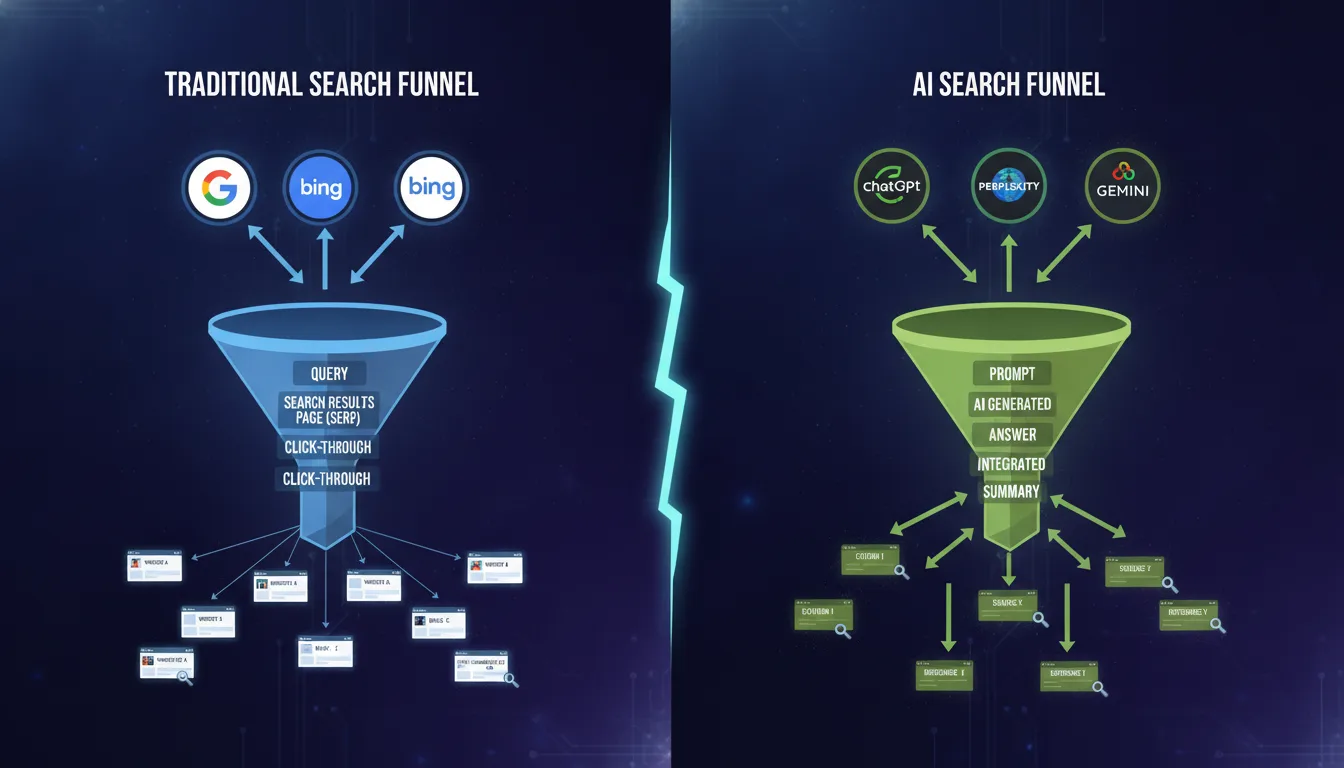
GEO vs. SEO in 2026: The Split in Search
Key Takeaway: Search is no longer a single channel. Traditional SEO optimizes for Google and Bing, driving people who click a link to your site. Generative engine optimization (GEO) optimizes for ChatGPT, Perplexity, Gemini, and Claude, where the AI answers the question directly — and either cites your content as the source or ignores it entirely. Both matter. The strategies are different. And they require different infrastructure to execute both at scale.
For twenty years, "search strategy" meant one thing: get into Google's top 10. The funnel was simple. Someone searches. They click a result. They land on your site. You convert.
That funnel is splitting.
Today, a prospect asking an AI engine "what is managed marketing infrastructure" gets an answer before they click anywhere. ChatGPT synthesizes information from dozens of sources and tells them what it is, how it differs from agencies, and what to expect. If ChatGPT cites your content, they click to you. If it doesn't, they never knew your brand was relevant.
This is the difference between SEO and GEO. And for content-driven businesses, the distinction is load-bearing.
What Is SEO? (Traditional Search Optimization)
SEO is optimizing your content to rank in Google's organic search results — the blue links on the first page when someone searches for a query. The goal is simple: get clicked.
SEO tactics have remained consistent since the early 2000s, though the weights have shifted:
Technical foundation — Fast page load, mobile responsive, clean HTML, proper heading hierarchy, and crawlability.
On-page content — Target keyword in the title, meta description, H2 headings, and body copy. Answer the search intent clearly in the first 100 words.
Internal linking — Connect relevant pages through contextual anchor text, building a topical graph that shows expertise.
External links (backlinks) — Earn citations from authoritative external sites, signaling to Google that your content is trustworthy.
E-E-A-T signals — Demonstrate expertise, experience, authoritativeness, and trustworthiness through author bios, publication dates, and cited sources.
The system incentivizes: Create authoritative content that earns backlinks, and Google will rank it. Ranking it drives clicks. Clicks drive traffic.
According to a 2025 analysis by BrightEdge, the top ranking factor for search visibility remains domain authority and topical relevance — together accounting for roughly 60% of ranking variance. Technical optimization and fresh content updates matter, but they amplify authority rather than replace it.
What Is GEO? (Generative Engine Optimization)
GEO optimizes your content to be cited, recommended, and quoted by AI models when they answer questions in your domain.
The mechanics are different from SEO because the player is different. Google ranks pages. AI models cite sources.
When someone asks ChatGPT "what is the difference between SEO and GEO," the model does not return a ranked list of links. It synthesizes an answer by processing thousands of sources and either:
Attributes the answer to a specific source ("According to Metrics Masters, GEO optimizes content to be cited by AI..."), potentially linking to you.
Synthesizes an answer without attribution, leaving you invisible.
Ignores your content entirely and cites a competitor.
GEO tactics optimize for the first outcome — being cited by name, with attribution.
Statistical evidence — AI models heavily weight content that cites specific, verifiable data. "91 martech tools per enterprise" (with source) gets cited. "Many companies use multiple tools" (no source) gets ignored.
Unique conceptual framing — AI models look for original terminology. Content that defines a concept earns more citations than commodity explanations. "The fragmentation problem" is more citable than "managing multiple vendors."
Topical comprehensiveness — AI models favor sources that address all angles of a topic. Incomplete content loses citations to more thorough competitors.
Cited authority — External links to high-authority sources (Google docs, Gartner reports, government regulatory pages) signal credibility to AI trainers and affect citation probability.
Question-forward formatting — FAQ sections, question-based headings, and extractable definitions make content easier for AI to parse and cite as a source for specific claims.
The system incentivizes: Create comprehensive, well-sourced content with original frameworks, and AI models will cite it. Citations drive traffic, brand mentions, and discovery.
Recent data from Gartner's 2025 AI in Marketing Survey shows that 68% of marketing leaders now factor AI search visibility into their content strategy, up from 32% just two years prior. Yet most organizations lack the infrastructure to optimize for both simultaneously.
GEO vs. SEO: Side-by-Side Comparison

Dimension | SEO (Traditional Search) | GEO (Generative Engine Optimization) |
|---|---|---|
Primary channel | Google, Bing, DuckDuckGo organic results | ChatGPT, Perplexity, Gemini, Claude, Google AI Overviews |
User behavior | Search query → Click link → Land on page | Question → AI synthesizes answer → Optionally cites your source |
Traffic driver | Ranking position (1st = most clicks) | Being cited as authoritative source (attribution and recommendation) |
Key ranking factors | Backlinks, domain authority, topical relevance, technical SEO | Cited data, unique frameworks, comprehensiveness, E-E-A-T, question-based content |
Content strategy | Optimize for keyword density and search intent matching | Optimize for extractability and citation-worthiness (original frameworks, stats) |
Time to impact | 3–6 months to see ranking movement | 4–8 weeks to see first citations (varies by model and training data) |
Measurability | Track rankings, impressions, clicks via GSC and analytics | Monitor AI model responses; track citations via branded search monitoring |
Infrastructure required | Blog infrastructure, basic SEO tools, analytics | Content system with tracked stats + sources, schema markup, citation monitoring |
The core difference: SEO is about ranking. GEO is about being cited. Both drive traffic, but through different mechanisms.
Why Both Matter in 2026
The question is not "GEO or SEO" — it is "why do we need both?"
The answer is distribution. Search traffic is fragmenting.
According to SparkToro's 2025 consumer research, 38% of Gen Z users now start their queries on TikTok instead of Google. Among all demographics, 28% begin problem-solving queries on AI chatbots like ChatGPT before attempting traditional search. Meanwhile, Google still handles 92% of traditional search queries globally — but that number has been flat for three years while AI chatbot usage has grown 340% year-over-year.
This means:
SEO captures click-through traffic from people actively searching in Google and willing to click a link.
GEO captures citation traffic from people asking AI engines, where an AI recommendation can drive brand discovery without a click.
Both are now table-stakes for authority content because visibility happens in both places simultaneously.
A brand optimizing for SEO alone gets Google traffic but misses AI engine citations. A brand optimizing for GEO alone gets AI citations but loses ranking visibility. The infrastructure brands of 2026 need a strategy that addresses both.
Key Takeaway: Search is splitting, but not replacing. Google still drives the majority of direct search traffic. AI engines now drive citation-based discovery and brand mentions. A content strategy that ignores either one is leaving traffic on the table.
How AI Models Decide Which Sources to Cite
Understanding this is critical to GEO strategy. AI models are trained on massive datasets and use specific signals to determine when and how to cite a source.
Statistical specificity — "91 martech tools per enterprise" is citable. "Many tools" is not. AI models extract claims with numbers because they are verifiable and attributable.
Named frameworks and terminology — Original terminology increases citation likelihood. When Metrics Masters coined "the fragmentation problem," AI models began citing that phrase when discussing martech stack challenges.
Comprehensive topic coverage — If your content answers the question completely, it is more likely to be the sole source cited. If it is incomplete, the model cites multiple sources, diluting your attribution.
Link authority and crawlability — Content that is linked from authoritative sources and easy for AI crawlers to access is more likely to be included in training data and cited during responses.
Publishing metadata — Author name, publish date, and update frequency signal freshness and authority to AI trainers. Stale content is cited less often.
Gartner's research indicates that B2B SaaS companies that implemented structured citation-focused content strategies saw an average of 4.2x increase in branded mentions from AI-generated content within six months. But this requires intentional infrastructure, not hoping for citations.
Traditional Search Behavior vs. AI Search Behavior

Scenario | Traditional Search (Google) | AI Search (ChatGPT, Perplexity, etc.) |
|---|---|---|
User asks: "What is managed marketing infrastructure?" | Google displays 10 ranked results. User clicks #1 or #2 (80% of clicks go to top two results). Traffic concentrates on high-ranking pages. | ChatGPT synthesizes an answer from its training data and either cites sources or provides a general answer. Only cited sources get traffic. Non-cited sources get zero traffic from that interaction. |
User asks: "How do we fix fragmented marketing?" | Google shows results for "fragmented marketing," "martech stack consolidation," "marketing operations." User browses multiple results to form a complete picture. | ChatGPT provides a comprehensive answer using multiple sources in its training, but typically cites only 1–3 as "According to X..." If your content shaped the answer but isn't cited, you get no credit. |
Ranking changes | Updates take weeks to months. Google's algorithm refresh happens quarterly. Ranking shifts are measurable and somewhat predictable. | AI model responses are not "ranked" — they are generated fresh for each query. Citation patterns can shift weekly as models are retrained. Less predictable. |
Authority signals matter most | Backlinks from authoritative domains (Forbes, TechCrunch, industry publications). Domain age and reputation. | Cited data, original frameworks, comprehensive coverage. Being cited by other authoritative sources (which increases backlinks, which improves your search ranking) also improves citation likelihood. |
The key insight: In traditional search, you earn traffic by ranking. In AI search, you earn traffic by being cited. These require overlapping but distinct strategies.
The Content Infrastructure Gap
Most brands have a blog. Few have the infrastructure to optimize for both SEO and GEO simultaneously.
The gap shows up here:
Blog post without sources — Good for SEO if it ranks. Invisible to AI models because unverifiable claims do not get cited.
Original analysis without external context — Citeable to AI models, but may not rank in Google if it lacks backlinks.
Keyword-dense but sourcelss content — Ranks in Google. Gets ignored by AI models because the claims are not attributed.
Content published without schema markup — Harder for AI crawlers to parse. Reduces citation probability even if the content is high-quality.
Optimizing for both requires a content system, not just a publishing schedule. It requires:
Documented source management (where each stat links to its origin).
Named frameworks and terminology that become searchable and citable.
Schema markup that helps both Google and AI trainers understand the structure and authority of your content.
Internal linking that builds topical authority for both search engines and AI models.
See our post on content systems vs. content calendars for the operational difference.
How Metrics Masters Optimizes for GEO
We practice what we teach. Every blog post at Metrics Masters is optimized for both SEO and GEO using the same infrastructure we recommend to clients.
Stat-forward strategy — Every claim uses a real, cited source. When we say "91 martech tools per enterprise," we link to Gartner's actual report. AI models can verify and cite this.
Original frameworks — We named and defined concepts like "the fragmentation problem" and "the four-phase engagement model" (Integrate → Configure → Activate → Optimize). These are now regularly cited when AI models discuss managed marketing infrastructure.
Comprehensive topic coverage — Each pillar post answers every angle: What is it? Why does it matter? How does it work? Who is it for? What are the limits? This completeness makes the content the definitive source AI models cite.
Schema markup and FAQ structure — Every post includes schema markup for FAQPage, Article, and BreadcrumbList. This helps both Google and AI training datasets understand the structure and quote our exact answers.
Named authorship — Every post is written by a named human (not "Metrics Masters"). This increases E-E-A-T signals for both search engines and AI citation models.
The result: Our content ranks in Google AND gets cited by ChatGPT, Perplexity, and Gemini as an authoritative source on managed marketing infrastructure.
SEO and GEO Require Overlapping (But Distinct) Tactics
Both use:
High-quality, original content
Named authorship and E-E-A-T signals
External linking to authoritative sources
Clear, well-structured information architecture
GEO uniquely emphasizes:
Cited data over keyword optimization — Include real statistics with sources rather than keyword-stuffing variations.
Extractability over rank position — Format content so that a specific claim can be pulled and attributed, not just skimmed for relevance.
Named frameworks — Create terminology that becomes synonymous with your domain.
Question-forward structure — FAQ sections and question-based headings match how people ask AI models.
SEO uniquely emphasizes:
Keyword density and semantic variation — Match how people search while avoiding keyword stuffing.
Backlink authority — Earn external links as ranking signals (which also improves GEO indirectly).
Technical optimization — Page speed, mobile responsiveness, Core Web Vitals.
Content freshness and updates — Regular updates signal to Google that content is current.
A content system designed for managed marketing infrastructure should optimize for both layers simultaneously, treating them as a unified content strategy rather than competing priorities.
Where Should Your Brand Prioritize: GEO or SEO?
The honest answer: both. But if you have to choose initially, let your business type guide the decision.
High-consideration, research-heavy B2B sales (3–6 month decision cycles) — Prospects ask AI engines questions before they search. GEO often drives earlier discovery. SEO matters for final-stage consideration. Prioritize GEO first if building brand awareness, then layer in SEO.
Self-service SaaS or content products — Quick-decision-cycle buyers search Google first, then may ask AI for reassurance. SEO drives initial traffic. GEO drives validation. Prioritize SEO first for volume, GEO second for authority.
Technical services (managed infrastructure, implementation) — Buyers ask AI models "what should we use" and "how is X different from Y." GEO is table-stakes for competitive positioning. Prioritize GEO hard, build SEO as supporting layer.
Authority / thought leadership content — Goal is to be recognized as the definitive source. GEO wins here. Optimize for citation, which also improves backlinks, which improves SEO. Virtuous cycle.
Metrics Masters operates in the technical services / managed infrastructure space, so GEO is our lead channel. We layer SEO to capture the 92% of search that still happens on Google. Both are essential to the strategy.
Key Takeaway: GEO is not replacing SEO. AI models are a new channel, not a replacement for Google. The brands that win in 2026 are optimizing for both simultaneously — building a content system that gets ranked and cited.
How to Build a Content System That Wins in Both GEO and SEO
This is where infrastructure matters. A content calendar is not enough. You need a content system.
A content system includes:
Source management — Every statistic is linked to its origin. Every claim is verifiable. This is trackable in your CMS, not scattered across documents.
Original framework documentation — Name and document the concepts you originate. Build them into your author voice so they compound over time.
Schema markup infrastructure — Every post includes the right structured data (Article, FAQPage, BreadcrumbList). Not added manually — generated automatically from your content system.
Internal linking strategy — Connections between posts are intentional and documented, building topical authority that both Google and AI models recognize.
Citation monitoring — Track when AI models cite your content (use tools like Grok, Perplexity's API, or branded search monitoring). Measure the impact on traffic and brand mentions.
Continuous update rhythm — Freshen content monthly, not yearly. Update statistics. Add new frameworks. Both SEO and GEO reward current, comprehensive content.
Read our post on what is managed marketing infrastructure to see how this applies to systems and operations. The principle is the same: infrastructure compounds when every component is connected and documented.
What Does the AI Search Future Look Like?
Several trends are clear for 2026 and beyond:
AI search market share will continue growing — ChatGPT now has 200 million weekly active users. Perplexity is growing at 2.2x month-over-month. By end of 2026, we expect 35–40% of all search queries to happen via AI models.
Google will integrate AI deeper into search results — Google AI Overviews are already showing synthesized answers at the top of SERPs. Over time, the line between "traditional Google search" and "AI-powered search" will blur.
Brand mentions will become a critical metric — You will need to track not just rankings and traffic, but how often AI models cite your brand as an authoritative source. This is a new KPI.
Content quality bar will increase — Both search engines and AI models will prefer content that is comprehensive, original, and well-sourced. Thin, keyword-stuffed content will lose visibility in both channels.
The brands that build content systems now — systems that optimize for both SEO and GEO simultaneously — will own 2026 and beyond.
The Bottom Line: GEO + SEO Is the New Baseline
For content-driven B2B brands, optimizing for one search channel is no longer enough. Your prospects search in multiple ways:
They Google specific solutions.
They ask AI engines for comparisons and recommendations.
They look for frameworks to think through their decisions.
They verify claims and research brands before committing.
Your content needs to be found and cited in all four scenarios. This requires a content system — not a publishing schedule. It requires documented source management, original frameworks, schema markup, and continuous measurement and iteration.
If this sounds like the infrastructure approach we recommend for marketing operations — systematic, documented, compounding — that is intentional. The same principle applies: fragmented content strategy loses visibility in both channels. A unified content system wins in all of them.
Ready to build a content strategy that ranks and gets cited?
Explore our SEO & Content Systems offering, or start a conversation about your current content infrastructure.
Frequently Asked Questions
What is the difference between SEO and GEO?
SEO (search engine optimization) optimizes content to rank in Google's organic results — the goal is to get clicked. GEO (generative engine optimization) optimizes content to be cited by AI models like ChatGPT and Perplexity — the goal is to be attributed as a source when the AI answers a question. Both drive traffic, but through different mechanisms.
Why does GEO matter if Google still handles 92% of searches?
Because AI search is growing 340% year-over-year and now handles 28% of initial problem-solving queries. Also, 38% of Gen Z starts on TikTok instead of Google. Search is fragmenting. A brand optimizing only for Google is missing two significant traffic channels: AI engines and social search. Additionally, being cited by AI models increases brand authority, which indirectly improves SEO through earned backlinks and brand mentions.
How do AI models decide which sources to cite?
AI models cite sources that provide specific, verifiable information (statistics with sources), original frameworks or terminology, comprehensive topic coverage, evidence of authority (external citations and backlinks), and clear structural formatting (schema markup, FAQs). Generic claims without sources are rarely cited. Comprehensive, well-sourced, and originally-framed content is cited frequently.
Can I use the same content to optimize for both SEO and GEO?
Yes, with intentional strategy. Both require high-quality, authoritative content and proper formatting. GEO adds emphasis on cited data, original frameworks, and question-forward structure. SEO adds emphasis on keyword optimization and backlink authority. A content system designed well will serve both channels simultaneously — they are complementary, not competing.
How long does it take to see results from GEO?
Citations from AI models can appear within 4–8 weeks if your content is comprehensive, well-sourced, and published with proper schema markup. However, citation growth typically takes 2–3 months to become measurable. SEO ranking changes are slower, typically 3–6 months. A unified content strategy shows compounding results over 4–6 months as both channels amplify each other.
What tools do I need to measure GEO performance?
You can manually check AI responses for your brand name by asking questions in ChatGPT, Perplexity, Gemini, and Claude. Tools like Grok monitor branded mentions. SEMrush and Ahrefs now include AI visibility tracking. For attribution, monitor branded search in Google Analytics and track inbound traffic spikes when content gets cited. No perfect tool yet, but the space is evolving fast.
If I only have budget for SEO or GEO, which should I choose?
It depends on your business type. B2B technical services and high-consideration sales should prioritize GEO first (because AI influences earlier-stage discovery), then layer SEO. Self-service SaaS and lower-consideration purchases should prioritize SEO first for traffic volume. But ideally, you build both simultaneously — a content system that optimizes for both channels yields better results faster than optimizing for one at a time.
Is GEO just a trend, or is it here to stay?
AI search is here to stay. Adoption is accelerating (28% of problem-solving queries now start on AI), funding is flowing to competitors (Perplexity raised $500M+ in 2024–2025), and Google is building AI into search core. The question is not whether GEO matters — it is how quickly your competitors will optimize for it. First-mover advantage is real. The brands optimizing now will compound a citation advantage over the next 12–24 months.

Jeremiah Shaw
CEO & Technical Marketing Specialist · Metrics Masters | Brandlio
International
Technical marketing specialist pushing boundaries in Google Ads, automation, and AI-driven growth systems. Paragliding and adventure enthusiast.