What Is Cross-Channel Attribution and Why Is It Critical in 2026?
Key Takeaway: Cross-channel attribution is the ability to credit which marketing touchpoints deserve credit for a conversion. With third-party cookies deprecated, attribution is no longer optional — it is the foundation of whether you know what's actually driving revenue. The model you choose determines whether you optimize based on data or guesses.
Cross-channel attribution answers one question: Which marketing touchpoint deserves credit for the conversion?
A customer sees your paid ad on Monday. They click an email on Wednesday. They land on a page Friday. They convert on Sunday. Did the ad start the journey? Did the email push them over the edge? Did the landing page content seal the deal? Attribution models assign credit across that chain — and your answer changes how you allocate budget, optimize campaigns, and measure what actually works.
For the last 15 years, that answer came from third-party cookies: invisible trackers that followed users across sites and platforms, giving advertisers a relatively clear (if privacy-invasive) picture of the customer journey. That era is over. Apple stopped tracking in iOS 14 in 2021. Google is phasing out third-party cookies from Chrome by the end of 2026. The tracking infrastructure that underpinned attribution is collapsing.
The question is not whether you need attribution — you do. The question is what attribution model, data collection method, and technology stack will work when the old infrastructure is gone.
Why Cross-Channel Attribution Matters More Than Ever?
When attribution breaks, budget allocation becomes guesswork. According to Triple Whale's 2026 Attribution Study, only 18% of marketers report having "high confidence" in their attribution accuracy. The remaining 82% are making million-dollar budget decisions on incomplete data.
The stakes are higher than they look. When you cannot track which channels drive conversions, you tend to over-invest in the channels you can measure (usually direct and organic search) and under-invest in the channels that are harder to track (like influencer, brand awareness, and mid-funnel nurture). This creates a death spiral: you cut budget from the channels that actually build demand, so they underperform, so you cut more. Meanwhile, the demand-driving channels are starved and you blame "declining performance" when the problem is your measurement.
The technical reality is stark: Segment's 2026 CDP benchmark found that only 23% of enterprises have fully integrated first-party data across channels without manual export-import workflows. The infrastructure gap creates visibility gaps. No visibility means no optimization. No optimization means revenue left on the table.

Here is what is actually happening: iOS privacy limits are causing 27-35% attribution loss for mobile-first brands, according to AppsFlyer's 2025 mobile attribution report. Android is heading the same direction. And as third-party cookies disappear, browser-based tracking accuracy will collapse too. Within the next 12 months, most traditional attribution methods will be unreliable.
The brands that win are not the ones that mourn the loss of cookies. They are the ones that have already rebuilt attribution on first-party data, server-side tracking, and consent-aware frameworks.
Understanding Attribution Models: Which One Is Right for You?
An attribution model is the rules engine that decides how much credit each touchpoint gets. The model you choose shapes where you spend money and what you optimize for. Here are the main models in use:

Model | How It Works | Best For | Limitations |
|---|---|---|---|
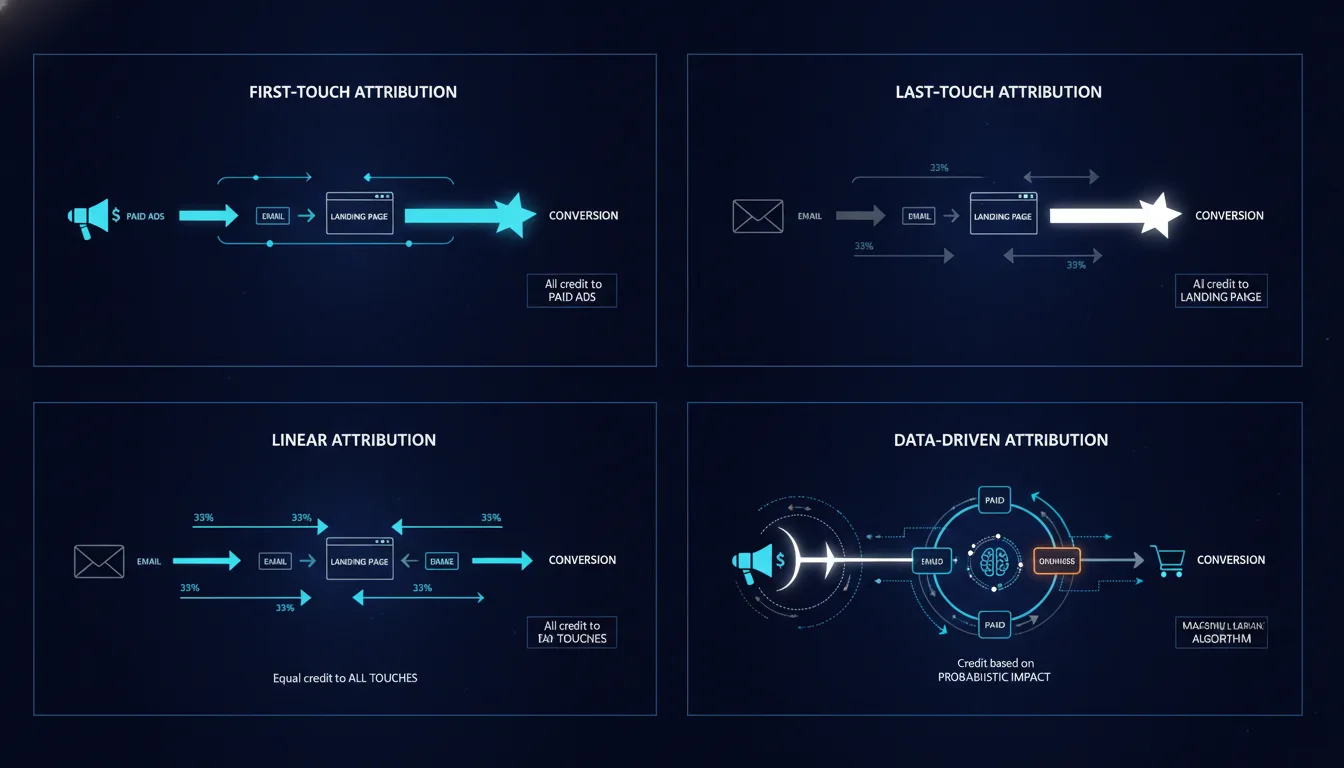
First-Touch | 100% credit to the first interaction in the journey | Identifying top-of-funnel channels; awareness campaigns | Ignores everything after the first click; undervalues nurturing |
Last-Touch | 100% credit to the last interaction before conversion | Bottom-funnel decision-making; direct response | Ignores the journey that preceded the last touch; over-credits remarketing |
Linear | Equal credit distributed across all touchpoints | Quick approximations when you lack detailed journey data | Assumes all touchpoints are equally valuable (usually false) |
Time-Decay | More credit to interactions closer to conversion | Recognizing the importance of recency without ignoring the journey | Arbitrary decay curves; requires careful tuning |
Data-Driven (ML-Based) | Machine learning assigns credit based on the actual likelihood each touchpoint caused conversion | Sophisticated, multi-channel brands with clean data | Requires historical conversion data; can be a black box |
Marketing Mix Modeling (MMM) | Statistical regression model isolating the effect of each channel's spend on conversions | Brands with high volume, consistent spend; long sales cycles | Requires 2-3 years of historical data; slower to implement |
No single model is "correct." They each make different trade-offs between accuracy, simplicity, and data requirements. The decision depends on your business model, data maturity, and funnel complexity.
Key Takeaway: First-touch and last-touch are fast and easy but biased. Linear is neutral but assumes equal value. Data-driven and MMM require better data but reward you with accuracy. Most sophisticated brands use a hybrid approach: last-touch for direct response optimization, data-driven for strategic allocation, MMM for long-term planning.
Pre-2026 Attribution vs. Post-Cookie Attribution: What's Changing?
The infrastructure is shifting. Here is what is breaking and what is replacing it:
Dimension | Pre-2026 (Cookie-Based) | Post-2026 (First-Party + Server-Side) |
|---|---|---|
Data source | Third-party cookies + pixels in user browser | First-party data (user directly provides) + server-side events |
Cross-domain tracking | Third-party cookies follow user across sites | Server-side container passes first-party data between owned properties |
Privacy compliance | Cookie consent banner (often ignored) | Explicit consent mode + Privacy Sandbox (Google Topics, Fenced Frames) |
Mobile tracking | Limited by iOS privacy; Android still trackable | App-to-web attribution via SKAdNetwork; first-party ID graphs |
Attribution accuracy | 40-60% visibility across full journey | 60-80%+ with full first-party + server-side implementation |
Implementation complexity | Pixel-based; mostly in browser | Requires server infrastructure, data engineering, consent logic |
Time to data | Real-time (immediate pixel fire) | Near real-time (server-side processing adds milliseconds) |
The pattern is clear: pre-2026 attribution relied on surveillance (third-party cookies following users). Post-2026 attribution relies on infrastructure (owned servers processing first-party data). The transition requires technical investment upfront but delivers better accuracy and full regulatory compliance on the back end.
Server-Side Tracking: The Foundation of Modern Attribution
Server-side tracking is no longer optional. It is the foundation of post-2026 attribution.

Here is how it works: Instead of firing pixels and third-party cookies in the user's browser, you set up a server-side tracking container (typically Google Tag Manager's Server-Side mode or a custom server) that receives conversion events from your own domain. That server forwards events to Google Ads, Meta, GA4, and other platforms using their native conversion APIs — not browser pixels.
Why does this matter? Three reasons:
First-party data control. You own the data; you decide where it flows. No reliance on third-party cookies or browser tracking.
Accuracy. Server-to-server communication is more reliable than browser pixels, which can be blocked by ad blockers, privacy tools, or browser privacy settings.
Consent-aware. Your server can check the user's consent status and only send data where permitted, avoiding compliance violations.
The technical lift is real. You need to implement conversion tracking on your domain (usually via a customer data platform, CDP, or custom API), configure a server-side tracking container, and connect it to all downstream platforms. This typically takes 4-8 weeks to implement fully depending on your stack's complexity.
But the alternative — trying to do attribution with degraded browser data — is worse. You will lose 30-40% visibility and make optimization decisions on incomplete information.
Consent Mode & Privacy Sandbox: Balancing Attribution and Privacy?
You cannot build attribution on data you do not have permission to collect. Two emerging frameworks are trying to solve the measurement-privacy trade-off:

Consent Mode (Google) is a framework where your tag management system detects the user's consent status (from your cookie banner) and dynamically adjusts what data you collect. If a user accepts all cookies, you get full data. If they decline, you get minimal data. Google then uses machine learning to estimate what the full conversion picture would have been — so you still get attribution insight even without full data.
Privacy Sandbox (Google) is a browser-level initiative to replace third-party cookies with privacy-preserving alternatives. The main tools are Google Topics (which categorizes user interests without tracking individual behavior), Fenced Frames (which isolate ads from surrounding content to prevent cross-site tracking), and Aggregated Reporting (which reports aggregate statistics without individual-level data).
Neither is perfect. Consent Mode gives you decent estimates but relies on Google's ML models. Privacy Sandbox requires opting in to new technologies that are still evolving. But together, they create a path to attribution that works even when traditional tracking is impossible.
Key Takeaway: You cannot choose between attribution and privacy compliance anymore. The frameworks that win are the ones that accept the privacy constraint and build attribution around it — using first-party data where you have consent, modeling where you don't, and being transparent about the limitations of both.
How Do You Actually Implement Cross-Channel Attribution?
Implementation comes down to five sequential steps:
Audit your current data sources. Map every place where customer data lives — GA4, CRM, email platform, ad platforms, website analytics. Document how they connect (or do not connect) today. This reveals your attribution gaps.
Build server-side tracking infrastructure. Set up a server-side tag manager or CDP to collect first-party events from your website and app. Connect it to each downstream platform's conversion API.
Define your touchpoints and conversion events. Decide what counts as a "touchpoint" (ad click, email open, landing page view, form submit) and what counts as a "conversion" (purchase, demo request, account signup). This definition shapes your attribution model.
Select and configure your attribution model. For most brands, start with data-driven attribution in GA4 (if you have 300+ conversions per month) or last-touch + time-decay (if you do not). Revisit in 6-12 months when you have more historical data.
Log, document, and iterate. Set up live dashboards showing attribution by channel, by campaign, by user segment. Review weekly. Document what changed and why. This is how knowledge compounds — and how you catch attribution misconfigurations before they cause budget mistakes.
Most brands can be live on basic server-side tracking and data-driven attribution within 6-8 weeks. Full sophistication — including multi-touch, marketing mix modeling, and incremental testing — takes 3-6 months.
How Managed Marketing Infrastructure Handles Cross-Channel Attribution
Attribution is one of the most common reasons brands reach out to Metrics Masters. They have outgrown their tracking infrastructure. They are losing signal from iOS, cookies, and third-party integrations. They cannot see which channels drive revenue.

Under a managed marketing infrastructure model, attribution is built into the operating system from day one. Here is what that looks like:
Server-side tracking configured in the first week. No reliance on third-party cookies or browser pixels. First-party data collected on your domain and sent directly to platforms via their native APIs.
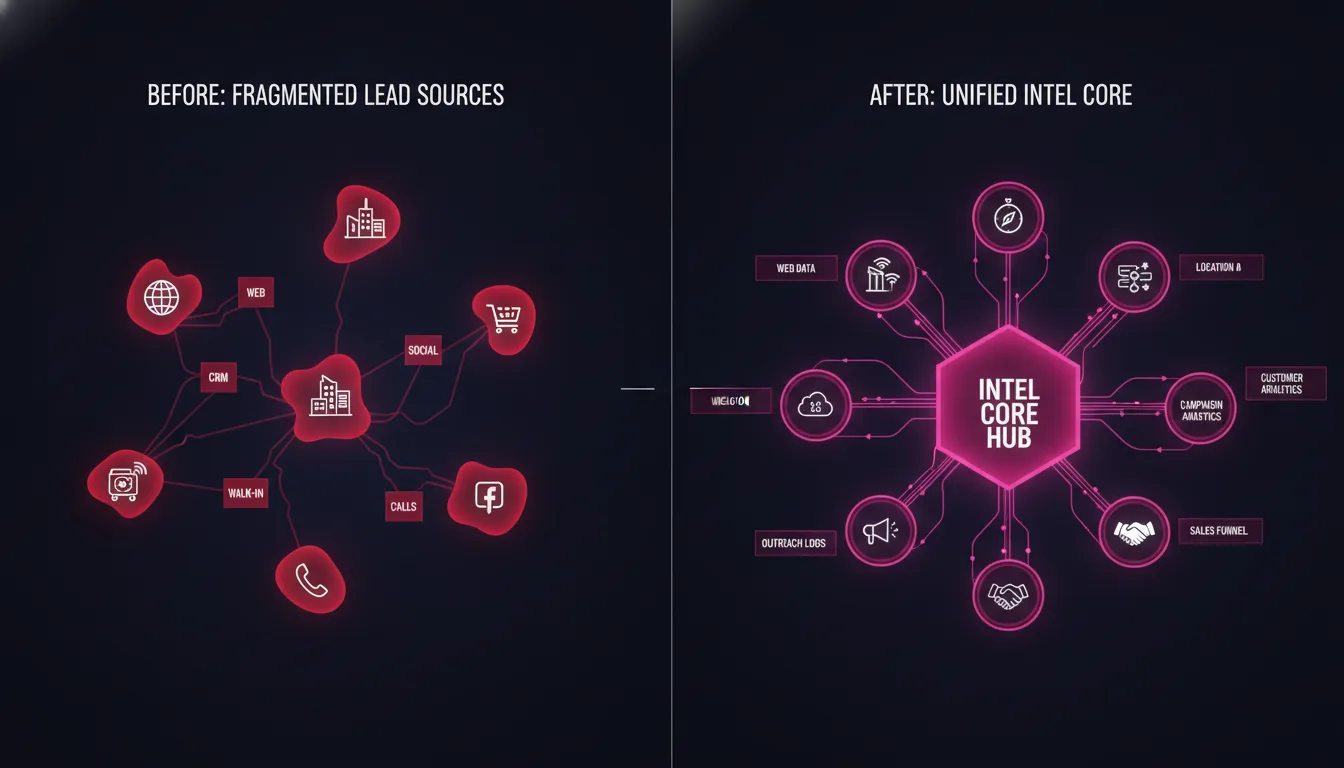
Unified signal collection. Paid ads, email, landing pages, CRM, and other channels all feed conversion data to a central system (Intel Core) where it is normalized and enriched.
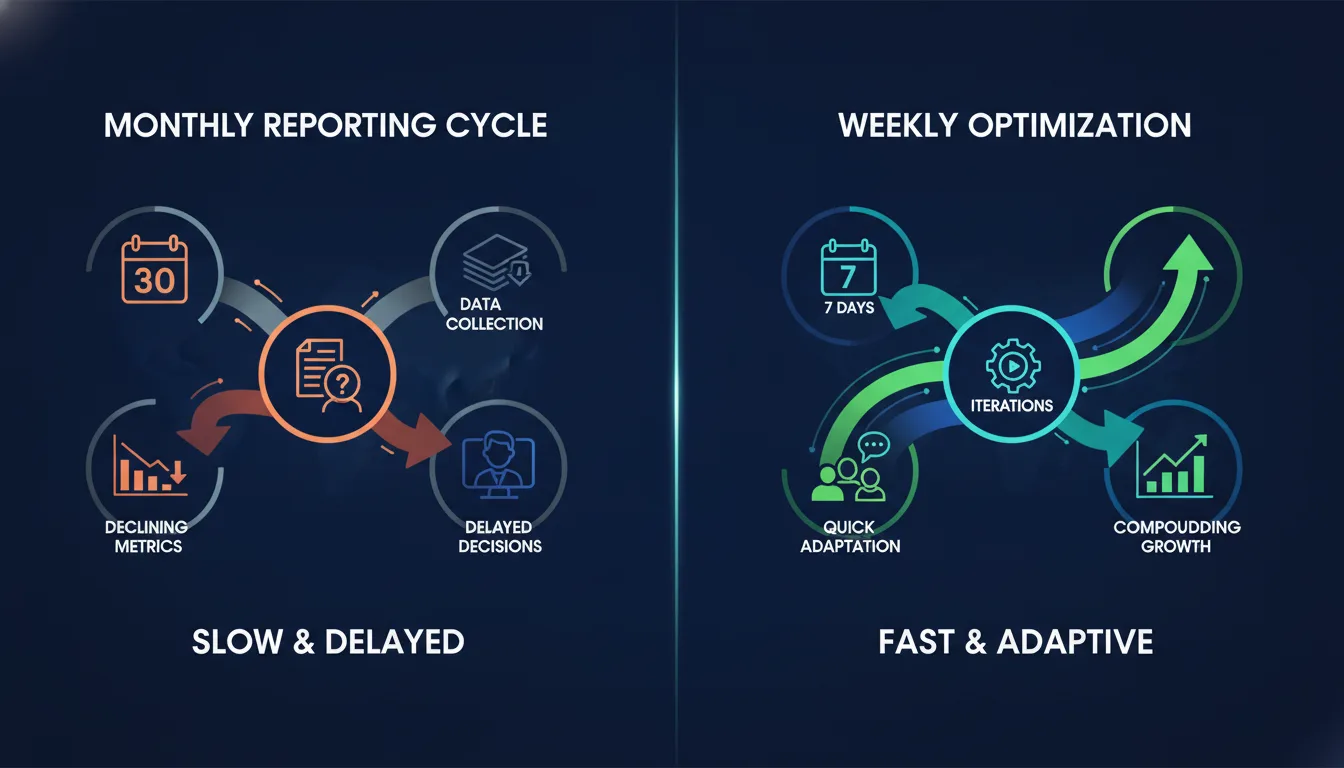
Flexible attribution modeling. You can run multiple models simultaneously — last-touch for optimization, data-driven for strategy, MMM for long-term planning — and compare them to understand trade-offs.
Consent-aware implementation. The system respects user consent automatically, ensuring compliance without sacrificing data where you have permission to collect it.
Documented decisions. Every optimization decision — why we adjusted bids, why we paused a campaign, why we increased email frequency — is logged with the before/after data, so you can see what worked and why.
This is not a turnkey dashboard you plug into. It is an infrastructure layer that your Brand Technical Expert builds and operates, ensuring it evolves as privacy regulations, platform APIs, and your business needs change.
What Are the Common Attribution Mistakes (and How to Avoid Them)?
Most attribution failures are not technical. They are conceptual.
Mistake 1: Confusing correlation with causation. Just because email sends and conversions happened in the same hour does not mean email caused the conversion. It might have been an ad the user saw yesterday that caused them to search for you today, then click email to complete. Attribution models try to solve this, but no model is perfect. Always ask: "Does this result pass the sanity test?"
Mistake 2: Choosing a model and never changing it. Your business is not static. Your funnel changes. Your channels change. Your data maturity changes. Revisit your attribution model every 6-12 months. A model that was right last year might be wrong now.
Mistake 3: Running attribution on incomplete data. If you are missing mobile conversions, iOS app events, or offline transactions, your attribution will be biased toward the channels you can measure. This does not mean mobile is not driving revenue — it means you cannot see it. Fix the data gap before you optimize based on attribution.
Mistake 4: Treating last-touch as gospel. Last-touch is easy to implement and tempting to optimize for. But it systematically undervalues awareness, nurturing, and brand-building channels. If you only optimize last-touch, you will starve your demand-generation channels and hit a ceiling on growth.
Mistake 5: Over-automating without validation. Attribution models are powerful, but they can be wrong in subtle ways. Manual spot-checks matter. Occasionally audit conversions one by one. Ask customers where they came from. Compare what your model says to what actually happened. This catches misconfigurations before they cost you money.
Key Takeaway: Perfect attribution is impossible. The goal is not perfect attribution — it is attribution good enough to make better decisions than you would without it, and transparent enough that you understand the limitations.
What Statistics Should You Track for Attribution?
Not every metric matters. Here are the ones that do:
Cost per acquisition (CPA) by channel. What does it cost to acquire a customer on each channel? This is the highest-level optimization lever. If one channel shows 2x the CPA of others, either its tracking is wrong or it should get less budget.
Attribution overlap rate. What percentage of conversions were touched by 2+ channels? If it is below 40%, you might have tracking gaps. If it is above 80%, you might have an unusually long funnel.
Time between first and last touch. How long is your typical customer journey? This tells you your funnel length and affects which attribution model to use. Longer funnels need time-decay or data-driven. Shorter funnels can use simpler models.
Contribution by position (first, middle, last). In your multi-touch journeys, which position has the highest lift? This tells you whether to weight early or late interactions. Varies wildly by business model.
Attribution model variance. How different are your results if you use first-touch vs. last-touch vs. data-driven? Large variance (50%+ difference in channel ranking) signals that your choice of model matters a lot. Small variance (< 20%) signals relative stability.
Track these metrics monthly. Use them to sanity-check your attribution model and catch changes in your customer journey.
Frequently Asked Questions
What is cross-channel attribution?
Cross-channel attribution is the process of assigning credit to the different marketing touchpoints that contributed to a conversion. It answers which channel (ads, email, content, etc.) deserves credit for the customer decision. The model you choose determines how that credit is distributed — first-touch gives credit to awareness channels, last-touch credits the decision driver, and more sophisticated models try to weight each touchpoint fairly based on actual influence.
Why is attribution breaking in 2026?
Third-party cookies — which were the backbone of traditional attribution — are being deprecated. Apple stopped third-party tracking in iOS in 2021. Google is phasing third-party cookies from Chrome by end of 2026. Browser-based pixels are increasingly blocked by privacy tools and privacy-respecting browsers. Without third-party cookies, traditional pixel-based attribution loses 30-40% accuracy. This is why server-side tracking and first-party data have become critical.
What's the difference between first-party data and third-party cookies?
First-party data is information a user directly provides to you or that you collect on your own domain (email signups, purchase history, behavior on your site). Third-party cookies are trackers that platforms install on your site to follow users across the broader web. First-party data is more privacy-friendly, more accurate, and fully in your control. Third-party cookies are disappearing but historically were easier to set up at scale.
Which attribution model should I use?
Start with last-touch if you are optimizing for direct response campaigns. Use first-touch if you are focused on awareness. Use data-driven attribution (in GA4) if you have 300+ conversions per month and want a more sophisticated model. Use marketing mix modeling if you have 3+ years of historical data and want to understand long-term channel contribution. Most mature brands use multiple models simultaneously — last-touch for daily optimization, data-driven for strategic decisions, MMM for long-term planning.
What is server-side tracking and do I need it?
Server-side tracking means setting up a server (usually via Google Tag Manager's server-side mode or a CDP) to receive conversion events from your domain and forward them to platforms directly, instead of relying on browser pixels and third-party cookies. Yes, you need it. Browser-based tracking is increasingly unreliable due to cookie deprecation, ad blockers, and privacy tools. Server-side tracking is more accurate, more compliant, and the future of attribution.
How long does it take to implement server-side tracking and new attribution?
Basic server-side tracking and data-driven attribution can be live in 4-8 weeks depending on your current stack. More sophisticated implementations — including multi-touch modeling, cross-domain tracking, and full compliance with Privacy Sandbox — take 8-16 weeks. The upfront time investment is significant but pays for itself through better optimization decisions and avoided compliance issues.
How does managed marketing infrastructure help with attribution?
Under managed infrastructure, attribution is built into the operating system from day one. Your Brand Technical Expert configures server-side tracking, selects and monitors your attribution model, and ensures the system evolves as platforms and privacy regulations change. This means you do not have to build and maintain attribution infrastructure yourself — it is part of the managed engagement. Your job is to trust the data and make budget decisions based on it.
What Should You Take Away?
Cross-channel attribution is not a nice-to-have — it is the only way to know which channels drive revenue in a privacy-first world.
Third-party cookies are dead. Server-side tracking and first-party data are the foundation of 2026 attribution.
The attribution model you choose (first-touch, last-touch, data-driven, MMM) determines what you optimize for. Pick the right one or build flexibility to compare multiple models.
Perfect attribution is impossible, but good-enough attribution — based on first-party data, server-side infrastructure, and honest assumptions — is achievable and transformative.
If managing attribution in-house feels like a distraction, managed marketing infrastructure handles it as part of the engagement.
Ready to Audit Your Attribution Before Third-Party Cookies Disappear?
Do not wait until your current tracking breaks. Start a conversation with Metrics Masters about building a first-party, server-side attribution foundation. Or read our full guide on Server-Side Tracking in 2026 and How to Audit Your Conversion Tracking. The time to act is now — the data you are losing today affects the decisions you make tomorrow.

Jeremiah Shaw
CEO & Technical Marketing Specialist · Metrics Masters | Brandlio
International
Technical marketing specialist pushing boundaries in Google Ads, automation, and AI-driven growth systems. Paragliding and adventure enthusiast.