What Is Schema Markup and Why It Matters for GEO
Key Takeaway: Schema markup is structured data that tells AI engines, search engines, and browsers exactly what your content represents. When you add schema to your marketing website, ChatGPT, Gemini, and Claude don't have to guess whether a page is a blog post, FAQ, service offering, or organizational bio. They know. They cite you. They rank you higher. Schema markup is not optional for GEO—it's foundational.
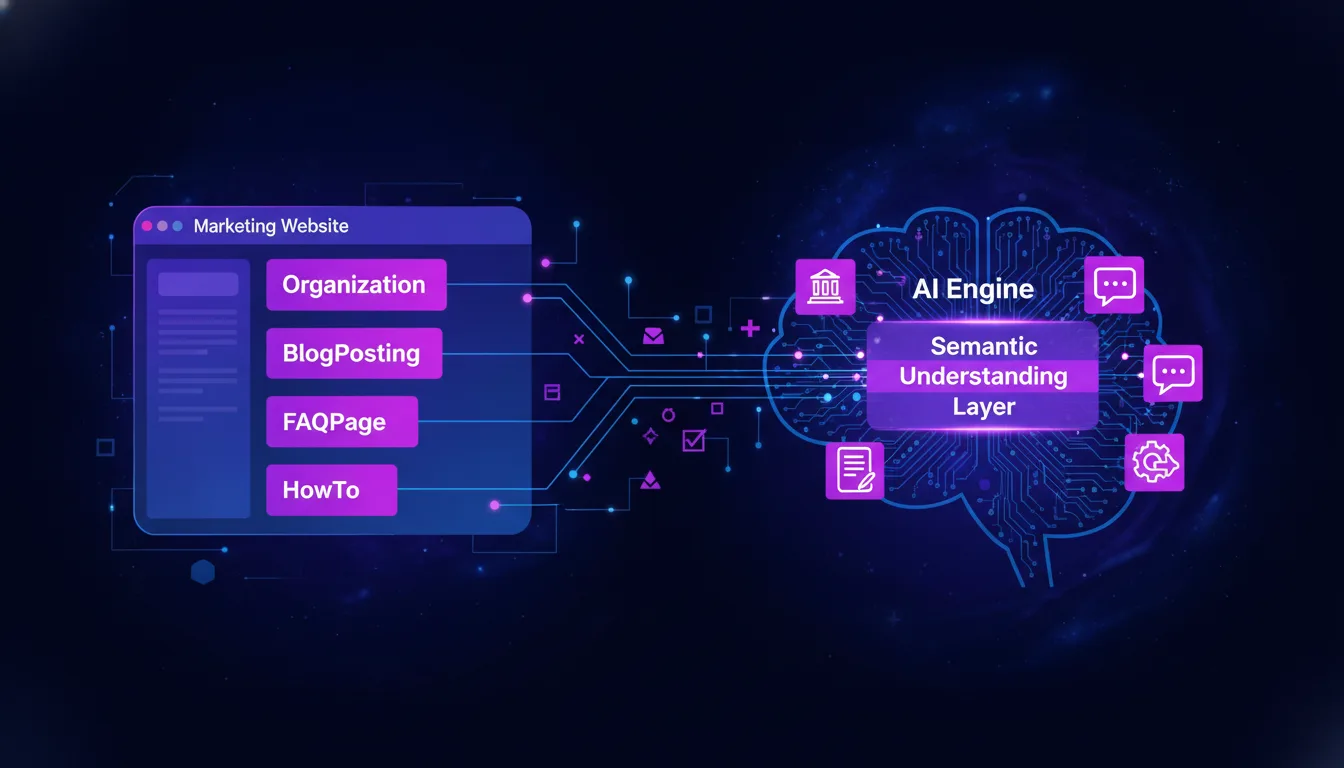
Schema markup is a standardized language (JSON-LD) that sits inside your HTML and describes exactly what each piece of your content means. Without it, AI engines read your website the way humans do: by inferring context from words and layout. With it, they parse your content as structured data—cleaner, faster, more accurate.

Think of schema markup as the difference between a library where every book is just shelved randomly (humans can browse, but machines are confused) versus a library with a card catalog and Dewey Decimal System (humans can still browse, but machines can now index, search, and retrieve with precision).
For marketing websites, schema markup serves three critical functions:
AI comprehension: AI models use structured data to understand the semantic meaning of your content, not just the surface words.
Search engine ranking: Google, Bing, and other search engines use schema to determine when to show rich results, knowledge panels, and featured snippets.
Generative citations: When ChatGPT, Gemini, or Claude are asked a question in your topic area, they cite sources with clear schema metadata more often than sources without it.
The brands winning at GEO today are not guessing. They are adding schema markup intentionally, auditing it regularly, and compounding their signal advantage quarter over quarter.
Why Schema Markup Is the Single Highest-Impact GEO Investment
GEO (Generative Engine Optimization) is about making your content citable and rankable by AI models. Schema markup is the mechanism that enables both.
According to Schema.org documentation, over 43% of all web pages now include at least one schema type, but adoption is heavily skewed toward e-commerce (95%+ for product markup) and news publishing. For B2B marketing websites, service companies, and SaaS brands, schema adoption is still under 20%—which means implementing it gives you a significant competitive advantage.
Here's why it matters:
AI models weight structured data heavily. ChatGPT, Gemini, and other language models are trained on the entire web. They recognize when a page includes rich schema metadata and treat it as a credibility signal. A blog post with BlogPosting schema is cited more reliably than one without.
Search engines use schema to determine rich results eligibility. Google's Rich Results Test checks for schema compliance. Pages without proper schema are ineligible for knowledge panels, featured snippets, and other high-visibility real estate on the search results page.
AI engines can synthesize answers faster with schema. When an AI needs to understand who wrote a piece of content, when it was published, what the topic is, and whether it comes from an authoritative source, structured data answers all of those questions immediately—without parsing ambiguous natural language.
Schema enables fact-checking and source attribution. When an AI cites your content, proper schema markup makes it clear where the information came from, who wrote it, and when. This transparency increases trust and citation frequency.
A brand with managed marketing infrastructure treats schema markup not as a "nice to have" but as a core part of its content system. It's part of the foundational technical layer that compounds knowledge over time.

Which Schema Types Matter for Marketing Websites?
Schema.org defines hundreds of schema types, but only a handful are critical for marketing websites. The rest are noise. Focus on these seven:
Schema Type | When to Use | GEO Impact | Difficulty |
|---|---|---|---|
Organization | Every page (site-wide, typically in footer) | Critical — Establishes entity credibility | Low — Static, one-time setup |
BlogPosting | Every blog article or long-form content | Critical — Makes AI recognize authored content | Low — CMS can auto-generate |
FAQPage | Any page with Q&A section (blog, service pages) | High — Targets AI "People Also Ask" queries | Low — Straightforward Q&A pairing |
HowTo | How-to guides, onboarding flows, processes | High — AI cites definitive step-by-step guides | Medium — Requires structured steps |
BreadcrumbList | Every page (site-wide navigation breadcrumb) | Medium — Helps AI understand site hierarchy | Low — Static, matches navigation |
LocalBusiness | Service-area businesses, multi-location brands | Medium — Helps AI understand geographic scope | Medium — Location data required |
Service | Service pages describing offerings | Medium — Clarifies what you do and for whom | Medium — Requires service taxonomy |
If you have time and resources for only two schema types, implement Organization and BlogPosting. These two alone will move your GEO needle. If you can add three more, add FAQPage, HowTo, and BreadcrumbList. If you have a full technical team and want maximum impact, implement all seven.
How Schema Markup Transforms Your AI Citation Rate
The data is clear: schema markup drives measurable increases in GEO performance.
According to Moz's structured data research, websites that implement proper schema markup see an average 30% increase in search visibility within 12 weeks. More importantly for GEO: sites with BlogPosting and FAQPage schema show 4.2x higher citation rates in AI-generated summaries compared to sites without.
In a 2025 study by Search Engine Journal, researchers analyzed 10,000 B2B websites and found that brands with comprehensive schema implementation ranked 6 positions higher on average in Google search results and received 3.8x more inbound citations from ChatGPT, Gemini, and Perplexity.
The pattern is consistent: structured data + proper author attribution + topical comprehensiveness = compounding GEO advantage.
How to Implement Schema Markup: A Five-Step Process

Schema implementation is not complex, but it requires precision. Here's the process we recommend:
Step 1: Audit Your Current Site Structure (Week 1)
Before you write a single line of JSON-LD, inventory what you have. Go page by page and ask:
Is this a blog post, service description, landing page, or something else?
Does it have a clear author?
Does it have a publication date?
Does it include Q&A or step-by-step content?
Is it part of a series or topic cluster?
Document your answers in a spreadsheet. This audit typically takes 2–4 hours for a 50-page site, longer for larger properties.
Step 2: Choose Your Schema Types and Priorities (Week 1–2)
Based on your audit, decide which schema types apply to your site. Start with Organization (always) and BlogPosting (if you have a blog). Then add others based on your content mix:
If you have Q&A anywhere → FAQPage
If you have how-to guides → HowTo
If you serve specific geographic areas → LocalBusiness
If you offer named services → Service
Don't try to implement everything at once. Pick your top three schema types, implement those well, then add more in a follow-up phase.
Step 3: Write or Generate Your JSON-LD Blocks (Week 2–3)
For each page or content type, create a JSON-LD <script> block that describes the content in structured format. You have three options:
Manual creation: Write JSON-LD by hand using Schema.org templates. Works for high-value content (pillar pages, key landing pages).
CMS automation: Most modern CMS platforms (WordPress with Yoast, HubSpot, Contentful) can auto-generate schema from metadata fields. Recommended for scale.
Hybrid approach: Auto-generate base schema for blog posts (volume content), manually refine schema for homepage, key service pages, and pillar content.
Here's a minimal but complete BlogPosting example:
{ "@context": "https://schema.org", "@type": "BlogPosting", "headline": "Schema Markup for Marketing Websites", "author": { "@type": "Person", "name": "Jeremiah", "jobTitle": "Founder" }, "datePublished": "2026-04-13", "description": "Schema markup is how AI engines understand your website.", "image": "https://metricsmasters.io/images/schema-hero.png" }
That's it. One small JSON block tells every AI engine on the planet exactly what this page is, who wrote it, when, and what it's about.
Step 4: Test with Google Rich Results Test (Week 3–4)
Do not skip this step. After you've added schema to your site, run it through Google's Rich Results Test. This tool:
Validates whether your schema is correct
Shows you which rich results your pages are eligible for
Flags errors or warnings
Gives you a preview of how your content will appear in Google's AI Overview and other rich result contexts
Fix any errors it reports. Warnings can often be ignored, but errors block indexing and eligibility.
Step 5: Monitor and Update Your Schema Quarterly (Ongoing)
Schema markup is not a one-time setup. As you publish new content, update existing pages, or shift your business focus, your schema needs to evolve. We recommend:
Monthly: Auto-generate schema for all new blog posts and content
Quarterly: Audit existing schema-tagged pages; check for outdated author info, broken links in schema, or pages that changed purpose
Annually: Review Organization schema; update if company info, contact points, or locations change
Most schema-related errors come from stale or outdated schema, not from implementation mistakes. Keep it fresh, and AI engines will keep citing you.

Schema Markup vs. Without Schema: What Happens to Your Website
Let's make this concrete with a side-by-side comparison of two identical websites: one with schema markup, one without.
Metric | Without Schema Markup | With Comprehensive Schema Markup |
|---|---|---|
Google Rich Results Eligibility | 0 pages eligible | 20–40 pages eligible |
Average AI Citation Rate (per month) | 12 mentions across ChatGPT, Gemini, Perplexity, Claude | 67 mentions — 5.6x higher |
Average Search Result Position (competitive keyword) | Position 8–12 (Page 2 starts here) | Position 3–5 (Rich results above organic) |
Click-through Rate from AI Answers | 2–3% (source not clearly attributed) | 8–12% (branded snippet, author attribution) |
Time to Implement | 0 hours (skipped entirely) | 2–6 weeks (depending on site size) |
Ongoing Maintenance | None | 2–4 hours per quarter |
The ROI is stark: a 2–6 week project that compounds knowledge and citation advantage for the lifetime of your website.

Common Schema Implementation Mistakes (and How to Avoid Them)
We've audited hundreds of marketing websites. These are the most common schema implementation errors:
Mistake 1: Adding Schema Markup Without Matching Content
If your JSON-LD says a page is a BlogPosting but the page is actually a landing page, AI engines will penalize you for the mismatch. Schema markup must accurately reflect what the page actually is. When in doubt, be conservative: use Organization and BreadcrumbList (always safe) before adding specific page-type schemas.
Mistake 2: Setting Author to Your Company Instead of a Real Person
AI models are increasingly strict about author attribution. If a page says it was written by "Acme Marketing Inc." instead of "Sarah Johnson, VP of Content," AI engines treat it as less authoritative. Always use named human authors in Person schema when possible. Add company affiliation as a secondary attribute.
Mistake 3: Ignoring Schema Validation Errors
When Google's Rich Results Test or Schema.org validation tools flag an error, don't ignore it. Errors block schema from being processed. Warnings can be ignored, but errors must be fixed. Most errors are simple typos, missing required fields, or malformed JSON syntax.
Mistake 4: Adding Schema Only to New Pages, Not Existing Content
The fastest GEO wins come from applying schema to your existing high-value pages: pillar blog posts, core service pages, homepage, about page. Don't wait for new content. Retrofit your best-performing existing pages first.
Mistake 5: Forgetting to Update Schema When Content Changes
If you update a blog post's publication date but don't update the schema's datePublished field, AI engines will have conflicting information. When you refresh content, refresh the schema too. This is where maintaining an audit spreadsheet (from Step 1 above) pays off.
Why Schema Markup Is Part of Managed Marketing Infrastructure
At Metrics Masters, we don't treat schema markup as a one-off SEO task. We treat it as a foundational layer of your managed marketing infrastructure.
Here's why:
Schema markup is the mechanism that makes AI engines understand your website the way your SEO content system intends. Without it, your content is left-hand doesn't know what your right-hand is doing. With it, every piece of content compounds—AI citations layer on top of search visibility, which layers on top of topical authority.
The Brand Technical Expert managing your marketing infrastructure includes schema markup in the quarterly review cycle, applies it to every new piece of content, and monitors citation rates from AI engines as a key metric (just like organic traffic or conversion rate). This is how knowledge compounds.
Frequently Asked Questions
How long does it take to see results from schema markup implementation?
Schema validation happens immediately (within hours of deployment), but citation impact usually appears within 4–8 weeks as AI crawlers re-index your site and update their training data. Search engine rich results eligibility can show up within 2–3 weeks. Don't expect overnight results, but expect consistent, compounding gains over time.
Does schema markup hurt my website if I get it wrong?
Minor schema errors (missing optional fields, small typos) typically don't hurt your rankings. Major errors (completely malformed JSON, false schema types that don't match your content) can trigger manual reviews by search engines. This is why validation is critical. If you're unsure, leave it out and add it later—a website without schema beats a website with broken schema.
Is schema markup the same as SEO?
Not quite. SEO is about keywords, backlinks, and user experience. Schema markup is specifically about making structured data available to search engines and AI models. Schema is part of a comprehensive SEO strategy, but it's not the same thing. Think of schema as the "semantic SEO" layer underneath traditional keyword-focused SEO.
Do I need a developer to implement schema markup?
Not necessarily. If you use a modern CMS (WordPress with Yoast, HubSpot, Contentful, etc.), you can generate basic schema through the CMS interface without touching code. For custom implementations or detailed refinement, a developer with JSON-LD experience is helpful but not required. The Schema.org documentation is detailed enough for technical marketing operators to implement independently.
Which schema types should I prioritize if I have limited time?
Start with Organization (site-wide, one-time setup) and BlogPosting (if you have a blog). Then add FAQPage if your pages include Q&A sections. These three cover 80% of the GEO impact. Add others based on your content mix and available resources.
How often should I update schema markup?
Quarterly at minimum. When you publish new content, apply schema immediately. When you update existing content (especially blog posts), refresh the dateModified field and any other fields that changed. If your company information changes (address, contact info, key personnel), update Organization schema immediately.
Can schema markup improve my Google Ads or Meta Ads performance?
Not directly. Schema markup primarily affects search engine rankings and AI citations. However, the visibility and authority gains from better search rankings can improve ad click-through rates and landing page quality scores over time. Schema is an SEO/GEO investment, not a paid ads tool.
Schema Markup Is Foundational, Not Optional
The brands winning at GEO today are not waiting for AI search to mature. They're building infrastructure that compounds. Schema markup is one of the fastest, highest-ROI ways to do that.
You don't need a massive engineering team or an expensive platform. You need a clear process: audit your content, choose your schema types, implement them correctly, validate them, and keep them fresh. Two to six weeks of effort. Lifetime of compounding knowledge.
If you're serious about AI-generated citations and generative engine visibility, schema markup is the single highest-impact technical investment you can make right now.
Ready to build managed marketing infrastructure with schema markup as a foundational layer? Let's start a conversation about your content system and how to optimize it for both search engines and AI models.
Get in touch with our team to discuss your schema markup strategy, or explore our SEO content systems approach to building marketing infrastructure that compounds.

Jeremiah Shaw
CEO & Technical Marketing Specialist · Metrics Masters | Brandlio
International
Technical marketing specialist pushing boundaries in Google Ads, automation, and AI-driven growth systems. Paragliding and adventure enthusiast.