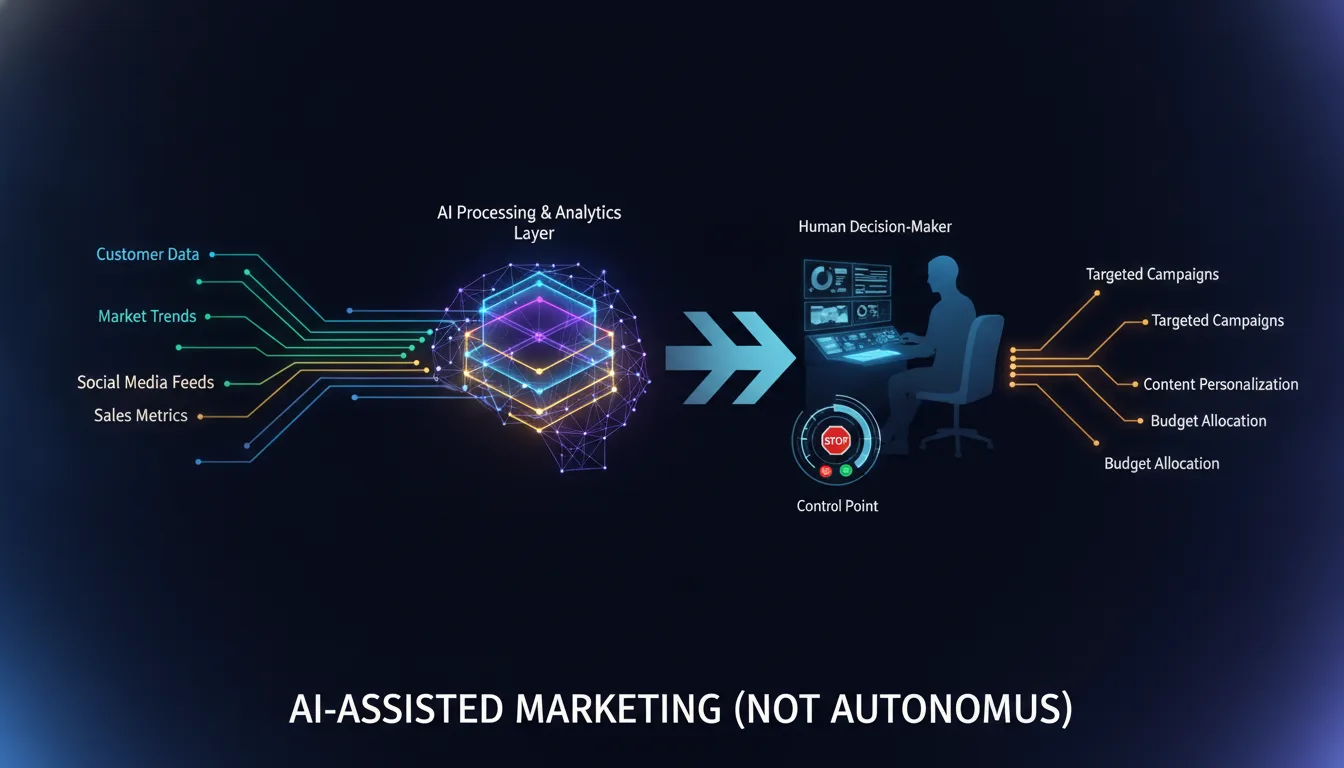
What Is AI-Assisted Marketing (Without the Hype)?
Key Takeaway: AI-assisted marketing is a model where artificial intelligence recognizes patterns, surfaces opportunities, and proposes decisions — but a human operator owns the final judgment. It is not AI replacing marketers. It is AI amplifying what marketers see and automating the routine parts so humans can focus on the strategic ones.
AI-assisted marketing has become one of the most misunderstood concepts in the industry. Venture capitalists talk about "AI-powered marketing." Startup CTOs promise "self-optimizing campaigns." Consultants sell "AI-first strategies." Most of it is hype shaped by misaligned incentives: if you are building a venture-backed AI software company, every marketing problem looks like it needs an AI solution.
The real story is simpler and more grounded.
AI-assisted marketing uses machine learning to recognize patterns in data, extract signal from noise, and automate routine operational decisions. The keyword is assisted. The marketer is still the decision-maker. The AI is the signal processor.
According to Salesforce's 2026 State of Marketing report, 72% of marketers report using AI tools, but only 34% say they trust those tools enough to let them act without human review. That gap reveals the truth: marketers understand the value of AI-powered analysis. They just refuse to let it operate unsupervised. And they are right to refuse.
At Metrics Masters, our Brand Technical Experts use Intel Core as the signal processing layer. Intel Core detects anomalies in click costs, recognizes winning audience segments, and identifies optimization opportunities that would take a human hours to spot. But it never acts alone. Every recommendation surfaces in a decision card that a Brand Technical Expert reviews, refines, or rejects before execution.
That is AI-assisted marketing.

Why AI Hype Dominates the Conversation
The AI hype cycle exists because three industries profit from it: venture capital, software vendors, and management consulting.
Venture firms fund companies on a "build the future" thesis. If the future is "marketers are obsolete," that makes for a compelling pitch deck. Software vendors sell licenses and subscriptions. If a marketer believes they can reduce team size or automate away headcount, they will pay to do it. Consultants sell transformation narratives. "You need an AI strategy" sounds more valuable than "you need better data hygiene."
But the evidence tells a different story. McKinsey's 2025 AI adoption study found that organizations with the highest returns on AI investments are those where AI acts as a decision-support layer, not an autonomous agent. And Gartner's research on AI in marketing consistently shows that the highest-performing teams treat AI as a tool for surfacing options, not making final calls.
The pattern is consistent across industries: AI works best when humans remain accountable for the outcome. That accountability requires that humans make the final decision.
AI-Assisted vs. AI-Autonomous Marketing

This distinction matters more than any other in the AI marketing conversation.
Dimension | AI-Assisted Marketing | AI-Autonomous Marketing |
|---|---|---|
Decision loop | AI proposes → Human reviews → Human executes | AI proposes and executes without review |
Accountability | Human owns the outcome | AI vendor owns risk, human owns consequences |
Speed | Fast but with a decision gate | Fastest — but no safety valve |
Transparency | Every recommendation is visible and reviewable | Black box. You see results, not reasoning |
Recovery from errors | Human catches mistakes before they execute | Mistakes execute at scale before detection |
Cost per decision | Higher — humans review every action | Lower — but higher financial risk |
Regulatory exposure | Easier to demonstrate responsible use | Harder to defend as responsible if outcomes go wrong |
The autonomous model is seductive because it sounds efficient. But efficiency is not the same as safety. A marketing decision made autonomously might save five minutes. But if it's the wrong decision, it can cost thousands in wasted ad spend before anyone notices. And if it results in brand harm — targeting the wrong audience, messaging that offends, privacy violations — the cost is reputational, not just financial.
The assisted model takes a bit longer to execute but gives you the safety of human judgment on every decision. That trade-off favors brands that care about long-term outcomes.
How Does the AI-Assisted Loop Work?
At Metrics Masters, we think about the AI-assisted loop in four stages.

Signal Recognition. Intel Core ingests data from ad platforms (Google Ads, Meta), conversion tracking systems, CRM, and analytics. It detects patterns that deviate from baseline: a cost-per-click spike in a specific cohort, a sudden drop in email engagement, a new high-performing audience segment. These are signals. Most marketers would miss them because they are buried in dozens of daily reports. AI finds them.
Pattern Extraction. Recognition alone is not enough. Intel Core goes deeper: it asks why. Is the CPC spike due to competitive bidding, audience saturation, iOS privacy constraints, or seasonal demand shifts? It compares the current pattern to historical patterns and similar cohorts. It isolates what is driving the signal. A human would need two hours with a spreadsheet. AI does it in seconds.
Decision Proposal. From the pattern, Intel Core recommends an action. "Pause iOS cohort, reallocate budget to Android." "Increase email frequency to re-engagement segment." "Test new creative on high-intent audience." The recommendation includes the reasoning, the expected outcome, the confidence level, and the reversibility (if something goes wrong, how fast can we undo this?). This is the decision card.
Human Review & Execution. The Brand Technical Expert sees the decision card. They have context: upcoming product launches, campaign budgets, client strategy changes, brand constraints, political considerations inside the client's organization. A machine does not have context. The expert does. The expert asks: Does this make sense? Is there risk I should factor in? Should I refine the parameters? Then they approve, refine, or reject. If approved, the system executes.
Key Takeaway: The loop is not automated. It is accelerated. Each stage takes what would normally take a human hours and compresses it to seconds. But the final decision gate — the place where human judgment enters — remains non-negotiable.
Real-World Example: How Intel Core Powers AI-Assisted Decisions
Here is a concrete scenario from actual client work.

One of our clients runs a SaaS product (infrastructure software) with a complex buyer journey. Three-month sales cycle. High-intent audience (VP of Ops and above at mid-market companies). Google Ads and LinkedIn campaigns running in parallel.
In the third week of a campaign, Intel Core detected an anomaly: cost-per-click spiked from $1.20 to $2.85 in the iOS cohort. Simultaneously, conversion rates held steady. Pattern extraction revealed why: Apple privacy changes had increased competition for iOS intent-based keywords, and our client's brand was not bidding as aggressively as competitors.
The recommendation? Shift 30% of iOS budget to Android (lower CPC, easier to reach the same high-intent audience), and reduce iOS max CPC from $3.50 to $2.95 to stay competitive without overspending.
But here is where the human layer matters: the Brand Technical Expert knew the client had just shifted budget toward brand awareness, which meant iOS volume matters more in this quarter than in previous quarters. She refined the recommendation. Instead of a 30% shift, they moved 15% and reduced the max CPC to $3.10 (higher than the AI suggestion, but still better than the original $3.50). The decision made sense in context. The AI surfaced the pattern. The human applied judgment.
Result: CPC normalized to $1.45, ROAS improved 18% week-over-week, and the client hit their awareness targets while recovering efficiency. The AI-assisted model worked because it was actually assisted — not autonomous, not advisory, but collaborative.
What AI Actually Does in Marketing Operations
If we strip away the hype, AI in marketing operations does three concrete things:
Recognizes patterns in scale. A human marketer can hold maybe a dozen metrics in their head at once. An AI system can monitor hundreds. It detects that mobile app installs are up 12% in Denver but down 3% in Austin. It catches the shift in email subject line performance before a human would notice. It flags the week when video content outperformed static creative across four different platforms. Pattern recognition is AI's strength. Use it.
Automates routine decisions. Not all marketing decisions require human judgment. Should you pause a low-performing ad? Should you increase budget for a high-performing audience segment? Should you send a re-engagement email to customers who haven't opened an email in 30 days? These are routine. They have clear decision logic. AI can handle them — with guardrails. The guardrails are the key: you set the rules ("don't allocate more than 20% of budget to any single segment," "never send more than one email per day per person"), and AI operates within them. That is automation with safety.
Builds a documented decision engine. Every time a Brand Technical Expert makes a marketing decision, Intel Core logs it: the hypothesis, the action taken, and the outcome. Over months, these decisions accumulate. Patterns emerge. "We always see this type of audience convert better in Q1 than Q4." "Video creative outperforms static by 28% on average, but only if CTR is above 2%." "Email frequency matters less than segment quality." This knowledge compounds. New decisions can reference historical patterns. And when a team member leaves, the knowledge stays in the system, not in their head.
Why Human Judgment Owns the Decision Layer
Let me be blunt: AI should never own the decision layer in a business context. Three reasons.
First, accountability. When something goes wrong, who is responsible? If an AI system made the decision, the AI vendor can point to the human who built the system, the client who deployed it, and the marketer who didn't catch the error. Accountability becomes diffused. If a human made the decision (using AI as a tool to see better), accountability is clear. The human is responsible. That clarity matters when outcomes miss.
Second, context. AI works on data. Humans work on data plus context. Your brand has upcoming product launches that competitors don't know about. You have budget constraints tied to company cash flow that aren't in the marketing platform. You know the CEO will be angry if we change creative messaging right now. You have long-term relationship dynamics with customers that no algorithm sees. Context is irreplaceable. An AI system optimizing purely for click-through rate or conversion rate will miss all of it and make a "perfect" decision that creates business problems.
Third, explanability. If a human decision fails, you can usually explain why. "We were chasing awareness that quarter, so I prioritized volume over efficiency." "I didn't have enough data on that cohort, so I was conservative." "I knew that competitor was launching, so I didn't want to reduce budget." AI cannot give you that story. It can give you weights and probability scores, but not explanation. And when a CMO or CEO wants to understand why a decision was made, probability scores do not satisfy.
What AI Cannot Do: The Limitations
In the interest of honest positioning, AI-assisted marketing has hard boundaries.
It cannot replace brand strategy. AI can optimize creative performance and audience targeting. It cannot decide whether your brand should be positioned as the premium option or the pragmatic choice. It cannot determine if you should compete on price, features, customer service, or speed to market. Strategy is inherently human.
It cannot generate truly original creative. AI can make existing creative perform better (finding the right audience, testing variations, optimizing frequency). It cannot generate the creative ideas that change how people think about your brand. That requires human intuition, cultural fluency, and the ability to take risks that a probabilistic algorithm will never recommend.
It cannot predict black swan events. AI optimizes based on historical patterns. It assumes the past predicts the future. But the best marketing decisions often come from anticipating what is not in the data — a regulatory change, a competitor move, a cultural shift, a macroeconomic surprise. AI cannot see what hasn't happened yet.
It cannot navigate the politics. Every organization has internal politics. Your CFO doesn't want to see ad spend increase this quarter. Your product team thinks the messaging is off. The sales team has a different take on the ideal customer. AI cannot negotiate these tensions. Humans have to.
AI-Assisted vs. AI-Generated Content: Different Concepts
One final clarification: AI-assisted marketing (what we are describing) is not the same as AI-generated content.
AI-generated content means using generative AI (ChatGPT, Claude, Gemini) to create copy, subject lines, social posts, or entire landing pages. It can work as a starting point. But pure AI-generated content performs worse than human-written or human-edited content because it lacks voice, is often generic, and does not understand your specific brand positioning and audience.
AI-assisted marketing means using machine learning to recognize what is working and help humans decide what to do about it. One is about content creation. The other is about operational decision-making. Don't conflate them.
Key Takeaway: AI-generated content is a tool for speed. AI-assisted marketing is a tool for signal clarity. You can use both, but they are solving different problems. One is about writing faster. The other is about deciding better.
The Documented Decision Engine
This is where AI-assisted marketing becomes genuinely powerful: the documented decision engine.

Most marketing organizations operate on oral tradition. A CMO knows something about the business that she never writes down. An account manager makes a decision, the client approves it, and six months later nobody remembers why. A campaign that worked three months ago gets re-run because someone remembers it performed well, but nobody documented what exactly made it work.
Intel Core reverses this. Every decision is documented: the hypothesis, the action, the outcome. Over time, a library of decisions accumulates. New campaigns reference what worked in previous campaigns. Team members can learn from decisions made before they joined. And if a great operator leaves the company, their knowledge stays in the system.
This is where the real value of AI-assisted marketing lives. Not in speed, not in efficiency, but in compounding knowledge. Each decision makes the next decision better.
How Do You Build AI-Assisted Marketing Infrastructure?
AI-assisted marketing is not a software feature you buy. It is a system you build.
You need three layers:
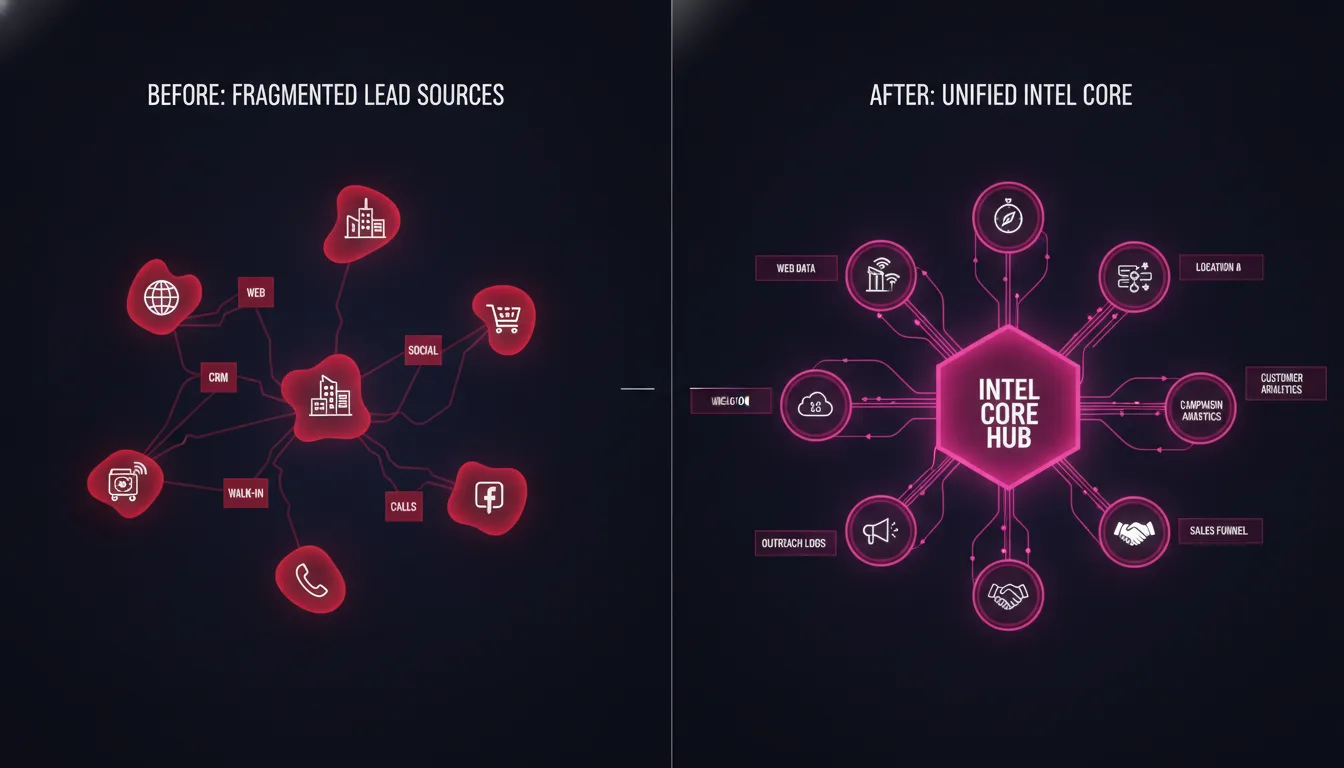
First, data integration. AI cannot work on disconnected data. You need direct API connections to all your marketing platforms: Google Ads, Meta, email platforms, CRM, analytics, conversion tracking. The data has to flow in real time. It has to be clean and unified. No manual exports. No weekly reports. Continuous, trustworthy data flow.
Second, signal processing. You need a system that ingests that data and asks intelligent questions. What is anomalous? What patterns did yesterday that we should amplify? What is breaking down? This requires either purpose-built software (like Intel Core) or a data team with expertise in SQL, Python, and statistical analysis. Building it yourself is possible but labor-intensive.
Third, human judgment layer. And you need humans who are trained to review AI recommendations, understand the reasoning, ask critical questions, and make decisions with context and accountability. You cannot automate this layer. You can optimize it — make it faster, clearer, better documented — but you cannot eliminate it.
Most agencies and in-house teams lack at least one of these layers. They have data integration but not signal processing. Or they have signal processing but no investment in the human layer. The AI-assisted model requires all three.
Are You Ready for AI-Assisted Marketing?
Not every brand needs this infrastructure today. But if you are hitting these conditions, you should start building:
You are running more than two paid media channels and finding it hard to see what is working across them
You have a dedicated marketing team (internal or outsourced) that spends hours each week manually pulling reports and making routine optimizations
You want to compound marketing knowledge across campaigns but are losing insights when people leave the team
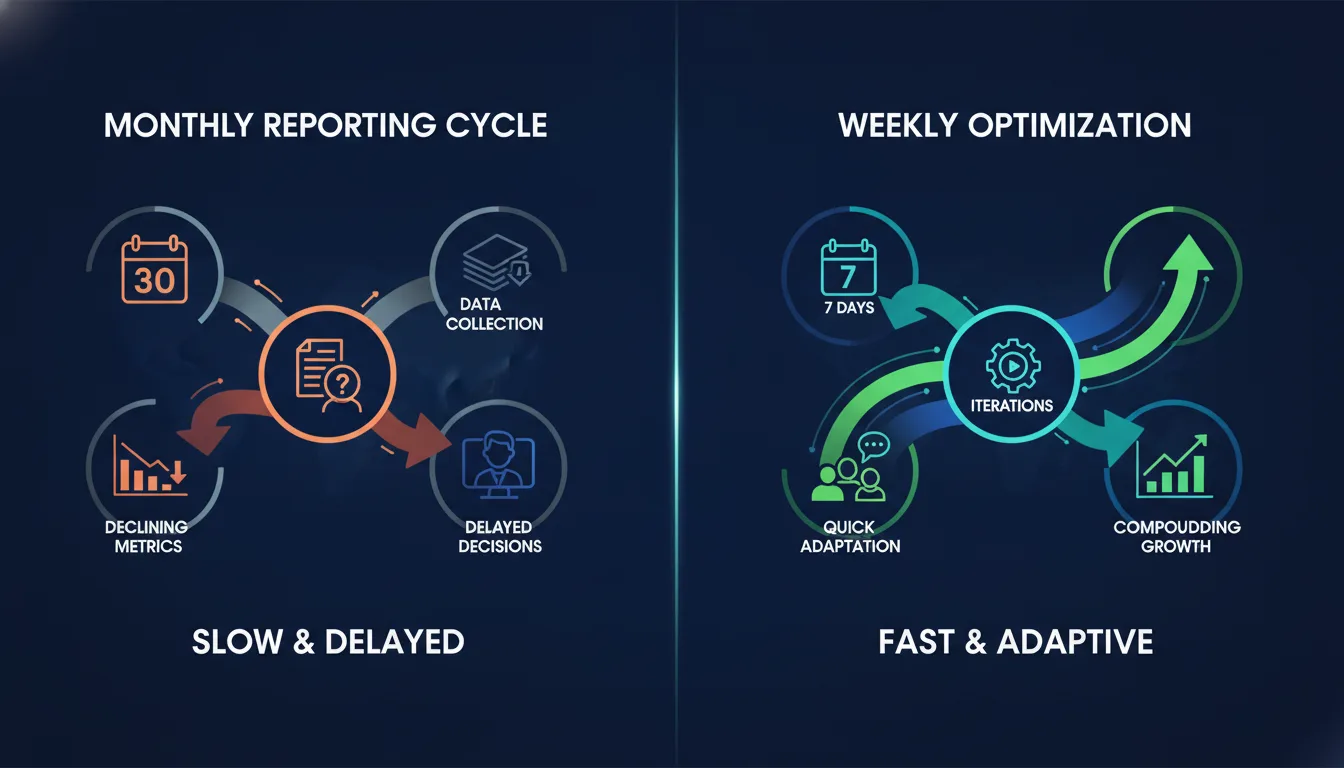
You are frustrated with agency-level reporting (monthly, generic, not actionable) and need daily signal clarity
You have the budget and organizational commitment to build (or partner on) a documented marketing system
If none of those describe your situation, you might be better off with simpler tools or traditional agency services. There is no shame in that. Use the infrastructure that matches your complexity.
The Future Is AI-Assisted, Not AI-Autonomous
The marketing industry will move toward AI-assisted models over the next three years. The AI-autonomous model (letting algorithms loose without human oversight) will fail because brands will not tolerate the risk. And they should not.
Metrics Masters builds managed marketing infrastructure where Intel Core is the signal processing layer and a Brand Technical Expert is the decision layer. We use AI to help humans see better. We use humans to judge responsibly. We document every decision so knowledge compounds instead of evaporating.
If your brand is ready to move from fragmented vendors and manual reporting to documented, AI-assisted marketing infrastructure, let us know.
Ready to turn raw signals into documented decisions? We are building managed marketing infrastructure for brands ready to optimize with confidence. Learn more about how Intel Core and our Brand Technical Experts can transform your marketing operations.
Start a conversation with Metrics Masters
---
Frequently Asked Questions
What's the difference between AI-assisted and AI-autonomous marketing?
AI-assisted marketing uses AI to recognize patterns and propose decisions, but a human makes the final call. AI-autonomous marketing lets AI make and execute decisions without human review. AI-assisted is safer and more appropriate for business-critical decisions. Autonomous is faster but carries more risk and accountability challenges.
Does AI-assisted marketing mean I need fewer marketing people?
No. It means your existing marketing people can focus on strategy and decision-making instead of routine reporting and optimization. You might not need as many junior analysts doing manual tasks, but you will need skilled operators who can review AI recommendations, apply business context, and make judgments. Different skill set, not fewer people.
Can AI-assisted marketing replace creative and strategy work?
No. AI works well on tactical optimization (budget allocation, audience targeting, timing, frequency). It cannot generate original creative strategy or decide your brand positioning. Those require human intuition and cultural understanding that algorithms cannot replicate.
Is AI-assisted marketing different from AI-generated content?
Yes. AI-generated content uses generative AI (ChatGPT, etc.) to create copy, subject lines, or social posts. AI-assisted marketing uses machine learning to help you recognize patterns and make better decisions about what to do with your marketing. They are complementary but different.
What data do I need to set up an AI-assisted system?
You need integrated data from all marketing platforms: ad platforms (Google Ads, Meta), conversion tracking, CRM, email, and analytics. The data must flow in real time, not as weekly exports. Without this integration, signal processing is impossible.
How long does it take to build AI-assisted marketing infrastructure?
If you are building in-house, expect 4-6 months to get data integration solid and signal processing working. If you are using a platform like Intel Core, you can be live in 2-3 weeks. The bigger time investment is in training your team to review recommendations and make documented decisions.
Will AI-assisted marketing reduce my ad spend or improve my ROAS?
Not directly. AI-assisted marketing helps you spend smarter — catching inefficiencies faster, recognizing winning patterns earlier, and automating routine decisions. This usually improves efficiency over time. But the primary value is clarity and speed of decision-making, not a guaranteed ROAS multiplier. Any vendor promising that is selling hype.

Jeremiah Shaw
CEO & Technical Marketing Specialist · Metrics Masters | Brandlio
International
Technical marketing specialist pushing boundaries in Google Ads, automation, and AI-driven growth systems. Paragliding and adventure enthusiast.