ChatGPT ads in 2026: the short answer
Quick answer: ChatGPT ads are now self-serve, with no published minimum spend, in more than 60 countries. You can pay per 1,000 impressions or per click, and OpenAI suggests starting at $3 to $5 per click. Conversion tracking works through a pixel and a Conversions API. Measurement is still thin, so test with a fixed budget and success criteria set before launch.
A year ago, buying ads in ChatGPT meant a sales conversation and a six-figure commitment. That changed fast. OpenAI launched ads in February 2026 as a CPM-only pilot. The minimum commitment started at $250,000 and was cut to $50,000 in April. On May 5, OpenAI opened a self-serve Ads Manager to US businesses and added cost-per-click bidding, according to PPC Land's coverage of the launch.
By October 2026, OpenAI's Ads Manager availability page lists self-service access for advertisers based in more than 60 countries, including the US, the UK, Canada, Australia, most of the EU, India, Brazil and Mexico. A conversion-optimized objective now sits alongside impression and click buying.
So the question for a growth-stage brand is no longer "can we get in?" It is "should we, and how do we test it without burning budget we could spend on channels we can already measure?" This guide answers that. It covers what ChatGPT ads cost, how the auction picks an ad, what you can and cannot measure, how it compares with Google Ads, and a 30-day test plan.
How ChatGPT ads work
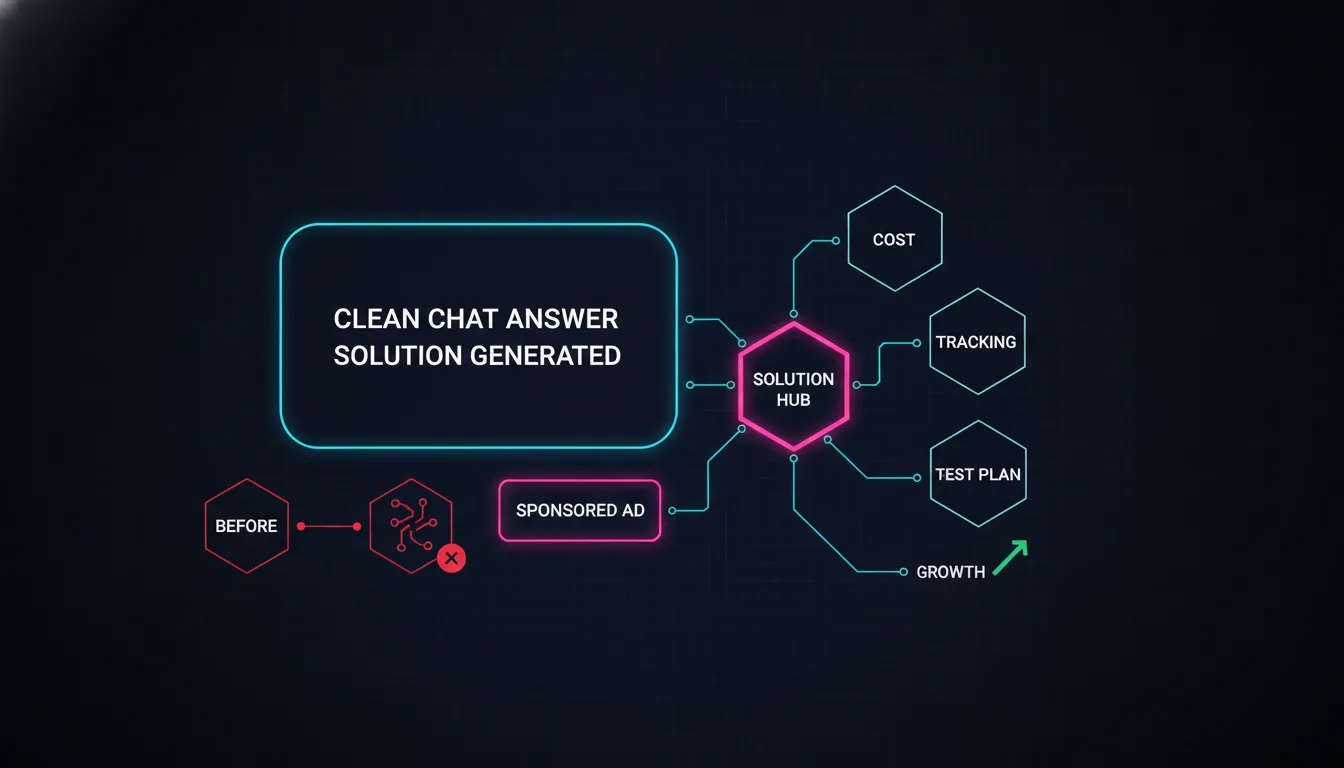
ChatGPT ads appear below ChatGPT's response, not inside the answer itself. Each ad unit carries your advertiser name, logo, a title, a short description, an image and a landing page. That is the format described in OpenAI's Ads in ChatGPT basics guide.
How an ad gets selected
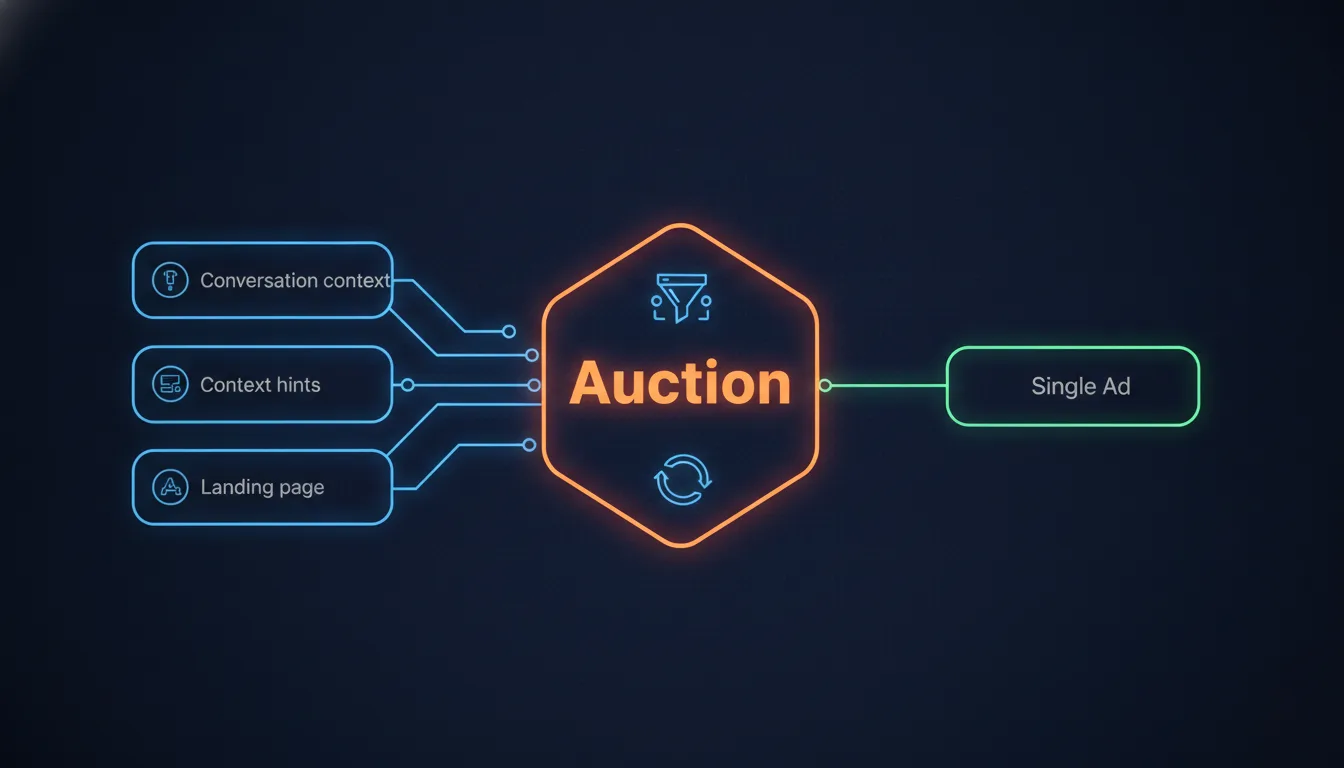
OpenAI's system chooses ads based on expected relevance and outcomes. It weighs four things:
The conversation. The context and intent of what the person is asking right now.
Your context hints. At the ad group level, you describe the topics, conversations or keywords where your product is relevant.
Your ad and landing page. The title, copy and the page itself are part of the relevance judgement.
Personalization signals. When a user has ads personalization switched on, select signals from their broader ChatGPT use.
The auction is relevance-weighted and second-price. A better-matched ad can win without the highest bid, and the winner pays roughly what it took to win, not its full maximum bid.
The most important detail is in OpenAI's own wording: context hints "are not exact-match keywords and do not guarantee delivery in specific conversations." If your team is used to Google Ads match types, reset expectations now. You are describing territory, not buying queries.
Who actually sees ChatGPT ads
Not everyone who uses ChatGPT. OpenAI does not show ads to people on Plus, Pro or any Business plan, or to accounts identified as under 18. At the May launch, PPC Land reported that ads were shown to users on the Free and Go plans.
That matters more than it sounds, especially in B2B. A buyer researching software on their company's ChatGPT Business account will not see your ad. The same person on a personal free account might. Factor that into who you expect to reach.
What ChatGPT ads cost
There are three ways to buy, and they bill differently. The difference that catches people out: optimizing for conversions does not mean paying per conversion.

Objective | You pay for | Delivery optimizes toward | Use it when |
|---|---|---|---|
Views (CPM) | Every 1,000 impressions | Reach | You want awareness in a category conversation and can measure lift another way |
Clicks (CPC) | Each valid click | Traffic | You are testing for the first time and want cost control while tracking matures |
Conversion optimization, click billing | Each valid click | Conversions that follow a click | Your pixel and Conversions API are live and one standard event fires reliably |
Conversion optimization, impression billing | Every 1,000 impressions | Conversions after views and clicks | You trust view-through measurement and have a way to check it |
Source: OpenAI's basics guide and conversion-optimized campaigns guide.
What to bid
For click campaigns, OpenAI recommends starting with a maximum bid of $3 to $5 per click. Ads Manager may show bid-strength guidance telling you whether a bid is likely to compete. At the May launch, the default maximum CPM bid was $60.
For conversion-optimized campaigns, OpenAI says there is no recommended bid amount yet. You set a bid cap, which is the most you are willing to bid for a conversion, and the auction sets what you actually pay.
Third-party guides quote CPC ranges anywhere from $2 to $8 depending on category. Treat those as anecdotes. OpenAI has not published platform-wide cost or conversion benchmarks, and early auction prices move as more advertisers enter.
Is there a minimum spend?
OpenAI's self-serve documentation does not set a minimum spend. The large figures you will see quoted, $250,000 and then $50,000, came from the pilot before self-serve opened. Larger advertisers can still go through OpenAI's ads team for sales support.
No minimum does not mean any budget is enough. A test needs enough conversions to tell you something. We cover how to size that below.
What you can measure, and what you can't
Measurement is where ChatGPT ads have improved the most, and where they are still furthest behind Google and Meta.
How conversion tracking works
According to OpenAI's conversion measurement guide, you create a data source in Ads Manager and send events through the OpenAI Pixel, the Conversions API, or both. A conversion is reported when the event matches one you configured for the campaign, falls inside the attribution window, and can be connected to an eligible ad click.
The connection runs through a click reference called oppref, which is appended to your landing page URL. The pixel stores it in a first-party cookie so later events can be matched. When you send events server-side, you can include it in the Conversions API call.
Four details decide whether your numbers are usable:
Run the pixel and the Conversions API together. Send the same event ID through both so OpenAI can deduplicate.
Protect the click reference. Redirects, link shorteners and some consent tools strip URL parameters. If
opprefis lost before the pixel reads it, the conversion may never be matched.Decide on advanced matching. Automatic advanced matching hashes contact details from your forms in the browser before sending them. It improves matching. Confirm it fits your privacy notice and consent setup before you leave it on.
Add UTM parameters. Static tracking parameters on your landing page URLs let GA4 and your CRM see ChatGPT ad traffic on their own terms.
If your tracking stack is already shaky on Google and Meta, fix that first. Our guide to server-side tracking covers the same pixel-plus-API pattern.
What you still can't see
No conversation data. Reporting is aggregated. You will not see what people asked before they saw your ad.
No query report. OpenAI's reporting covers delivery, cost and conversions. There is no equivalent of a Google search terms report showing which conversations triggered spend.
Modeled numbers in the total. Reported conversions may include modeled conversions where OpenAI has them.
No benchmarks. OpenAI has not published platform-wide conversion rates, so you cannot tell whether your results are good or simply early.
Delayed spend. Spend figures can lag by 7 to 8 hours, so a zero in the morning does not mean nothing was charged.
Advertisers feel this. In Marketing Brew's July 2026 reporting, ButcherBox's VP of growth marketing called the platform's levers "just low right now" and named incrementality as the measurement question on her team's mind.
OpenAI itself notes that its numbers will not match your analytics tool. It points to different attribution windows, time zones, consent conditions and deduplication rules, and says a difference does not necessarily mean an error. Plan for that before the first report lands.
ChatGPT ads vs Google Ads
They are not substitutes, at least not yet. Here is how they compare for a team deciding where the next dollar goes.
ChatGPT ads | Google Ads (Search) | |
|---|---|---|
Intent signal | The whole conversation, including follow-up questions | A single search query |
Targeting control | Context hints, not exact-match keywords | Keywords, match types, negatives, audiences |
Who you reach | Logged-in users on plans that show ads; no paid-plan users | Nearly everyone who searches |
Bidding | CPM, CPC, and conversion optimization with a bid cap | Full Smart Bidding, value-based bidding, portfolio strategies |
Reporting depth | Aggregated; no query or conversation report | Search terms, auction insights, attribution reports |
Benchmarks | None published | Years of industry data |
The case for testing is the first row. Someone who has spent five messages comparing options with ChatGPT has shown more intent than most single searches. The case for caution is every other row.
Who should test ChatGPT ads now, and who should wait
Test now if
Your buyers compare before they buy. Considered purchases, such as B2B software, professional services, home services and higher-ticket ecommerce, match the way people use ChatGPT to research.
Your tracking is already healthy. You can install the pixel, send server-side events with event IDs, and see conversions in your CRM or store.
You can fund a real test. You can set aside a budget that buys enough conversions to judge, without starving Google or Meta campaigns that are already profitable.
You know what your search campaigns teach you. The terms and themes that convert on Google are your best starting context hints. ButcherBox told Marketing Brew it borrows keywords and copy from its Google campaigns.
Wait if
Your measurement is broken elsewhere. Adding a channel with thinner reporting to a stack you already cannot trust makes every decision harder.
Your core channels are not proven yet. If Google and Meta are still finding their footing, the next dollar usually does more there.
Your buyers mostly use paid ChatGPT plans. Teams on ChatGPT Business, and power users on Plus or Pro, will not see ads.
You sell low-priced impulse products. People rarely ask ChatGPT to help them decide on a $20 purchase. Paid social is still the better fit.
A 30-day ChatGPT ads test plan

This is the plan we use to decide whether ChatGPT ads earn a permanent line in a budget. Write the success criteria down before you launch, so the result is a decision, not a debate.
Days 1 to 5: fix tracking first. Install the OpenAI Pixel on every page in the conversion path. Send the same events through the Conversions API with matching event IDs. Confirm
opprefsurvives your redirects. Add UTM parameters. Pick one standard conversion event that fires often enough to learn from: a qualified lead or a purchase, not a page view.Days 6 to 12: launch a Clicks campaign. Start at a $3 to $5 maximum CPC, as OpenAI recommends. Build two or three ad groups by theme, with context hints drawn from your best-converting Google search themes. Write ad copy that answers the question the conversation is likely about, not a generic brand line.
Days 13 to 21: read the signals. Watch click-through rate, cost per click and conversions in Ads Manager. Compare them with what GA4 and your CRM record for the same UTM traffic. Expect the totals to differ, and look for the direction and size of the gap.
Days 22 to 30: decide. Compare cost per qualified conversion with your non-brand Google Search campaigns. If the test produced enough conversions to trust, clone the campaign into conversion optimization. If it did not, decide whether the problem was budget, offer or fit, and write that down.
How much budget a test needs
Our rule of thumb: budget for at least 30 conversions at the cost per acquisition you are willing to pay. If your target is $150 per qualified lead, that means about $4,500 over the test. Fewer conversions than that and you are reading noise.
What a good result looks like
Set two bars before launch:
A cost bar: cost per qualified conversion within a set range of your non-brand search benchmark.
A quality bar: the leads or orders it produces behave like those from your other channels, measured in your CRM or store, not in Ads Manager.
Pass both and ChatGPT ads earn a place in the plan. Pass the quality bar but not the cost bar and the channel may be worth revisiting as the auction matures.
Common mistakes with ChatGPT ads
Treating context hints like keywords. They guide matching. They do not guarantee where you appear, so judge ad groups on results, not on the hints you wrote.
Launching on the pixel alone. Browser-only tracking loses conversions to ad blockers, consent choices and cookie limits. Use the Conversions API from day one.
Losing the click reference. A redirect that strips
opprefquietly breaks attribution, and nothing in Ads Manager will tell you why.Choosing the wrong objective at setup. You cannot change a campaign's objective or its conversion event after creation. You have to clone or rebuild it.
Judging on view-through conversions. Someone who saw an ad and bought later may have bought anyway. Decide on click-through results unless you have an incrementality check.
Expecting the numbers to match GA4. They will not. Agree in advance which system makes the decision.
How Metrics Masters runs ChatGPT ads
ChatGPT ads work best as part of one system, not as a standalone experiment run by a separate vendor. When the same operator owns Google, Meta and ChatGPT campaigns, plus the tracking underneath them, budget moves to whatever the data supports, and the test result is read against the same numbers as everything else.
That is how we run ChatGPT ads management. Tracking is verified before a dollar is spent. Every change is documented with the reasoning. You own the ad account, the pixel and the data from day one. Engagements start at $2,500 a month, and you can see how scope is set on our engagement scope page.
What to do this week
Check that your tracking can support a new channel: pixel, server-side events and event IDs.
Pull your five best-converting Google search themes. They are your first context hints.
Write down the cost and quality bars a test must clear before you launch it.
Frequently asked questions
How much do ChatGPT ads cost?
You set your own bids. OpenAI recommends starting click campaigns at a maximum of $3 to $5 per click, and the default maximum CPM at launch was $60. You can buy on impressions, clicks or conversion optimization. OpenAI has not published average costs, so third-party CPC figures are estimates.
Is there a minimum spend for ChatGPT ads?
OpenAI's self-serve documentation does not list a minimum spend. The $250,000 and $50,000 commitments often quoted applied to the pilot before self-serve Ads Manager opened in May 2026. You still need enough budget to generate meaningful conversion data.
Who sees ChatGPT ads?
Ads are not shown to people on Plus, Pro or Business plans, or to accounts identified as under 18. At launch, ads were shown to Free and Go users. Ads appear below ChatGPT's response, not inside the answer.
Can you target keywords in ChatGPT ads?
Not in the Google Ads sense. You add context hints at the ad group level that describe relevant topics, conversations or keywords. OpenAI says these guide matching but are not exact-match keywords and do not guarantee delivery in specific conversations.
How do you track conversions from ChatGPT ads?
Create a data source in Ads Manager and send events through the OpenAI Pixel, the Conversions API, or both. Use the same event ID in both so conversions are deduplicated, and make sure the oppref click reference survives any redirects. Add UTM parameters so GA4 and your CRM can track the traffic too.
Do you pay per conversion with ChatGPT ads?
No. Conversion-optimized campaigns steer delivery toward a chosen conversion event, but you are billed per valid click or per 1,000 impressions, depending on the billing option you choose. Your actual cost per conversion is set by the auction.
Which countries can use ChatGPT Ads Manager?
As of October 2026, OpenAI lists self-service access for advertisers based in more than 60 countries, including the US, UK, Canada, Australia, most EU markets, India, Brazil and Mexico. The legal entity that is billed must be based in a listed country. Check OpenAI's availability page for the current list.
Are ChatGPT ads worth it for B2B?
They can be, because B2B buyers often research and compare options in ChatGPT. The catch is that people using ChatGPT Business at work do not see ads. Test with a fixed budget, judge on lead quality in your CRM, and compare against your non-brand Google Search cost per qualified lead.
Want to know if ChatGPT ads fit your budget?
Start with the numbers you already have. We will audit your tracking, attribution and live campaigns, tell you whether your setup can measure a new channel, and say plainly whether a ChatGPT ads test makes sense for you. Get your free infrastructure audit.

Jeremiah Shaw
CEO & Technical Marketing Specialist · Metrics Masters | Brandlio
International
Technical marketing specialist pushing boundaries in Google Ads, automation, and AI-driven growth systems. Paragliding and adventure enthusiast.