How to get recommended by ChatGPT and AI Overviews: the short answer
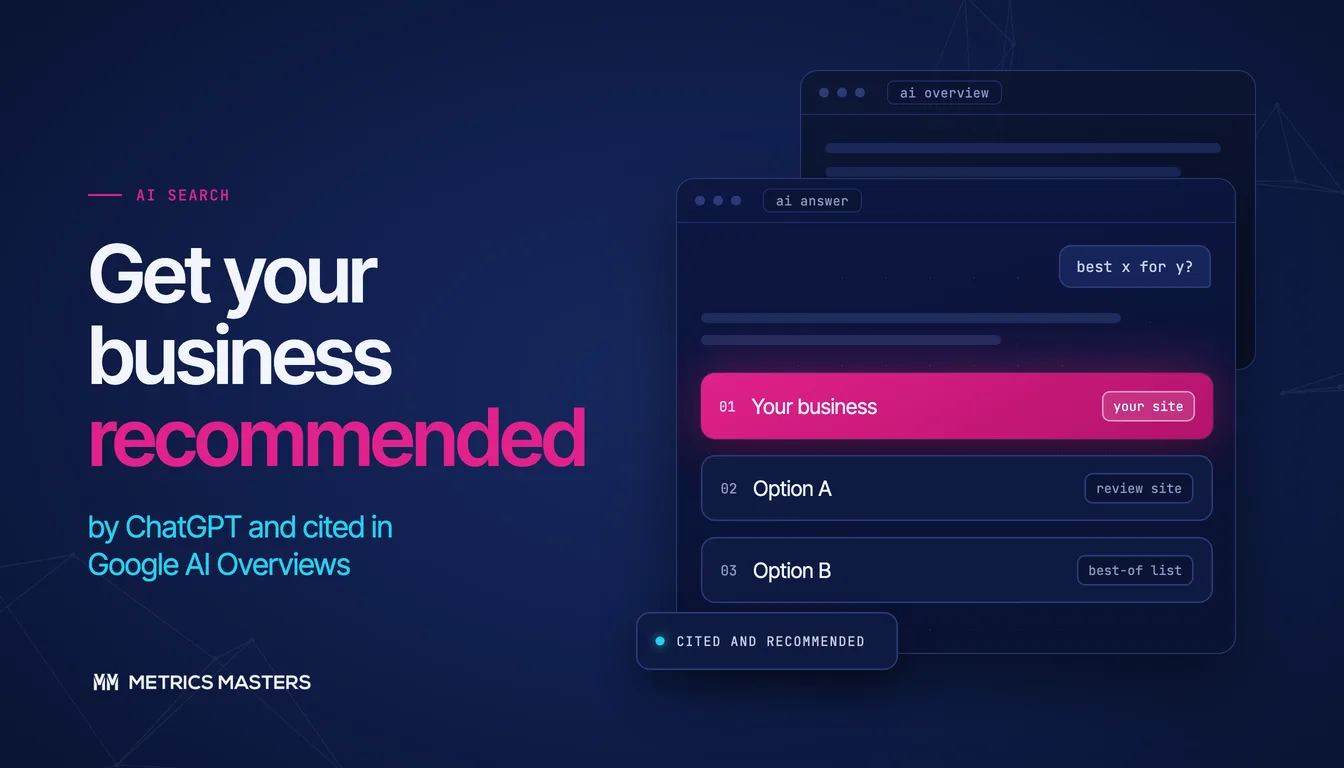
Quick answer: You can't pay for a place inside ChatGPT's answers, and there is no single switch. You earn it. Let AI search crawlers reach your site. Answer the buyer's question in the first third of the page. Back claims with sourced numbers and real updates. Build mentions on review sites, industry lists and forums. Then run a fixed set of prompts every month to see whether it is working.
"How do I get my business on ChatGPT?" now comes in more than ten phrasings in Google Autocomplete: listed, found, recommended, show up. In the Google Keyword Planner data we pulled on 8 October 2026, "how to get my business on chatgpt" carried an average cost per click of $88.84. Advertisers pay real money to reach the people asking it.
The reason is simple. ChatGPT, Perplexity and Google's AI features answer questions by retrieving web pages and summarizing them. Which brands they name now shapes the shortlist before anyone clicks. Google's AI Overviews alone had over 2.5 billion monthly active users by May 2026, according to Sundar Pichai at Google I/O.
The useful news is that 2025 and 2026 produced real data on what gets cited, and on which popular tactics do nothing. This guide covers both, with plays for ecommerce, multi-location and B2B businesses. For the strategy behind it, read our guide to SEO vs AEO vs GEO.
How ChatGPT and AI Overviews pick sources
Both retrieve candidate pages from a search index, then a language model writes the answer and cites some of what it read.
Google AI Overviews and AI Mode run on Google's core ranking systems and fan a question out into several related searches. In Ahrefs' March 2026 data, 37.9% of cited URLs appeared in the top 10 results for the original query. The rest came from deeper results and those related searches.
ChatGPT search depends on OpenAI's OAI-SearchBot crawler. OpenAI's crawler documentation says sites that opt out of it will not be shown in ChatGPT search answers.
Each engine has favorite sources. In Profound's analysis of about 680 million citations (vendor data, August 2024 to June 2025), Wikipedia was ChatGPT's top source at 7.8% of citations. Reddit led Google AI Overviews at 2.2%, ahead of YouTube and Quora, and Perplexity at 6.6%.
That gives you two jobs: be the page worth citing, and be the brand other sources mention.
What works, with the evidence

Answer in the first third of the page
Kevin Indig analyzed 1.2 million ChatGPT responses for his Growth Memo newsletter, which is paywalled. In his write-up for Search Engine Journal in February 2026, he reported that 44.2% of citations came from the first 30% of a page, 31.1% from the middle and 24.7% from the final third. A separate study by Bright Data's Daniel Shashko, reported by Practical Ecommerce, found 46.1% of AI Mode and Gemini citations came from the first 30% of a page.
Put the direct answer in the opening 60 words. Define the thing, give the number, state the recommendation, then explain. Indig also found cited passages were nearly twice as likely to contain definitional phrasing as uncited ones: 36.2% against 20.2%.
Use sourced statistics and expert quotes
SE Ranking's November 2025 model of ChatGPT citations (vendor data, 129,000 domains) found pages with 19 or more statistics averaged 5.4 citations, against 2.8 for pages with little data. Pages with expert quotes averaged 4.1 against 2.4. That matches the original GEO research, where adding statistics, quotations and source citations gave a relative improvement of 30 to 40% in visibility.
The quotes must be real and the numbers traceable. Link each statistic to its primary source and date it. A number nobody can trace gives an engine no reason to prefer your page over the original.
Update pages for real
Ahrefs' July 2025 study of about 17 million citations found pages cited by AI assistants were 25.7% fresher on average than pages in organic results. ChatGPT showed the strongest preference for newer content and Google's AI Overviews the weakest. In SE Ranking's data, pages updated in the past three months averaged 6.0 ChatGPT citations against 3.6 for older ones.
Freshness means new substance: current prices, this year's data, changed recommendations. Changing the date without changing the content is the trap. Ahrefs notes that Google's John Mueller has warned against it.
Earn authority and mentions off your site
SE Ranking found sites with more than 32,000 referring domains were 3.5 times more likely to be cited than sites with up to 200. Citations also rose with how often a domain was mentioned on Quora and Reddit. Domains listed on review platforms such as Trustpilot, G2, Capterra and Yelp averaged 4.6 to 6.3 citations, against 1.8 for domains absent from them.
These are correlations, not proof. Bigger brands have more links and reviews. But the direction is consistent, and it fits how a synthesized answer works: it leans on what many sources say. Google's AI optimization guide adds a caution that chasing inauthentic mentions is less helpful than it might seem. Earn them by being useful where your buyers already ask.
What doesn't measurably help
Tactic | What the data shows | Our verdict |
|---|---|---|
FAQ schema | SE Ranking: pages with FAQ schema averaged 3.6 ChatGPT citations, against 4.2 without | Not a citation lever |
FAQ sections | SE Ranking: 3.8 with, 4.1 without | Write FAQs for readers, not for AI |
Question-style headings | SE Ranking: question-style titles averaged 3.4 against 4.3. Indig: question marks were more common in cited text, mostly in headings | Mixed evidence. Use questions only where readers ask them |
llms.txt | SE Ranking: negligible impact. Google says Search ignores such files | Hygiene at most |
AI-only schema or chunked pages | Google: no special schema.org markup needed, and no need to break content into tiny pieces | Skip |
None of these hurt much. The cost is the hours not spent on the four factors above.

Ecommerce: product data, feeds and reviews
Product questions work differently. In Ahrefs' study of 146 million results pages, AI Overviews appeared on only 3.2% of shopping-industry results and 2.1% of transactional queries. When AI does recommend products, in AI Mode or ChatGPT, structured product data does much of the work.
Keep your Merchant Center feed complete and accurate. Google's guide says Merchant Center and Business Profile data can help products appear in AI responses as well as other results. Titles, attributes, price, availability, shipping and returns should match the product page exactly.
Get your catalog in front of ChatGPT. OpenAI's commerce documentation describes a structured product feed that lets ChatGPT index and display products accurately. Shopify merchants are surfaced through Shopify Catalog, and since March 2026 purchases complete on the merchant's own store, according to Digital Commerce 360.
Build reviews on and off your site. Review-platform presence correlated with more ChatGPT citations in SE Ranking's data. Reviews on your own product pages give AI something specific to summarize.
Write buying guides for comparison questions. "Best X for Y" is the question AI gets. Keep guides specific, honest and current.
What we check first: Merchant Center diagnostics for disapproved items and price or availability mismatches with the site. Feed errors are the cheapest visibility fix there is. Our shopping feed management starts there.
Multi-location and local: Business Profile, reviews and consistent data
For local questions, such as "emergency plumber near me" or "dentist open Saturday", AI engines lean heavily on listings. BrightLocal's August 2026 study (vendor data) analyzed nearly 2 million citations for 1,355 business locations across AI Overviews, AI Mode and ChatGPT. Google Business Profile made up 28.5% of all citations. ChatGPT leaned most on Yelp, then Tripadvisor, OpenTable, BBB and Angie's List. About 93% of cited domains were individual business websites.
Complete every Business Profile. Categories, services, hours, attributes, photos and booking links, for every location. Google's guide names Business Profile data as a way into AI responses.
Claim Yelp and your industry directories. BrightLocal's advice is to claim both your Business Profile and your Yelp profile, then keep them current.
Keep location data identical everywhere. Same name, address, phone and hours on your site, Business Profile and directories. Our rule of thumb: treat every mismatch as a reason for an AI answer to pick a competitor whose details agree.
Give each location a real page. Local services, team, parking, hours and reviews, so the business websites that earn most local citations have something specific to cite.
Ask for reviews steadily. Recent reviews that name specific services give AI summaries more to work with.
B2B: third-party lists, comparison pages and analyst mentions
B2B buyers ask AI for shortlists: "best CRM for a 50-person team", "alternatives to X". Ahrefs' December 2025 study of 750 ChatGPT prompts across software, products and agencies found "best X" lists made up 43.8% of cited page types. Brands ranked higher on third-party lists were more likely to appear in the answer.
Get onto the lists that already get cited. Run your category prompts, note which "best X" articles the answers cite, and pitch those authors with something verifiable, such as a customer reference or published pricing.
Keep review profiles active. G2 was among ChatGPT's 10 most-cited domains in Profound's data, and review-platform listings correlated with citations in SE Ranking's.
Publish honest comparison pages. In a 2026 Ahrefs experiment, 34 self-promotional pages were tracked across 9,886 AI answers. They were cited, but 43% of answers citing its conference list never mentioned Ahrefs' own event and recommended others from the list. Their advice: include yourself where you belong, don't crown yourself, keep comparisons current.
Earn analyst and press mentions. Gartner was among the 10 most-cited domains for Google AI Overviews and Perplexity in Profound's data. Trade press, analyst notes and podcasts are where B2B authority gets set.
A 90-day plan to get cited
Week 1: access and baseline. Confirm Googlebot, Bingbot and OAI-SearchBot can crawl your key pages, and that those pages are indexed with snippets allowed. Check Search Console's generative AI setting. Run your prompt set once.
Weeks 2 to 4: rewrite the ten pages that matter most. Pick the pages tied to buying questions. Add an answer in the first 60 words, sourced numbers, first-hand detail and a visible updated date.
Weeks 4 to 8: fix listings and feeds. Business Profiles, Yelp, review platforms, Merchant Center, and a ChatGPT product feed if your platform supports one.
Weeks 6 to 12: earn mentions. Pitch the lists and publications the engines already cite for your prompts. Answer real questions in the communities your buyers use, as a named person.
Week 12: compare against baseline. Rerun the prompt set, read AI impressions and AI referrals, and decide where to double down.
Our rule of thumb: judge the plan on the trend across three monthly checks, not one. Answers vary between runs. In the Ahrefs experiment, about a quarter of cited pages were cited once and never again.
How to measure AI visibility

Build a fixed prompt set
Write 20 to 30 prompts in your buyers' words: category questions, comparisons, problems they describe, and local variants for each market. Keep them fixed. Each month, run them in ChatGPT, Google AI Mode and Perplexity in a clean session, and log four things per answer: were you mentioned, were you cited with a link, were you recommended, and which competitors appeared.
Read the platform reports
GA4. The default channel group now includes an AI Assistant channel for sources such as ChatGPT, Gemini, DeepSeek, Copilot and Grok. It excludes Google's AI Overviews and AI Mode, which still count as organic search. It matches on referrer, so treat it as a floor.
Search Console. The generative AI performance reports show impressions in AI Overviews, AI Mode and Discover by page, country and date. For now they report impressions only.
Bing Webmaster Tools. The AI Performance report, in public preview since February 2026, counts how often your pages are cited in Copilot and Bing's AI summaries, as PPC Land reported.
Your CRM. Add "How did you hear about us?" to your forms. A buyer who found you in an AI answer may arrive later by typing your name, and only they can tell you.
If GA4 itself is not trustworthy, fix that first. Our conversion tracking audit guide covers the checks.
Common mistakes when chasing AI recommendations
Blocking the wrong crawler. Blocking GPTBot keeps your content out of model training. Blocking OAI-SearchBot keeps you out of ChatGPT search answers. Decide each one on purpose.
Expecting ads to buy a recommendation. OpenAI says ads do not influence ChatGPT's answers and appear below them, marked as sponsored, as PPC Land reported. Ads and citations are separate budgets.
Crowning yourself on your own list. AI may cite the page and recommend your competitors from it.
Measuring once. One check is an anecdote. Three months of the same prompts is a trend.
How Metrics Masters handles AI visibility
AI visibility spans content, listings and feeds, reputation and measurement. Split across vendors, nobody owns whether a citation became a lead. In our model one Growth Operator owns all of it, with a specialist team executing behind them, so the prompt check, the feed fixes and the CRM data are read together.
That is how our SEO and content systems run: access checked first, pages rebuilt answer-first with sourced evidence, listings and feeds cleaned up, and every change documented with the reasoning. You own every account and dataset from day one. Engagements start at $2,500 a month, and you can see how scope is set on our engagement scope page.
What to do this week
Check robots.txt and your firewall allow OAI-SearchBot, Googlebot and Bingbot.
Write 20 buyer prompts and run them once in ChatGPT, AI Mode and Perplexity.
Pick the page that should answer your most valuable prompt and move the answer into its first 60 words.
Frequently asked questions
How do I get my business recommended on ChatGPT?
Make sure OpenAI's OAI-SearchBot can crawl your site, because ChatGPT search does not show sites that block it. Then answer buyers' questions near the top of your pages, back claims with sourced data, keep pages genuinely updated, and earn mentions on review sites, industry lists and forums. Check a fixed set of prompts monthly.
How do I get my business listed on ChatGPT?
For most businesses there is no directory to submit to. ChatGPT finds businesses through the web: your site, listings such as Yelp, Tripadvisor and Google Business Profile, review platforms and articles that mention you. Retailers can also share a structured product feed with OpenAI. Keep your details consistent everywhere so the sources agree.
How do I rank in ChatGPT search results in 2026?
ChatGPT doesn't rank pages like a results list. It cites sources. The factors linked to more citations in 2025 and 2026 studies are an answer early on the page, sourced statistics and expert quotes, recent substantive updates, strong referring domains and presence on review platforms. FAQ schema, question-style headings and llms.txt showed no measurable benefit.
How do I get cited by ChatGPT?
Write pages a model can quote. Put a clear, definitional answer in the first third of the page, where Kevin Indig found 44.2% of ChatGPT citations come from. Add statistics with linked primary sources and real expert quotes, which SE Ranking found on more-cited pages. Update the substance regularly, not just the date.
How do I show up in Google AI Overviews?
Start with normal SEO. Google says AI Overviews use its core ranking systems, and a page must be indexed and eligible for a snippet. Rank for the question and its related questions, answer clearly near the top, and keep Merchant Center and Business Profile data complete. Search Console now reports AI Overview impressions by page.
Can I pay to be recommended by ChatGPT?
No. OpenAI says ads do not influence ChatGPT's answers. Ads in ChatGPT appear below the answer and are marked as sponsored. You can buy that ad placement, but the recommendation inside the answer has to be earned through content, listings and reputation. Treat ChatGPT ads and AI visibility as two separate plans.
Does llms.txt help my business show up in ChatGPT?
Not measurably. SE Ranking's study of ChatGPT citations found llms.txt had negligible impact, and Google says its Search ignores AI text files. Having one does no harm, so keep it accurate if you already publish it. Put the effort into the factors that do correlate with citations: early answers, sourced data, real updates and earned mentions.
How do I check if ChatGPT recommends my business?
Write 20 to 30 prompts your buyers would use and run them monthly in ChatGPT, Google AI Mode and Perplexity, in a clean session. Log whether you were mentioned, cited with a link or recommended, and which competitors appeared. Add GA4's AI Assistant channel and Search Console's generative AI report for traffic and impressions.
Want to know whether AI engines can find you?
We will check whether AI crawlers can reach your key pages, whether your listings and feeds agree, and whether your analytics can see AI traffic at all. Then we will tell you plainly which fixes come first. Get your free infrastructure audit.