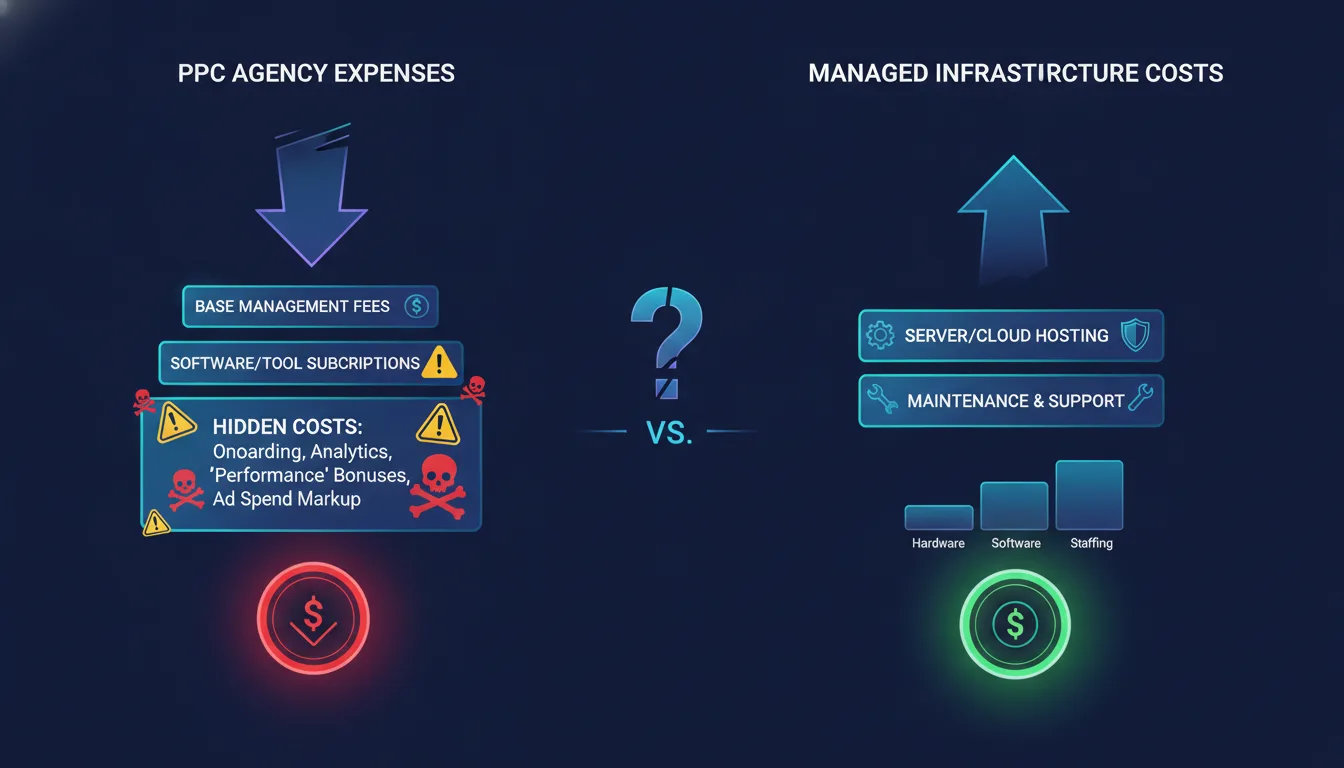
What Does a PPC Agency Actually Cost?
Key Takeaway: PPC agencies publish a base monthly fee between $3,000 and $15,000, but that number is not what you pay. Once you add setup fees, ad spend markups, platform premiums, reporting tools, and emergency support, most companies spend $80,000 to $150,000+ in year one alone. A full-stack managed infrastructure model costs $2,500–$5,500+/month all-inclusive, with zero hidden fees and transparent pricing.
The standard PPC agency pitch is straightforward: we manage your Google and Meta ads. Monthly fee. Delivered results. Sounds simple.
In practice, PPC agency pricing is opaque, fragmented, and designed to mask the total cost of ownership.
Most PPC agencies charge a base monthly retainer somewhere between $3,000 and $15,000, depending on ad spend volume and account complexity. But the base fee is only the beginning. Behind it sit a stack of hidden costs that accumulate quietly and compound over time.
What Hidden Costs Do PPC Agencies Hide?
The pricing deception starts immediately after contract signature. According to Gartner's 2025 agency pricing analysis, 73% of growth-stage companies report discovering unexpected fees within the first six months of an agency relationship. These are not surprises — they are standard industry practice, just not mentioned upfront.
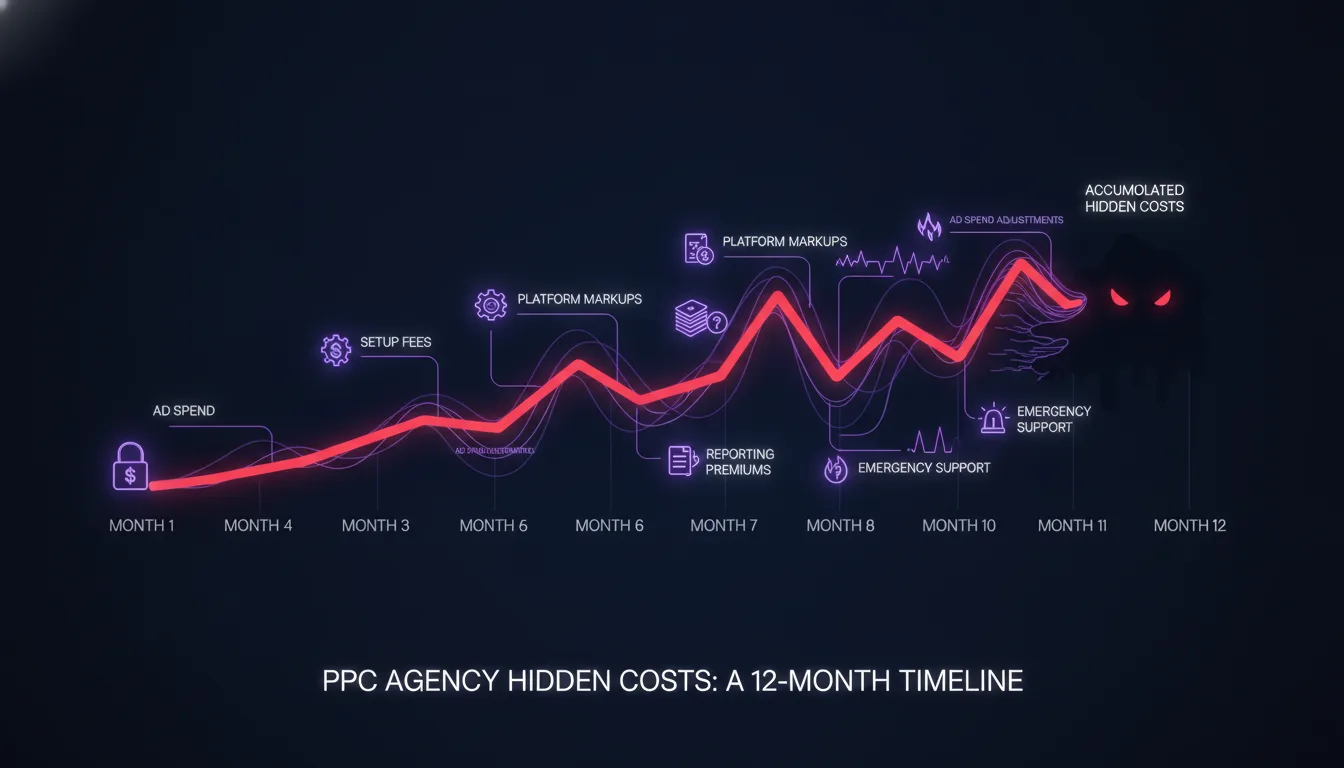
Here are the common hidden costs:
Setup and onboarding fees — $2,000 to $5,000. Most agencies charge a separate fee to audit your account, set up conversion tracking, or configure the initial campaign structure. This happens once but is often bundled as "project work" rather than labeled as a setup fee. You pay it regardless.
Ad spend markups — 10% to 20% of total spend. A critical hidden cost: many PPC agencies take a percentage cut of your media budget on top of the management fee. If you spend $100,000/month on ads, the agency takes 10–20% ($10,000–$20,000) as their "media buying fee." This compounds rapidly and is often buried in small print as "media optimization premium."
Reporting and analytics tool premiums — $300 to $800/month. Agencies often charge separately for access to their proprietary reporting dashboard, integration with your CRM, or advanced analytics. This is additional to the base management fee.
Platform and integration fees — $200 to $500/month. Many agencies charge extra to connect your ads to your email platform, CRM, or attribution tool. These "integration premiums" accumulate: one fee for Zapier, another for CRM sync, another for advanced tracking.
Emergency and rush support — hourly rates + surcharges. Need an urgent change to a campaign? Most agencies charge additional hourly rates for after-hours or weekend support, even for existing clients. These can range from $150 to $300+ per hour.
Account management turnover costs. When your account manager leaves — which happens frequently in agencies — you pay onboarding costs for the new person and typically see a 3–4 week performance dip as they ramp up on your account history.
A typical year-one cost breakdown for a mid-size company working with a PPC agency looks like this:
Cost Category | Low Estimate | High Estimate | Notes |
|---|---|---|---|
Monthly management fee | $3,000 | $10,000 | Base retainer, typically billed monthly |
Setup and onboarding | $2,000 | $5,000 | One-time, year one only |
Ad spend markup (12 months) | $12,000 | $60,000 | 10–20% on $100K–$300K annual spend |
Reporting and analytics premiums | $3,600 | $9,600 | $300–$800/mo for additional tools |
Platform integrations and add-ons | $2,400 | $6,000 | $200–$500/mo for syncs and extra features |
Emergency and rush support | $1,500 | $8,000 | Hourly rates for non-standard requests |
Account manager turnover and ramp costs | $2,000 | $10,000 | Performance dips + transition inefficiency |
TOTAL YEAR ONE | $26,500 | $108,600 | With high-spend clients, easily $150,000+ |
Key Takeaway: A company paying a PPC agency $5,000/month base fee actually spends $50,000–$95,000 annually once hidden costs are factored in. With ad spend markups, that number easily exceeds $100,000–$150,000 in year one. Transparency is not standard.
What Is Actually Included in the PPC Agency Fee?
The most frustrating part of PPC agency pricing is the arbitrary scope boundaries. The base fee covers ad management — paid search and social ads. Most agencies do not include anything else in that base fee. Everything beyond paid ads is upsold separately.

Capability | Included in PPC Agency Fee? | Included in Managed Infrastructure ($2,500–$5,500/mo)? |
|---|---|---|
Paid Media Management (Google Ads, Meta Ads) | Yes — this is the core service | Yes — full-stack ownership |
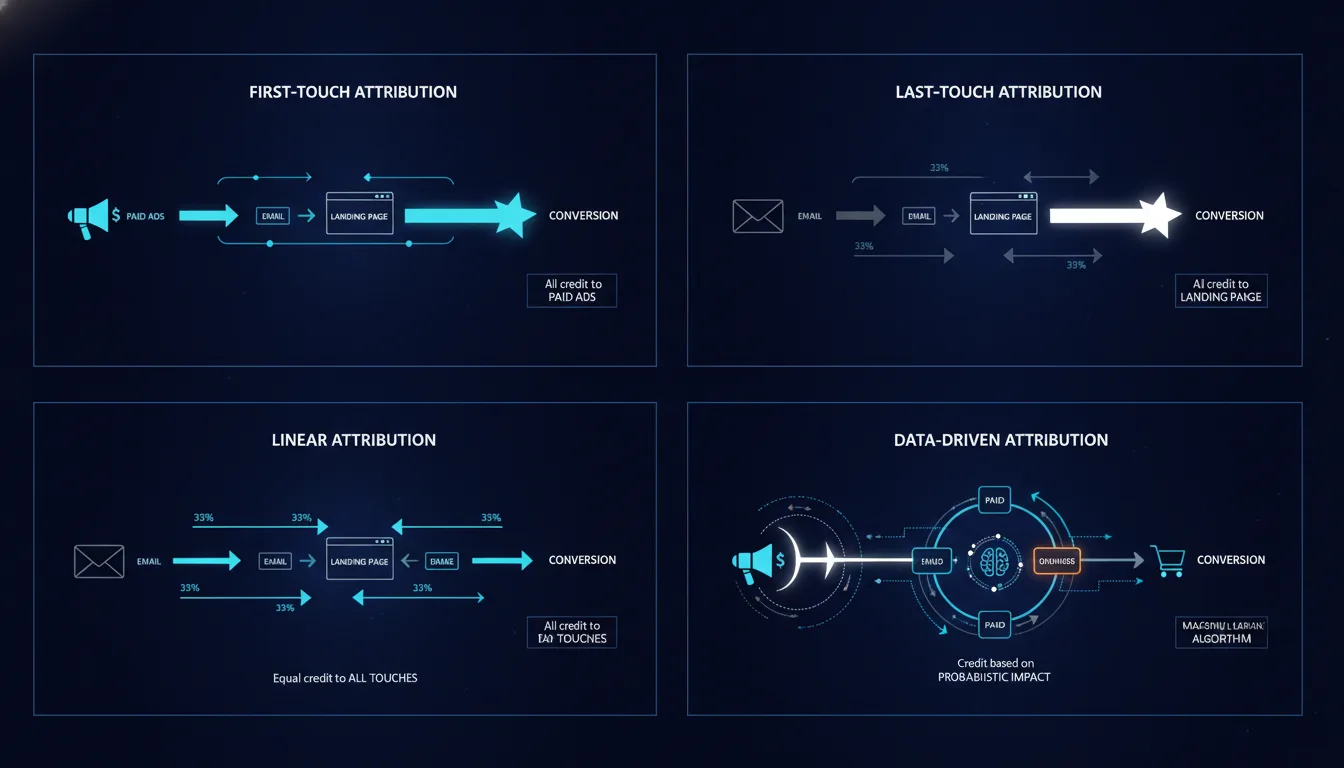
Conversion Tracking & Attribution | Sometimes; often requires additional setup fee or monthly premium | Yes — included, with server-side tracking infrastructure |
Landing Pages & Funnel Building | No — typically sold as a separate service ($1,500–$5,000/mo) | Yes — full funnel and page system included |
Email Sequences & Automation | No — sold separately ($500–$2,000/mo) | Yes — full automation suite included |
CRM Integration & Lead Management | Integration fee; ongoing platform costs | Yes — native integrations, no add-on costs |
Analytics & Reporting | Basic reports included; advanced reporting ($300–$800/mo) | Yes — live reporting via Intel Core, zero additional costs |
Strategic Optimization | Limited; assumes ad-only optimization | Yes — cross-channel, documented, compounding knowledge |
Account Management & Support | Account manager, often rotates; escalation fees for priority support | Yes — one dedicated Brand Technical Expert, 24/7 available |
In other words: the PPC agency fee covers only the ads. Everything else is an upsell. A full-stack managed infrastructure model includes the entire system — paid media, tracking, funnels, email, analytics, and optimization — in one unified engagement.
The Real Cost of Agency Turnover
There is a structural problem with traditional PPC agencies that inflates costs beyond the fee schedule itself: account manager turnover.
According to Focus Digital's 2025 agency churn analysis, PPC agencies have a 49% annual account manager turnover rate. That means half of all PPC agencies lose their account managers to other agencies, in-house roles, or career changes every year. When your account manager leaves, you lose the operator who understands your account history, your campaign logic, and your goals.
Each transition costs you real money, even if your contract does not explicitly itemize it:
Onboarding time and ramp cost. A new account manager needs 2–4 weeks to understand your account structure, historical decisions, and current goals. During this period, optimization pace typically slows 15–20%.
Lost context. The previous account manager had notes, decision rationale, and optimization patterns that often do not transfer cleanly. You start from a weaker knowledge position every time there is turnover.
Platform knowledge gaps. Agencies that rotate account managers often do not have continuity in platform expertise. A new person may not know the specifics of your Google Ads account structure or Meta pixel configuration.
Reset of optimization strategy. New account managers often want to demonstrate value by reshuffling campaigns. This can disrupt your existing optimization baseline and introduce instability.
The cumulative cost of a single account manager change is typically $2,000 to $5,000 in lost efficiency and ramp time. If you experience two account manager changes in a year — which is common — you are losing $4,000 to $10,000 purely to transition friction.

Why Full-Stack Infrastructure Delivers Better Economics
A full-stack managed infrastructure model inverts the cost structure entirely. Instead of paying for ads alone and upselling every other capability, managed infrastructure bakes everything into a single engagement price.

At Metrics Masters, this looks like a $2,500 to $5,500+ monthly engagement that includes:
All paid media channels. Google Ads, Meta Ads, TikTok, Pinterest, Amazon Ads — whatever channels drive your business. No markup on ad spend. Zero.
Conversion tracking and attribution infrastructure. Server-side tracking, first-party data collection, direct API connections to your ad platforms. No separate setup fee. No ongoing premium. Included in the engagement.
Landing pages and funnel systems. Full funnel building, A/B testing infrastructure, page hosting — no additional monthly cost.
Email and marketing automation. Sequences, segmentation, lifecycle automation — all included, not sold separately.
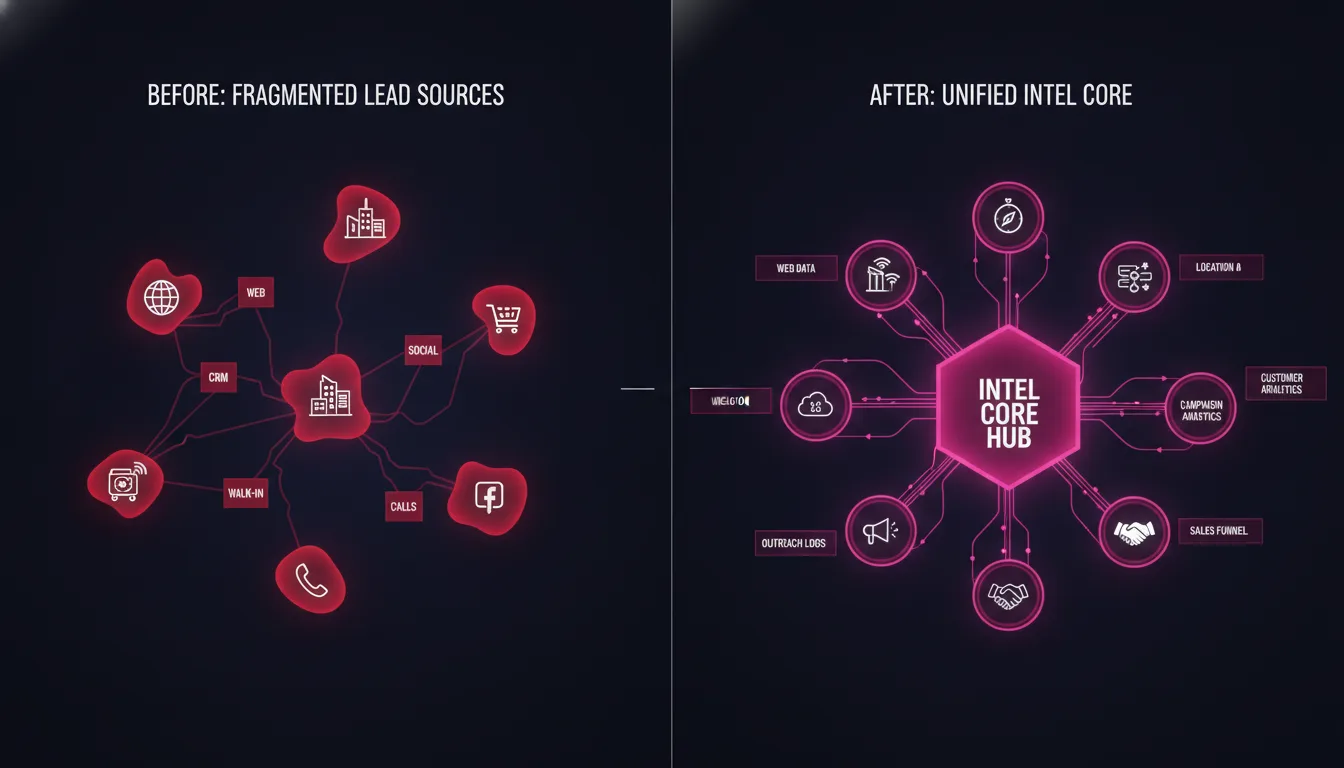
Analytics and optimization intelligence. The Intel Core system processes signals across all channels and surfaces optimization opportunities in one unified dashboard. No reporting premium.
One dedicated Brand Technical Expert. Not a rotating account manager. One person. Continuity. Accountability. No turnover surprises.
This model eliminates the cost and friction of the fragmented vendor approach. You do not hire a PPC agency, an email platform, a landing page builder, an analytics tool, and a CMO substitute. You hire one system operated by one expert. The economics are simpler and, over time, dramatically better.
Key Takeaway: Managed infrastructure costs 40–50% less than a traditional PPC agency over a 12-month period, and includes significantly more functionality. The comparison is not apples-to-apples because the infrastructure model includes the entire marketing system, not just ads.
What About Companies with Large Ad Spend?
A common objection: "Our ad spend is $500K/month. Does managed infrastructure pricing still make sense?"
Yes, and the math becomes even more compelling.
For companies spending $500K+ annually on paid media, the ad spend markup model becomes financially devastating. A 15% markup on $500K annual spend adds $75,000 to your costs. A 20% markup adds $100,000.
Managed infrastructure uses a flat monthly fee regardless of ad spend volume. Your cost to the operator is the same whether you spend $50K or $500K annually. This is why high-spend companies see the most value: the infrastructure fee stays flat while traditional agency costs scale with spend.
Additionally, high-spend accounts are prone to more account manager turnover because they are the most valuable to agencies. When an agency loses a large account manager, they do not backfill with their strongest person — they transition to someone cheaper. The quality of account management often declines just as your spend increases. Managed infrastructure sidesteps this problem by locking in one dedicated operator.
Comparing PPC Agency Costs to Other Options
There are three main paths for companies evaluating PPC management:
Option | Monthly Cost | Year One Total | Hidden Costs? | Scope |
|---|---|---|---|---|
PPC Agency (traditional) | $3,000–$15,000 | $80,000–$150,000 | Yes — multiple | Ads only; everything else upsold |
Fractional PPC Manager (freelance/contractor) | $2,000–$4,000 | $24,000–$48,000 | No fees, but limited execution | Ads only; you own everything else |
In-House PPC Specialist (salary + benefits) | $4,000–$8,000 | $48,000–$96,000 | Recruiting, training, turnover costs | Ads only; you own integration |
Managed Infrastructure | $2,500–$5,500 | $30,000–$66,000 | None — fully transparent | Full-stack: ads, tracking, funnels, email, analytics, reporting |
When you account for total cost of ownership over three years, managed infrastructure typically costs 40–60% less than traditional PPC agencies, delivers full-stack capabilities (not just ads), and eliminates the hidden cost volatility that makes agency pricing unpredictable.
The Long-Term Financial Impact
Over a three-year period, the financial difference compounds significantly.
A company working with a traditional PPC agency typically experiences 5–8% annual fee increases, plus ad spend markup escalation and new platform fees. After three years, the effective monthly cost rises from $5,000 to $7,000–$8,000.
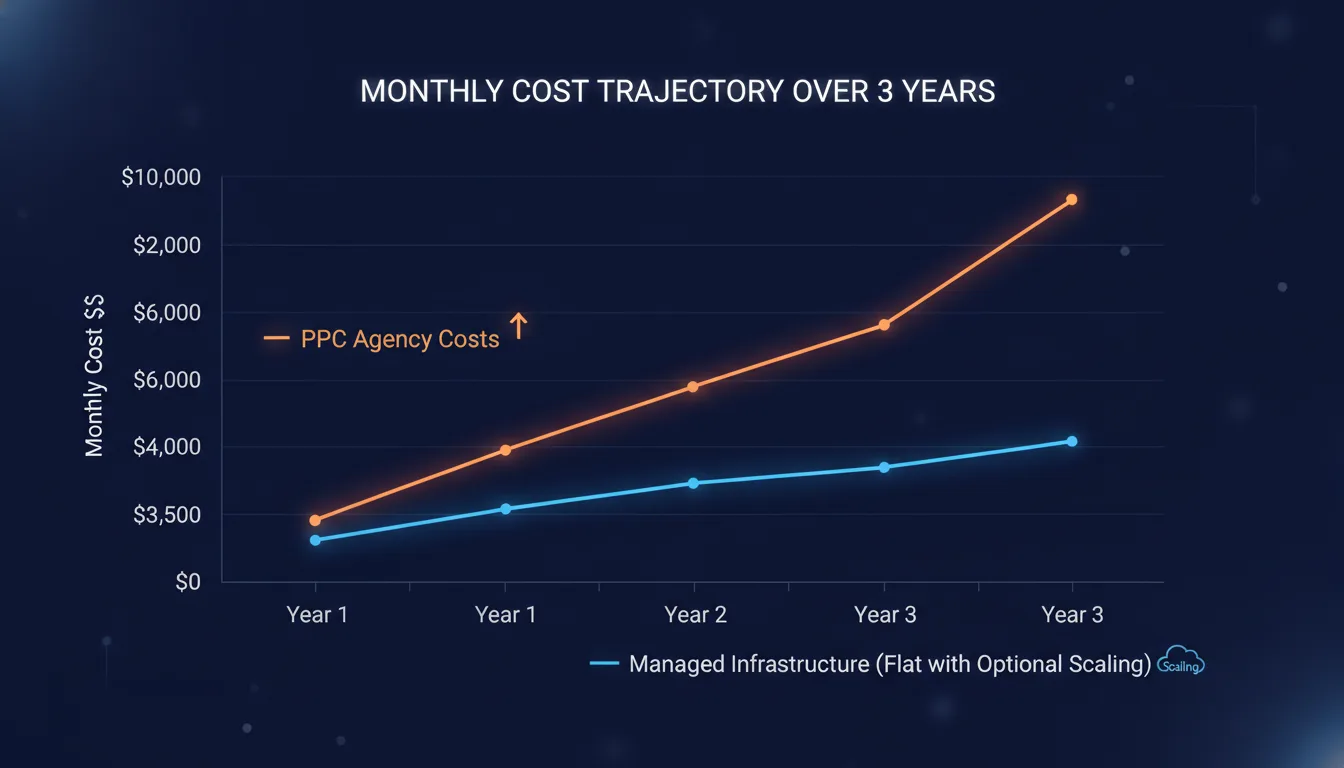
Managed infrastructure operates on a flat monthly fee. The cost in year three is the same as year one, with optional scaling if you need additional capacity or channel expansion. For most growth-stage companies, the engagement fee remains stable.
Over three years:
Traditional PPC Agency: $80,000–$150,000 (year 1) + $95,000–$170,000 (year 2) + $110,000–$190,000 (year 3) = $285,000–$510,000 total cost
Managed Infrastructure: $30,000–$66,000 (year 1) + $30,000–$66,000 (year 2) + $30,000–$66,000 (year 3) = $90,000–$198,000 total cost
Savings: $195,000–$312,000 over three years
Additionally, managed infrastructure compounds optimization knowledge over time. A traditional PPC agency resets that knowledge every time your account manager changes. Managed infrastructure preserves and builds on every optimization decision via the Intel Core documentation system, creating increasing value and efficiency over time.
Is Hiring a PPC Agency Actually Worth It?
The honest answer depends on what you are trying to optimize for.
A PPC agency is worth the cost if your only goal is managing Google and Meta ads on a part-time basis. If your in-house team is overwhelmed with ads alone and needs to delegate that channel, an agency can solve that specific problem.
A PPC agency is not worth the cost if:
You need cross-channel attribution (you will need a separate system)
You run landing pages or funnels (upsold separately)
You use email marketing (upsold separately)
You want full-stack visibility into your marketing system (fragmented vendors make this impossible)
You want predictable, transparent pricing (hidden costs are structural to the agency model)
You want continuity and accountability (account manager turnover is endemic)
For growth-stage companies — the target for serious marketing infrastructure — the agency model rarely fits. Your marketing is too interconnected for a single-channel vendor to manage effectively. The fragmentation creates operational chaos and inflates costs.
Key Takeaway: PPC agencies optimize for billing, not for your business. They charge by the hour, by the campaign, by the platform, by the feature. Each additional capability is a new revenue stream. Managed infrastructure aligns incentives: the operator benefits when you succeed, not when you buy additional services.
How Do You Get Started with Managed Infrastructure?
The decision to move from a fragmented vendor model (or traditional agency) to managed infrastructure is a structural shift, not a quick fix.
The engagement process at Metrics Masters follows four phases:
Integrate. Audit your current stack, consolidate data, connect all platforms directly to one system.
Configure. Build tracking infrastructure, landing pages, email sequences, and optimization systems from the ground up.
Activate. Launch live campaigns with documented hypotheses, starting with paid media and expanding across channels.
Optimize. Run on Intel Core intelligence, document every decision, and compound optimization over quarters and years.
This typically takes 2–4 weeks from kickoff to live activation. You are not switching vendors overnight. You are building one system to replace many.
The cost structure is simple: $2,500–$5,500+/month depending on engagement scope, account complexity, and your specific channels. This price includes everything — all channels, all platforms, all capabilities, all support. No hidden fees. No add-ons. No surprises.
For companies currently spending $5,000–$10,000/month on a PPC agency alone — plus separate costs for landing pages, email, analytics, and other vendors — moving to managed infrastructure often reduces total marketing spend by 40–50% while expanding capability to the full stack.
Ready to compare your current marketing costs against a full-stack infrastructure model?
Start a conversation with Metrics Masters. We will audit your current vendor stack, calculate your true cost of ownership, and show you exactly what managed infrastructure costs for your business.
---
Frequently Asked Questions
Why Is PPC Agency Pricing So Unclear?
The agency business model incentivizes complexity. Every separate service is a separate revenue stream. Conversion tracking, reporting tools, landing pages, email — each generates additional margin. Transparent, all-inclusive pricing would mean agencies earn less per client. Hidden fees are not a bug in the agency model. They are a feature.
What If We Need Only Google Ads Management?
If your business truly needs only Google Ads, a part-time freelancer or low-cost PPC specialist can often handle it more cheaply than an agency. But most growing companies discover, once they start measuring carefully, that ads are part of a larger system. Conversion tracking, funnel optimization, email follow-up, and analytics are all connected. A PPC-only vendor creates blind spots everywhere else. Managed infrastructure removes those blind spots by design.
Does Managed Infrastructure Work for High-Spend Accounts?
Yes. In fact, high-spend accounts benefit most from infrastructure pricing. A company spending $500K annually on paid media pays a 15–20% markup in the traditional agency model — that is $75,000–$100,000 annually in pure overhead. Managed infrastructure uses a flat monthly fee regardless of spend, so high-spend companies see the biggest savings. Additionally, high-spend accounts are most prone to account manager churn at traditional agencies, destabilizing your most important channel.
What If Our Current Agency Drops Their Fees?
Dropping fees is extremely rare in the agency world. When agencies offer discounts, they usually reduce service quality, assign junior staff, or narrow scope. The hidden cost structure prevents true price competition. Managed infrastructure is structurally different — the operator benefits from your long-term success, so there is no incentive to cut corners or reduce quality to maintain margin.
How Long Does It Take to Transition from an Agency?
Most transitions take 2–4 weeks. The Integrate phase includes auditing your current agency setup, pulling historical data, and consolidating everything into one system. Once that foundation is solid, activation is rapid — typically 7–10 days to go live with your first campaigns. You do not need to cut off your current agency immediately. Many companies run both in parallel for 2–3 weeks to ensure continuity, then sunset the agency contract.
What If We Want to Stay with Our Current Agency But Reduce Costs?
You can try to negotiate, but structural costs make deep reductions difficult. The agency's cost structure — account manager labor, platform overhead, profit margin — does not disappear when you ask for a discount. You will likely be offered a reduction in service hours, lower-priority staffing, or narrower scope. The fragmentation problem remains: you still own landing pages, email, analytics, and attribution separately. Managed infrastructure addresses the root problem, not just the price.
What Happens If We Outgrow the Managed Infrastructure Engagement?
The engagement scope scales with your business. If you need additional channels, more complex tracking, or expanded automation, the fee adjusts upward to reflect the increased complexity and your Brand Technical Expert's bandwidth. But scaling is intentional and transparent, not driven by hidden fees or unexpected markups. The operator has every incentive to scale you efficiently — their goal is your long-term success, not maximizing line items on an invoice.

Jeremiah Shaw
CEO & Technical Marketing Specialist · Metrics Masters | Brandlio
International
Technical marketing specialist pushing boundaries in Google Ads, automation, and AI-driven growth systems. Paragliding and adventure enthusiast.