Why Your Campaigns Don't Compound
Key Takeaway: Most marketing teams run campaigns. They do not compound them. Campaigns ship, run, end, and disappear — taking all their learning with them. The next campaign starts from zero. Real growth compounds by capturing, retaining, and evolving what you learned. That requires infrastructure, not campaigns.
A campaign is a time-bound effort: ship creative, run it for 8 weeks, measure results, report to leadership, archive the files. Then the next quarter starts and the next team (or contractor, or freelancer) runs the next campaign. Everything learned is lost. Nothing compounds.
This is not a problem of effort. Marketing teams are working harder than ever. The problem is structural. Campaigns are not built to compound. They are built to ship.
According to Gartner's 2025 Marketing Technology Survey, organizations using 91+ martech tools achieve only 33% utilization of their capabilities. The data is being captured. The insights are sitting there. But they are not being retained, connected, or evolved because there is no system designed to do that.
This post explores why campaigns fail to compound, what compounding actually looks like, and why managed marketing infrastructure is the only model that makes it possible.
What Does Compounding Actually Mean in Marketing?
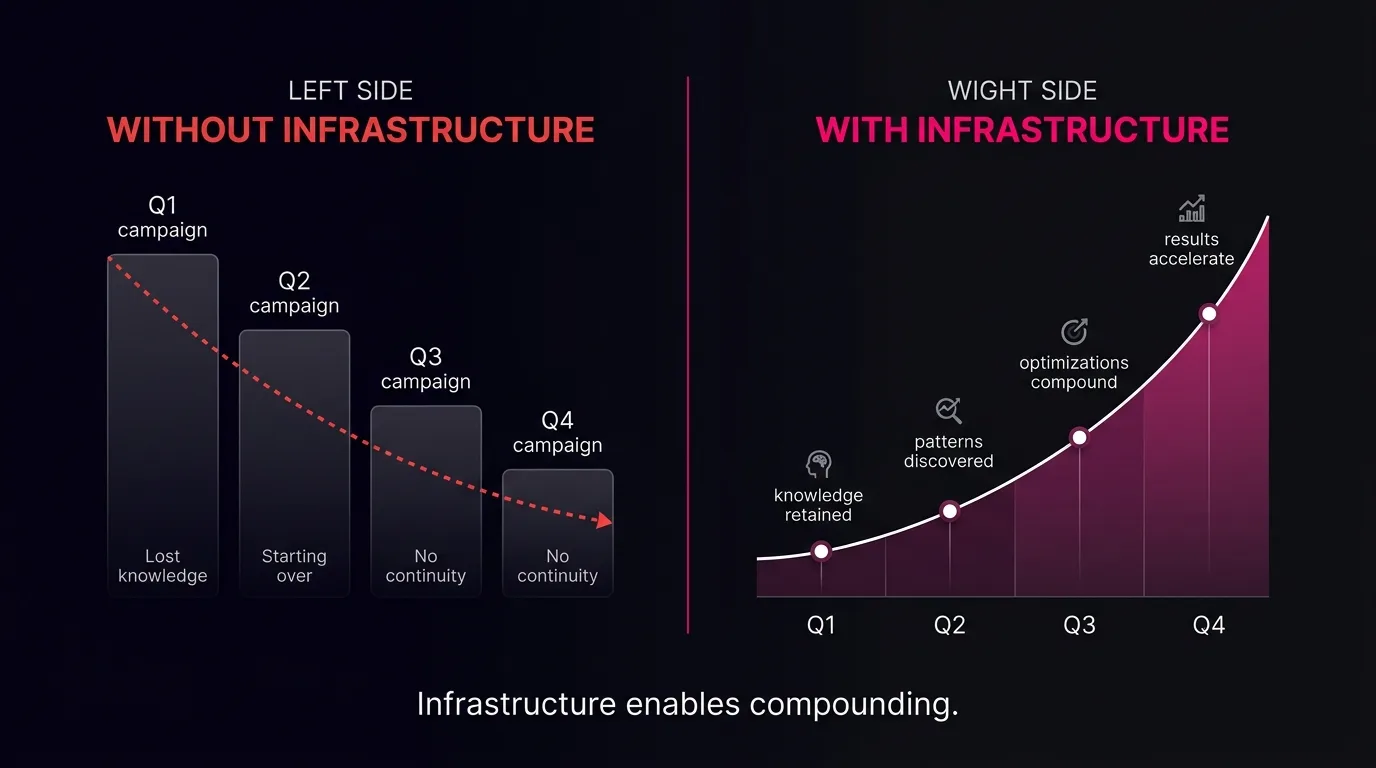
Compounding in marketing means that the knowledge, data, and optimizations from one period improve the performance of the next period. Results accelerate over time because you are not restarting — you are building on what you learned.
Here is the difference:
Campaign thinking: Run Campaign A from Jan–Mar. Achieve a 2.1x ROAS. March ends. The contract ends. The files go into a folder. April starts with Campaign B run by a different agency or contractor. They do not have the learnings from Campaign A. They build their own strategy from scratch. Campaign B runs Apr–Jun.
Compounding thinking: Run Test 1 in Jan–Mar. Achieve a 2.1x ROAS. That result is not archived — it is documented. The data and reasoning behind it are retained. The systems, tracking, and audience segments that enabled it persist. In Apr, Test 2 builds directly on Test 1 with the same operator, same system, same institutional knowledge. Result: Test 2 starts at 2.1x and improves from there, not from 1.0x again.
The mathematics are staggering. If Campaign A generates 100 units of value and Campaign B is unaware of Campaign A's learnings, it must regenerate that learning cost (wasting 40% of its effort on rediscovery). But if Campaign B inherits Campaign A's data and optimizations, it can begin at 100 and compound to 130. By Quarter 4, the compounding model has created cumulative value of 100 + 130 + 169 + 220 = 619 units, while the fragmented model creates 100 + 60 + 36 + 22 = 218 units. Compounding nearly triples the return.

Compounding is not a nice-to-have. It is the difference between efficient marketing and marketing that wastes 60%+ of its effort on rediscovery.
Why Campaigns Reset Every Quarter
Campaigns reset because the industry is structured around deliverables, not systems.
When you hire an agency to run a Q1 campaign, you are hiring a team to design, build, launch, and report on a time-boxed effort. That is what they are contracted for. The contract expires on March 31. The team moves to the next client. The documents, tracking implementation, audience segments, and institutional knowledge from Campaign A evaporate because nobody owns their retention.
Even when the same agency continues into Q2, the knowledge rarely compounds because agencies optimize for campaign deliverables, not system continuity. The Q1 campaign files sit in a shared drive. The Q2 team reviews the results (maybe), nods at the ROAS, and builds Q2 from the playbook, not from Q1's actual learned patterns.
On the internal side, the problem is worse. You hire someone to manage marketing for 18 months. They understand your business, they build systems, they start to compound. Then they leave. The next person inherits a stack but not the reasoning, the decisions, the patterns, the context. They rebuild because they cannot trust the undocumented knowledge of the previous person. Compounding stops.

The root cause: there is no infrastructure designed to retain learning. There is only project management and contract management.
How Infrastructure Creates Compounding (and Agencies Don't)
Real compounding requires three layers:
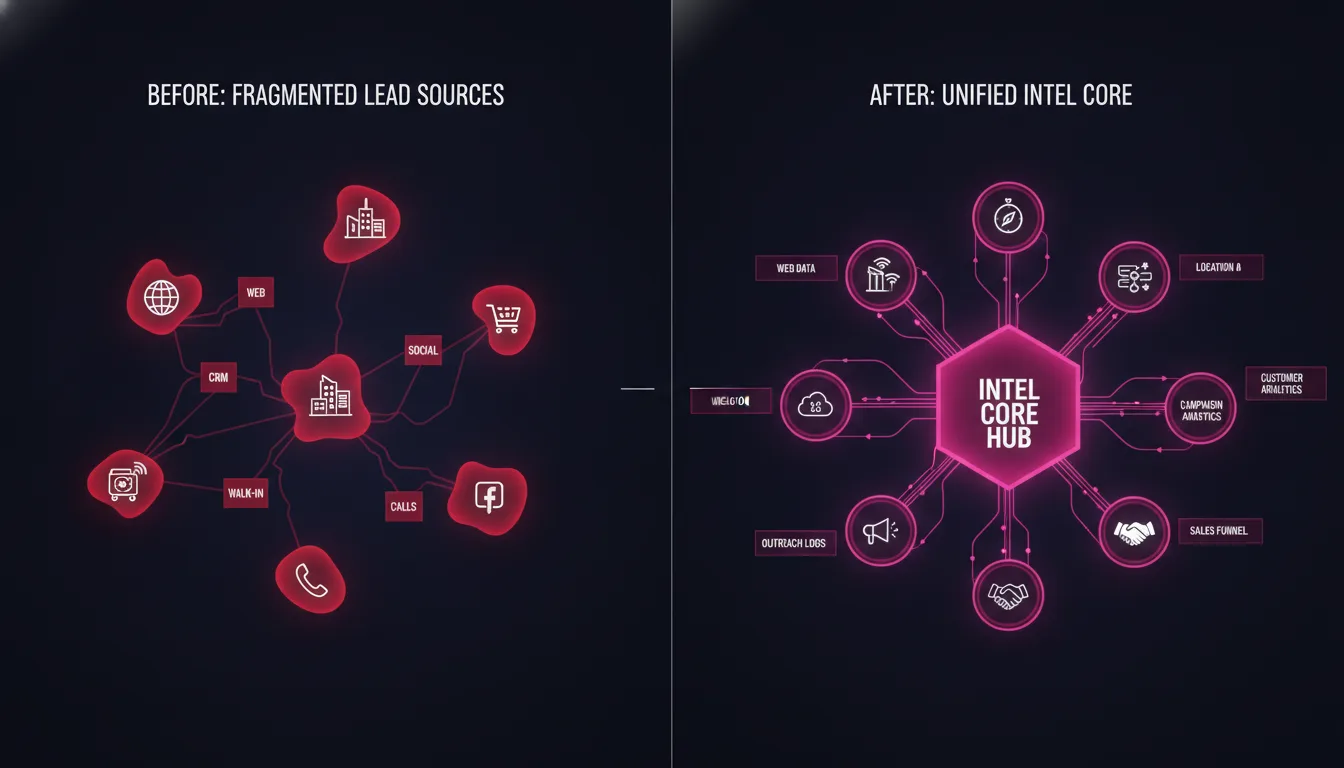
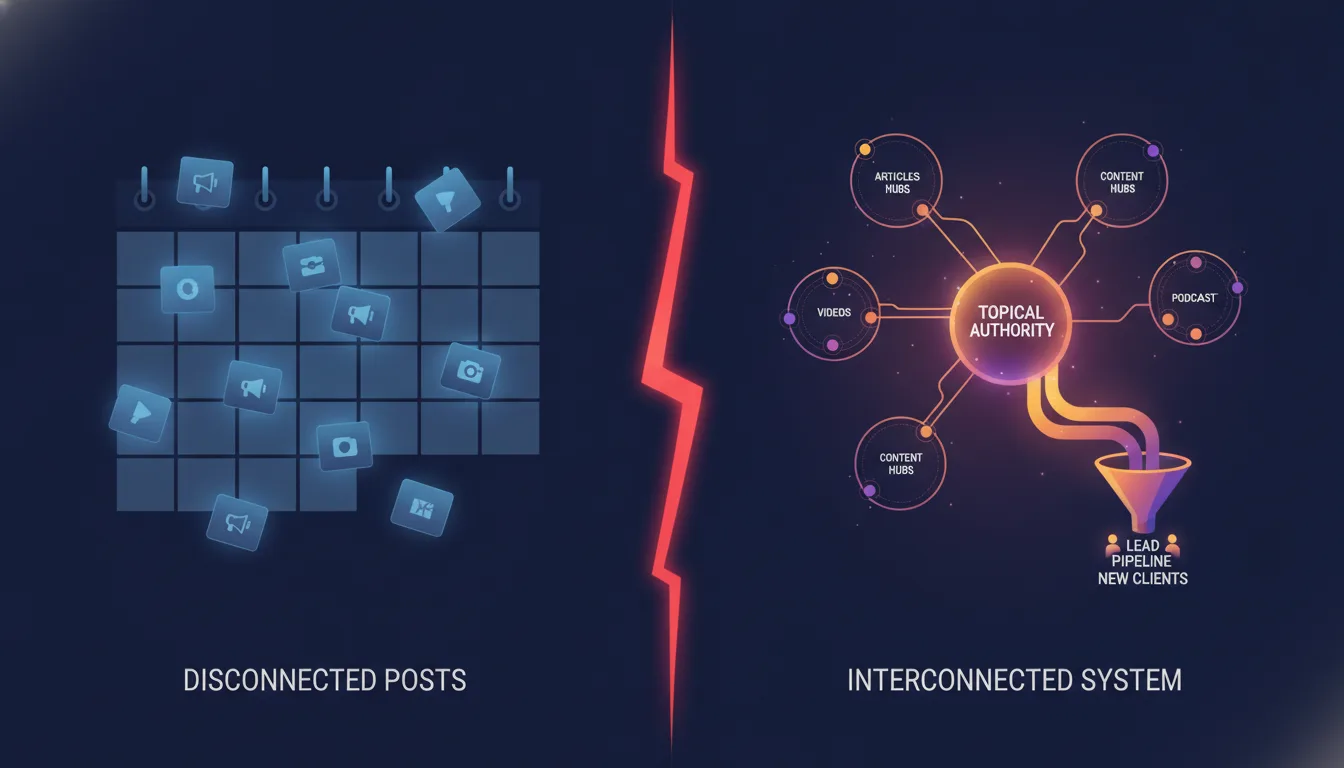
Unified system. All channels (paid media, email, funnels, tracking, content, automation) operate through one connected platform, not six disconnected vendors. When everything is unified, signals flow, patterns emerge, and optimizations cascade across channels instead of staying siloed.
Documented decisions. Every hypothesis tested, every action taken, every outcome measured is logged in the system with full context. Not stored in a PowerPoint. Not emailed to stakeholders. Logged in the infrastructure where it becomes searchable, referenceable, and evolvable. This is how a team (or a new team member) knows why a decision was made, what was tested, and whether the hypothesis held.
Single operator with continuity. One person owns the entire system over time, not rotating teams, not account managers who change every 18 months, not freelancers on retainer. One operator who understands every connection, every decision, every pattern because they have been there through the whole journey. This is what we call the Brand Technical Expert.
When these three layers exist together, compounding happens automatically. The system captures learning. The learning compounds across quarters. The operator evolves it based on fresh patterns. Results accelerate.

What Breaks Compounding | What Enables Compounding |
|---|---|
Campaigns are time-boxed projects | Infrastructure is a continuous system |
Knowledge is siloed in email, decks, spreadsheets | Knowledge is documented in the system (accessible, evolvable, shareable) |
Multiple vendors, each with their own optimization goals | One unified system with one optimization goal: compound growth |
Teams rotate; context is lost | One operator owns continuity; context is preserved |
Each quarter starts from 1.0x baseline | Each quarter builds from the previous quarter's learning |
Results are reported; learnings are archived | Results are measured; learnings are retained and evolved |
This is not theoretical. According to HubSpot's 2025 State of Marketing Report, companies that document their marketing decisions and maintain consistent execution achieve 3.5x better retention of learning and 2.8x faster optimization cycles compared to companies that run isolated campaigns.
Why Most Campaigns Fail to Compound
Even teams with good intentions fail to compound because the incentives are misaligned.
Agencies are paid for campaigns, not systems. A typical agency contract is "manage our paid media for Q1, deliver reporting, optimize for ROAS." The agency optimizes for the campaign deliverable. They succeed by getting campaign results. They succeed less by setting up the infrastructure for Q2 and Q3 to inherit and build on those results. The incentive is not wrong, but it is not aligned with compounding.
Tool vendors optimize for their tool, not your system. Your email platform wants your email campaigns to be good. Your analytics tool wants your data to be complete and accurate. Your ads platform wants your campaigns to be efficient. But none of them are designed to help you understand how email compounds paid media, or how yesterday's tracked conversion informs tomorrow's audience segment. Each tool is optimizing locally, not systemically.
In-house teams struggle with continuity. You hire a marketing manager who builds systems, documents processes, and gets things working. Then 18 months later, they leave for a bigger company. The next person inherits the stack but not the knowledge. Even if documentation exists, it often lacks the context and reasoning that allow someone new to evolve it. So they rebuild.
The only way to break this pattern is to build infrastructure with compounding as the explicit design goal.
What Managed Marketing Infrastructure Compounds
Managed marketing infrastructure is designed for compounding. Every element of the model is built to capture, retain, and evolve learning.
Unified system (Intel Core). At Metrics Masters, Intel Core is the central nervous system. Every channel — paid media, email, landing pages, conversions, audiences, reports — flows through one connected system. That means signals compound: a discovery in paid media feeds into audience building in email; a pattern in email feeds back into paid media optimization; a conversion insight improves landing pages. No silos. No handoffs. One flow of information that improves with each iteration.
Documented hypotheses. Every test is logged with its hypothesis, the action taken, the outcome, and the learning. Not filed away. Logged into Intel Core where it is searchable and referenceable. When the next test is designed, the operator can instantly see what was tried, why it was tried, and how it performed. This prevents rediscovery and enables building on what worked.
Single operator ownership. The Brand Technical Expert owns the entire system for the full engagement. Not contracted for Q1. Not rotating. Owned continuously. That continuity means the operator understands every connection, every decision, every pattern because they are there for all of it. Compounding is natural because the operator is the continuity.
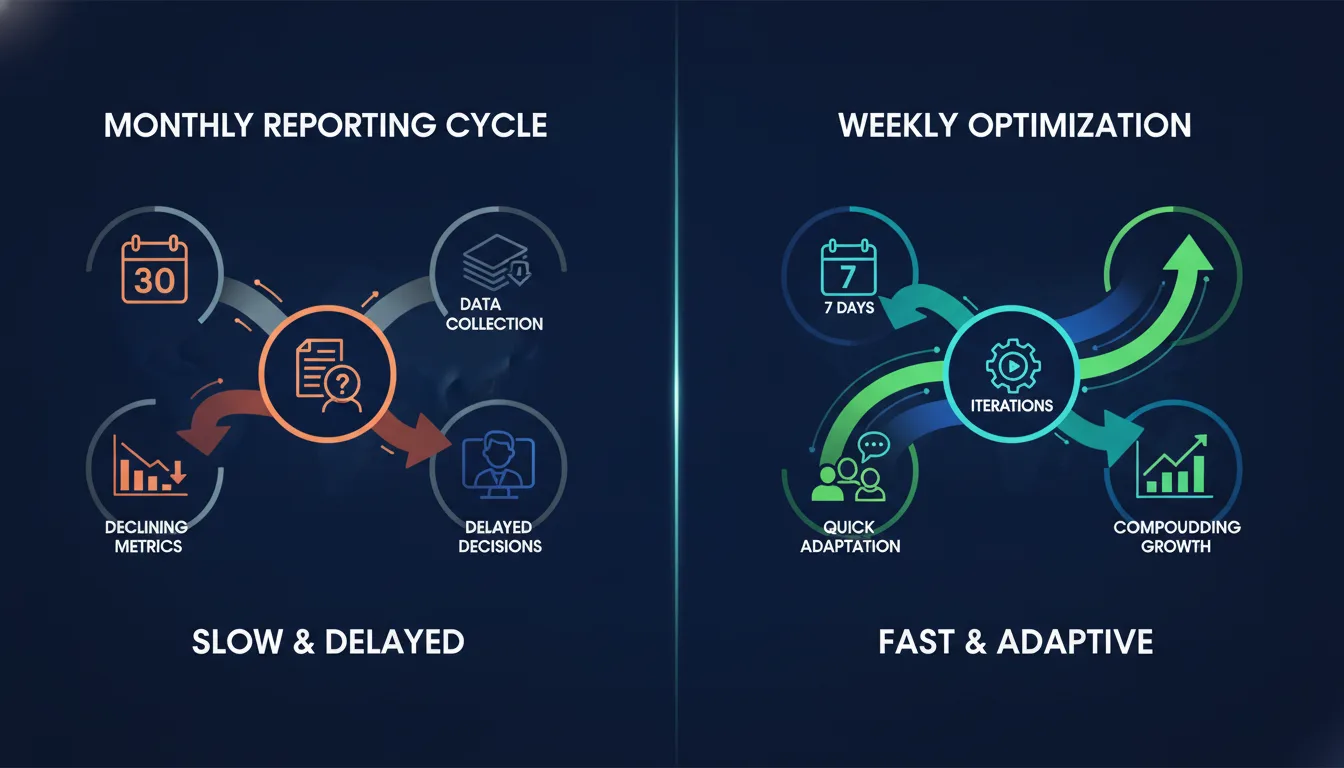
Weekly cadence with live reporting. Knowledge does not need to wait for monthly reports. Managed infrastructure operates on a weekly rhythm. Signals are visible weekly. Patterns emerge faster. Optimizations are tested faster. Learnings compound in weeks, not quarters.
The Compounding Effect on Your ROAS and Retention
The impact of compounding infrastructure is not subtle.
In the first 12 weeks, most campaigns (agency-run or in-house) show similar results. ROAS settles into a range. But after 12 weeks, the trajectories diverge dramatically.
Campaigns without infrastructure tend to flatten or decline after the initial optimization sprint. Why? Because the learning has stopped being retained. New campaigns start over. Teams rotate. Context is lost. By Month 12, that initial 2.0x ROAS often settles into 1.2x as the easy wins are exhausted and the system cannot surface new patterns.
Infrastructure-driven systems compound. By Month 4, the operator has captured enough signals to recognize patterns that were invisible in Month 1. By Month 8, cross-channel optimizations are paying dividends — email audiences informed by paid media performance, landing page improvements driven by funnel analysis. By Month 12, the system is self-improving, with Intel Core surfacing optimization opportunities faster than the operator can test them.
A typical comparison: a campaign-driven approach reaches ~2.0x ROAS in Month 1–3, then settles at ~1.3x by Month 12. An infrastructure-driven approach reaches ~2.0x in Month 1–3, but compounds to ~3.2x by Month 12. Not because the team is better. Not because you paid more. But because the system is designed to retain and evolve learning instead of restarting it.
The same compounding effect applies to retention. According to MarTech.org's 2025 State of the Stack analysis, companies with unified infrastructure experience 40% lower vendor churn and 2.5x higher team retention than companies managing fragmented stacks. When everything compounds, the cost of switching systems becomes prohibitive — you would be abandoning all the documented, embedded learning.
How to Build Infrastructure That Compounds
Compounding infrastructure requires three things — and most marketing teams have none of them:
One connected system. Not five platforms loosely integrated with APIs and webhooks. One system where all channels are native, not bolted on. This is radically different from the point-tool mindset. Instead of "Ads Tool + Email Tool + Analytics Tool," it is "One system that does ads, email, and analytics natively."
Documented decision-making at every step. Not monthly reports. Not quarterly strategy decks. Every decision — every test, every hypothesis, every optimization — documented in the system in real-time. This means context is preserved. Patterns become visible. Future decisions build on past ones.
Continuous, single-operator ownership. Not a campaign manager on a 6-month contract. Not a rotating team. One person who understands the business, owns the system, and is incentivized to compound learning, not just deliver campaigns. This is the Brand Technical Expert model.
Building this yourself is possible but rarely happens because it requires sustained investment with no short-term ROI signal. The payoff compounds — but it requires patience and system thinking. Most organizations cannot sustain that focus when campaign pressure is constant.
This is why managed marketing infrastructure exists. The operator (the Brand Technical Expert) owns the infrastructure and continuity. Intel Core documents every decision. The unified system retains every signal. Compounding happens automatically as a byproduct of how the system is built.
Infrastructure vs Campaigns: Real Examples
Example 1: E-commerce brand, $2M ARR
They hired Agency A to run paid media for Q1. Campaign delivered 2.3x ROAS and $180K revenue. Great result. Contract ended. Q2, they hired Agency B to run media. Agency B had no context about the audience segments Agency A built, the creative testing Agency A did, or the pixel implementation Agency A configured. Agency B rebuilt from scratch. Q2 delivered 1.8x ROAS and $145K. They paid for two campaigns but did not get compounding.
With infrastructure, that same brand would have run Test 1 (Q1) and achieved 2.3x, then Test 2 (Q2) building directly on Test 1's learnings, reaching 2.8x. Same team, same system, same operator. The learning compounds. By Q4, the compounding model would have delivered 270K+ in attributed revenue versus 180 + 145 + 120 + 95 = 540K fragmented.
Example 2: SaaS company, $5M ARR
Internal marketing manager ran campaigns well for 18 months, then left. The company hired a new marketing manager and gave them the previous person's "playbook" — Google Sheets with tactics, email templates, ad copy templates. But the playbook lacked context. Why these audience segments? Why this landing page structure? Why this email cadence? The new manager could not evolve the system because they did not understand the reasoning. So they rebuilt. Compounding stopped cold.
With managed infrastructure, the Brand Technical Expert documents not just what was done but why. Every decision is logged. When a team transition happens (or when the operator evolves the strategy), the new direction builds on 18 months of logged context, not on email templates. Compounding continues seamlessly.
Is Compounding Marketing the Future?
The technology is moving in that direction whether companies are ready or not. McKinsey's 2025 B2B marketing research shows that organizations optimizing for long-term knowledge compounding outperform campaign-driven organizations 3.2:1 on three-year ROAS. The data is clear: compounding wins.
The shift from campaigns to infrastructure is a shift from project thinking to system thinking. Campaigns are projects. Infrastructure is a system. Projects end. Systems compound.
If you are still running isolated campaigns each quarter, your marketing is still in the project era. The compounding era requires a different model: one operator, one system, documented decisions, and the discipline to retain and evolve what you learn.
That is what managed marketing infrastructure builds.
How to Start Compounding Your Marketing
If you recognize this pattern in your own marketing organization — campaigns restarting every quarter, teams rotating, learnings lost — there are three steps to shift toward compounding infrastructure:
Audit what you know and where it lives. What decisions have you made about your audience, creative, messaging, and channels? Where is that knowledge stored? Is it in email? Spreadsheets? One person's head? If that knowledge leaves the organization, is it gone forever? If the answer is yes, you are not compounding.
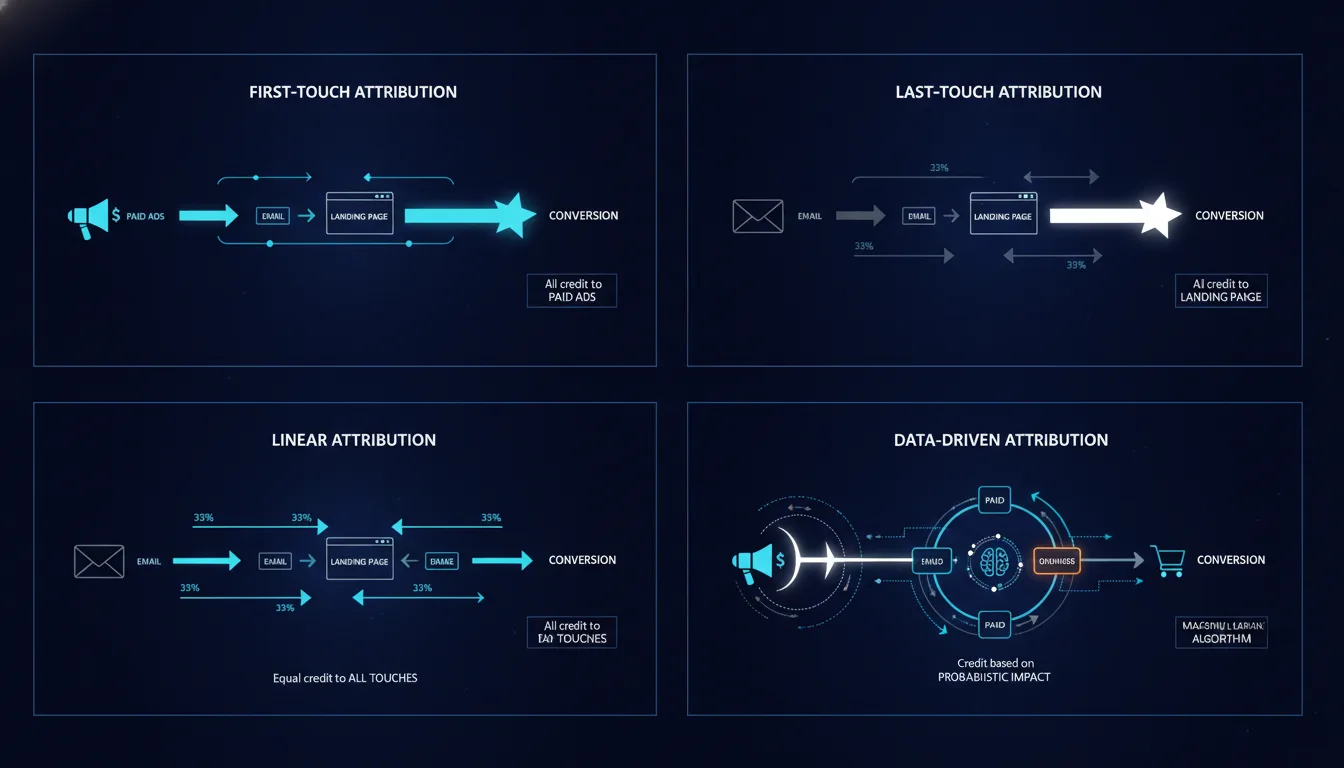
Identify the gaps in your system. Do your tools talk to each other, or do they require manual reporting? Can you trace a conversion all the way back to the original touchpoint, or does attribution break down? Can you see patterns across quarters, or does each quarter feel like starting from zero? These gaps are where compounding breaks.
Choose continuity over rotation. Whether you hire in-house, bring on a fractional CMO, or partner with managed infrastructure, pick a model that prioritizes continuity of knowledge over project-based deliverables. The operator should own the system long enough to see learning compound, not just the current quarter's results.
Compounding is possible. It just requires a different model than the one most marketing teams are using today.
We built managed marketing infrastructure specifically to make compounding the natural outcome of how your marketing operates. If you are ready to shift from campaigns to systems, let us talk about what that looks like for your brand.
Contact us to explore how managed infrastructure can help your marketing compound.
Frequently Asked Questions
How long does it take for compounding to show up in results?
Most teams see the first signs of compounding around Week 12–16. The first 8 weeks are spent setting up the system, documenting baseline performance, and establishing the operator's understanding of your business. After that, patterns start to emerge and optimizations begin compounding. By Month 6, the difference versus a campaign approach becomes statistically significant. By Month 12, the cumulative advantage is typically 2.0–3.0x.
What happens to our learning if we switch operators or agencies?
If your infrastructure is designed around documented decisions (logged in the system, not in a person's head), learning persists through operator transitions. The new operator can read the hypothesis, the test, the outcome, and the reasoning. They can continue the work without restarting. This is the key difference between "knowledge in a system" and "knowledge in a person." We always recommend that learning is captured in the infrastructure, not dependent on individual people.
Does compounding work for all types of marketing?
Compounding works for any marketing that operates in cycles — paid media, email, content, funnels, landing pages, automation, audience building. The more integrated your channels, the faster compounding compounds because signals flow across channels. Single-channel marketing (like a paid-only budget) still compounds but more slowly because there are fewer feedback loops.
Is this different from regular optimization cycles?
Yes, significantly. Regular optimization means you test things within a campaign and improve the current campaign. Compounding means you test things in Campaign A, document what you learned, and build Campaign B on top of Campaign A's foundation. The difference is that optimization improves the current thing; compounding improves the future thing by retaining the past thing. Both matter, but compounding is the longer-term accelerant.
How much does it cost to build compounding infrastructure?
Building it yourself (hiring in-house talent, integrating tools, documenting processes) costs $150K–$300K+ annually, depending on your team size and system complexity. Hiring a fractional CMO adds $8K–$15K/month but does not guarantee system continuity. Managed infrastructure typically costs $2,500–$5,500+/month depending on complexity and channel scope, and includes the operator, the system, and the compounding methodology as part of the engagement. Most growth-stage brands find the managed model more cost-efficient because the operator is accountable for compounding, not just campaign delivery.
What if we want to test this before committing?
The best way is to pick one channel (like paid media) and run it on the infrastructure model for 12 weeks with full documentation of decisions. At 12 weeks, you will see whether compounding is happening (patterns emerging, optimizations accelerating, ROAS improving beyond initial wins). If it is working, expand to other channels. If it is not, you have only invested 3 months and will have learned what is missing from your current system. We offer a structured 4-phase engagement designed exactly for this kind of testing and validation.
How does managed infrastructure work with our existing tools and vendors?
We integrate with your existing tools where it makes sense — your CRM, your analytics, your ads platforms. But the core intelligence (decision logging, pattern recognition, optimization sequencing) runs in our unified system, which becomes the source of truth. This hybrid approach lets you retain investments in existing tools while building the compounding layer on top. Intel Core becomes the operator's command center, connecting everything to make compounding automatic.

Jeremiah Shaw
CEO & Technical Marketing Specialist · Metrics Masters | Brandlio
International
Technical marketing specialist pushing boundaries in Google Ads, automation, and AI-driven growth systems. Paragliding and adventure enthusiast.