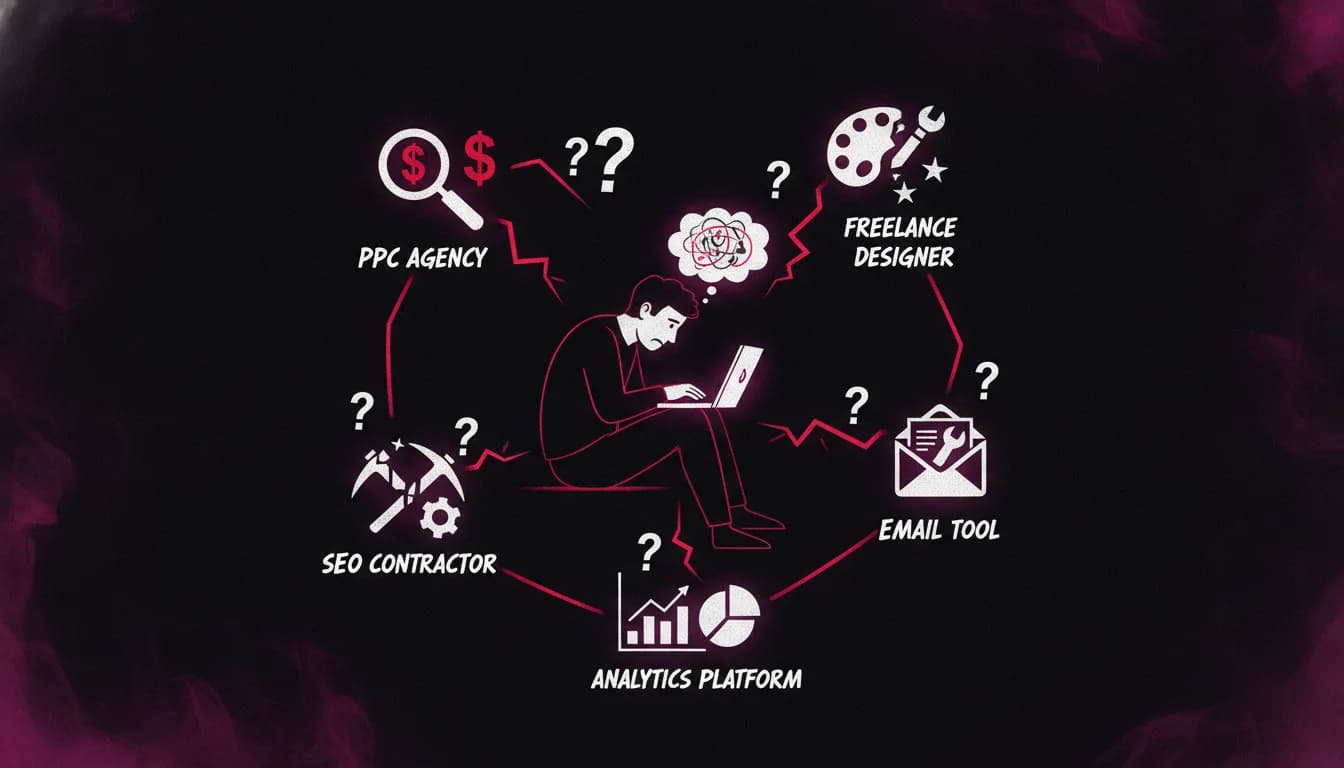
What Happens When Marketing Fragmentation Takes Over?
Growth-stage brands hit a predictable moment: the marketing strategy that worked at $500K in revenue stops working at $2M. Not because the strategy is wrong. Because the execution model has become fragmented.
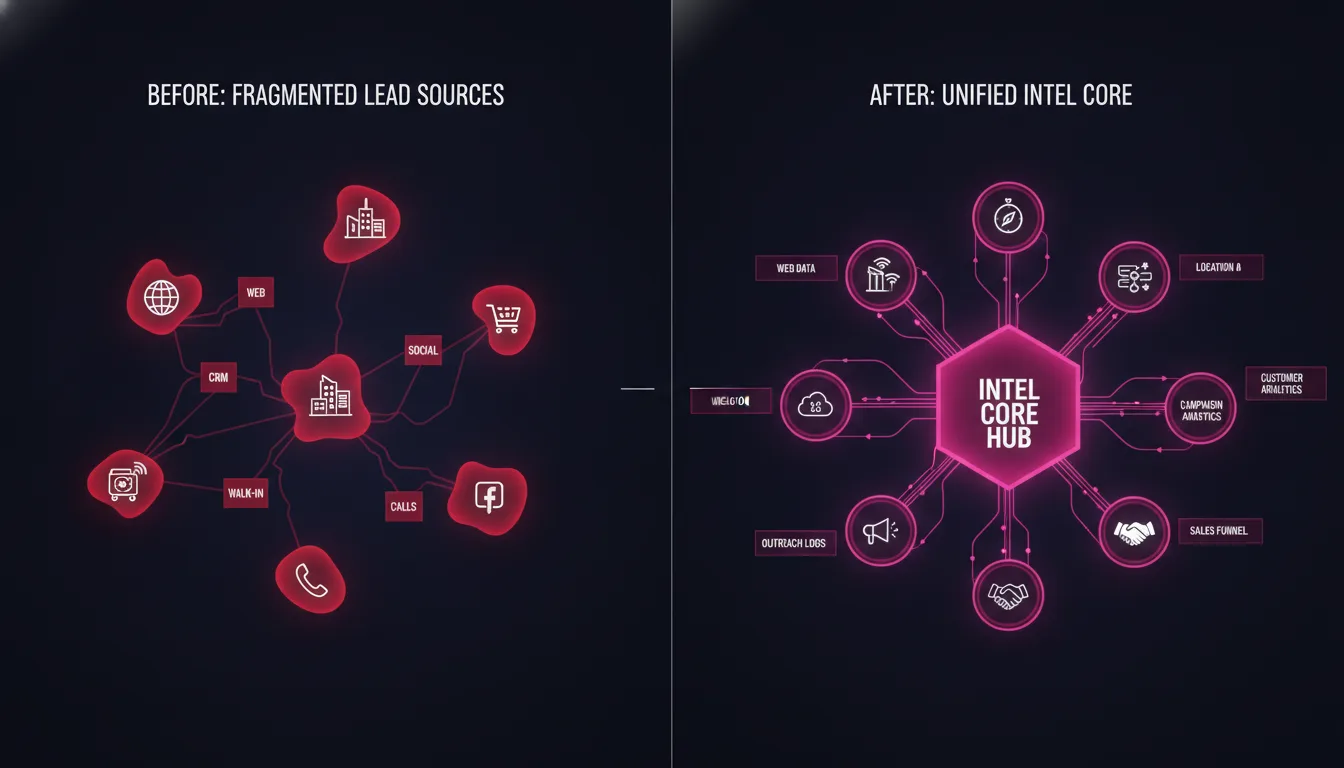
One vendor manages paid ads. A freelancer handles email. Someone internal (usually you) manages the landing pages. A separate tool powers analytics. A different contractor produces content. And all of it is disconnected.
The result: nobody owns the full picture. The founder or CMO becomes the unpaid project manager. Decisions are made without complete context. Optimizations in one channel create problems in another. Time spent coordinating replaces time spent strategizing. This is the fragmentation problem.
It is not a skills gap. It is a structural failure. And the harder you try to fix it with better vendors, better tools, or better meetings, the deeper it gets.
What Does Fragmented Marketing Actually Cost?
The financial impact of fragmentation is measurable and large. Companies with fragmented marketing operations spend 20% more on media buying than integrated peers — with little to no performance gain. For a $50K/month media budget, that is $10K/month wasted. Over a year, that is $120K in dead spend.
67% of growth-stage marketing teams manage 16 or more distinct tools, according to recent industry research. And as tool count increases, ROI clarity collapses. Organizations using 11-25 marketing tools report nearly 90% unclear ROI, compared to 62% for those with 6-10 tools.
The data waste is real too. E-commerce brands lose between $200K and $850K annually to fragmented marketing data costs — tool stack bloat, duplicate subscriptions, wasted analyst hours fixing data problems, and poor decision-making from incomplete attribution.

Even more sobering: 65% of marketing leaders report that more than half their team's time goes to fixing issues instead of creating campaigns. And only 33% of martech capabilities are actually being used by the organizations that license them.
Put another way: you are paying for tools you do not use, spending time coordinating between vendors, losing insight because data is siloed, and burning budget on media buys that are not informed by complete attribution. All of this compounds because nobody owns the system end to end.
Why Does Fragmentation Feel Inevitable?
It feels inevitable because it is the industry default. The traditional agency model was designed around separation: one team for paid ads, one for email, one for design, one for analytics. That model worked when channels operated independently and data lived in silos.
That era is over. 68% of business and technology leaders now recognize vendor consolidation as a strategic priority, specifically because the coordination costs and data gaps have become too large to ignore.
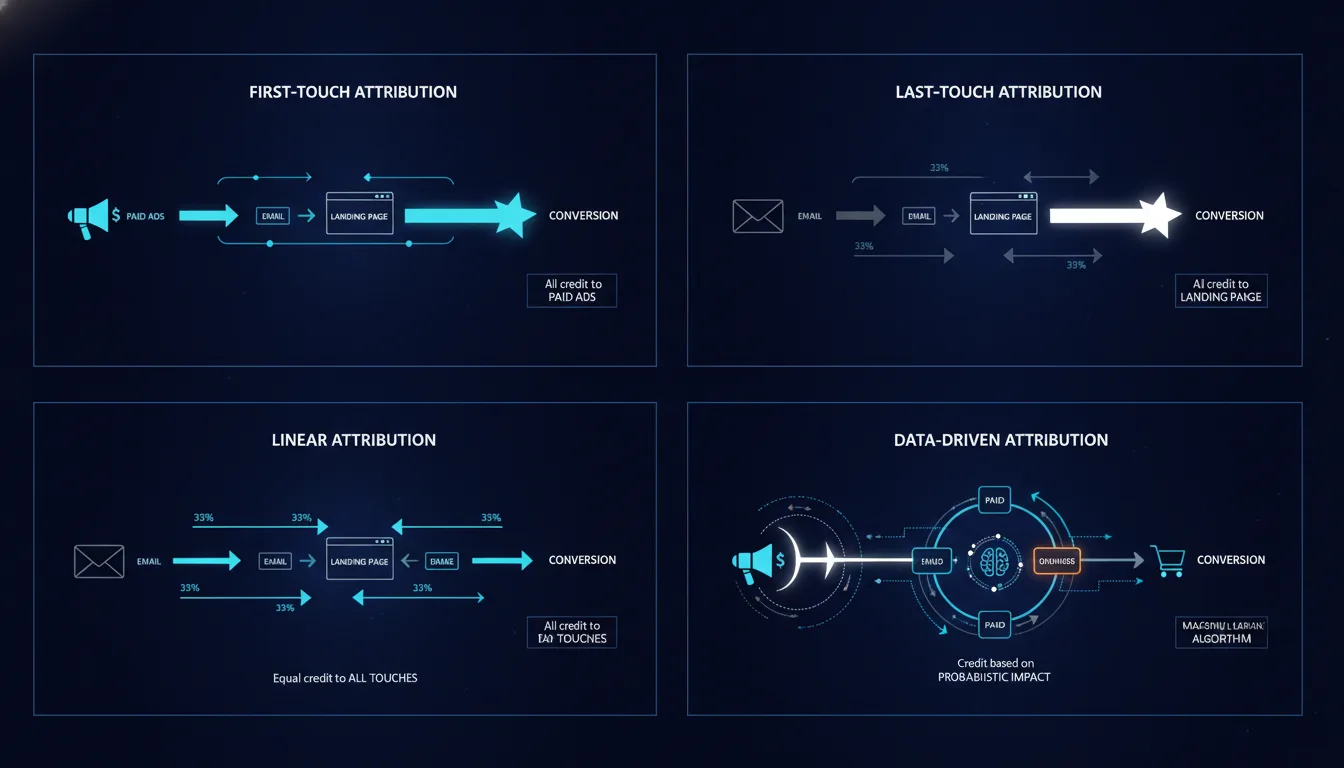
Modern consumers interact with brands across multiple touchpoints spanning social media, connected TV, podcast advertising, and traditional digital channels. Attribution is cross-channel. Privacy regulations require server-side infrastructure. Automation spans email, ads, and CRM simultaneously. The old separation of concerns no longer works.
But the vendor and agency ecosystem has not caught up. Most agencies still operate as separate departments. Most freelancers still work on disconnected contracts. Most in-house teams still exist as functional silos. The fragmentation problem persists because the structure of the industry incentivizes it.
What Is the Real Coordination Burden?
Let us be concrete about what coordination chaos actually looks like. A conversion rate drops 12%. You notice it. What happens next in a fragmented setup?
You email your PPC agency. They respond in 24 hours: "Could be the landing page."
You contact the freelancer who manages your funnels. They reply the next day: "Could be the traffic source."
You realize nobody has access to clean attribution data. You need the analytics person.
The analytics person is at a different company, works part-time. Email sent. Wait for response.
You schedule a call to get everyone aligned. It takes three days to find a time.
One person cannot make it. You have the call anyway. Get partial answers.
Someone needs to check the email automation settings. That is another conversation thread.
Finally, 5-7 days later, you understand the issue and can take action.
In a unified system with one operator, that same problem takes 24 hours. The Brand Technical Expert traces it from the ad platform through the landing page to the tracking configuration to the email follow-up sequence — all in one sitting, with one set of data — and takes action immediately.

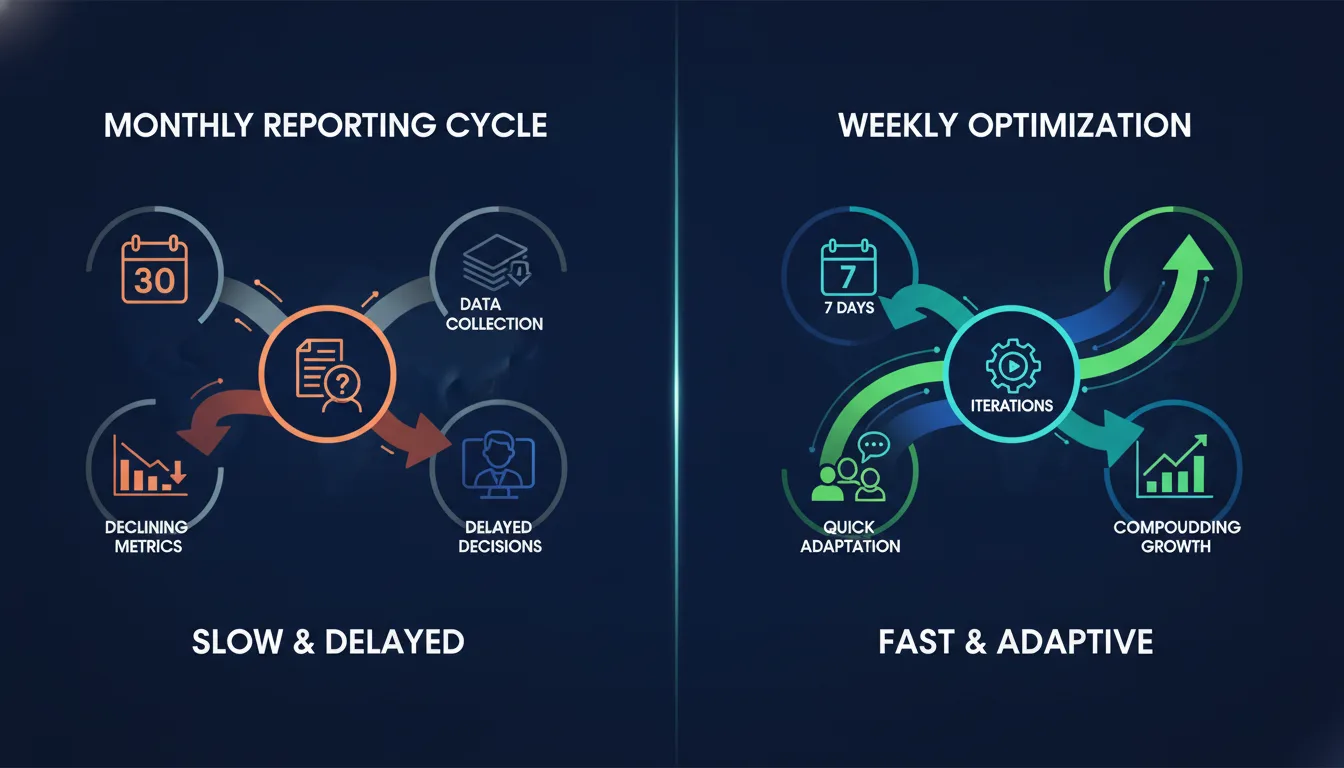
Multiply that 5-day lag across 20 issues per quarter, and you have lost a month of optimization cycle time. You are operating with stale data. Decisions are made weeks after the information that would have changed them arrives.
This is why organizations consolidating vendors report up to 35% improvement in team productivity — not because individual tools get better, but because the coordination overhead disappears.
How Does a Unified System Fix This?
A unified system replaces coordination with direct execution. One Brand Technical Expert operates the entire marketing infrastructure — paid media, landing pages, conversion tracking, email automation, content, and analytics — through a single connected system.
This is not an agency that coordinates across departments. It is not a fractional CMO who sets strategy and delegates execution. It is not a dashboard or a SaaS tool you manage yourself. It is an operator who owns the full stack, accountable for everything from end to end.
The structure changes everything. When one person owns all six channels, decision-making is immediate. When data flows through a single system (Intel Core), attribution is clear. When knowledge is documented inside the system, it compounds instead of leaving when people change. When the Brand Technical Expert can see the entire picture, they optimize for the system, not for individual channel metrics.

This is the difference between managing channels and managing a system. Channels can be optimized independently. Systems compound. Systems remember. Systems get better over time, not worse.
What Does One System Actually Look Like?
In practice, managed marketing infrastructure includes:
Paid media — Google Ads, Meta Ads, Microsoft (Bing) Ads, and LinkedIn managed through direct API connections with unified bidding logic informed by cross-channel data
Landing pages and funnels — built, tested, and optimized as load-bearing parts of the conversion system, not isolated projects
Conversion tracking — GA4, Google Tag Manager, server-side tagging, and platform-specific event APIs configured to capture the full user journey without data loss
Email and automation — behavioral sequences, lifecycle campaigns, and audience synchronization that flow directly from funnel and ad data
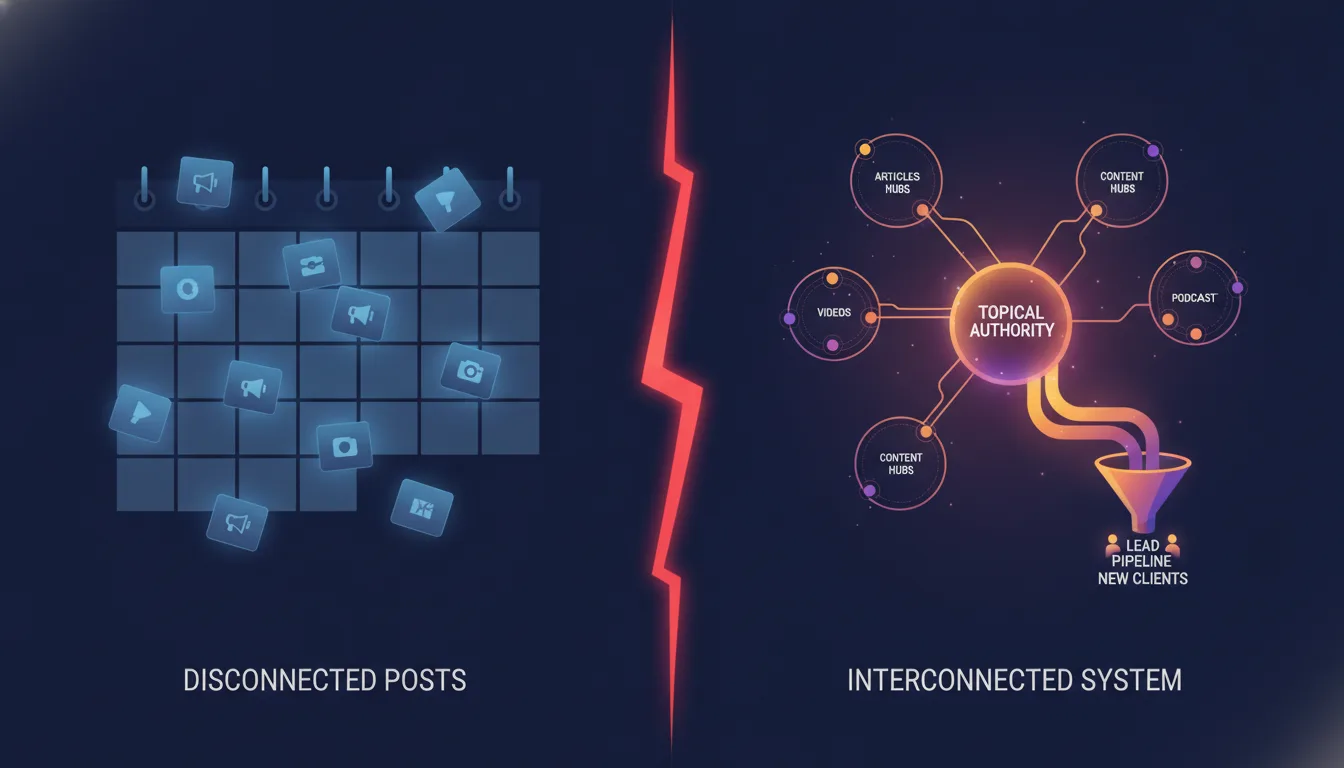
Content systems — structured production pipelines informed by what converts, not editorial hunches
Analytics and reporting — live dashboards, automated anomaly detection, and documented decision logs so patterns become visible and repeatable
All of it operates as one system. Nothing is sold separately. Nothing is optional. The value is in the connections between these systems, not in any single channel.
The Brand Technical Expert configures each one and operates the entire stack. They own the decisions. They own the data. They own the outcomes. There is no "let me check with the email person" or "I need to loop in analytics." There is one accountable operator with complete context.
How Is This Different from Hiring Another Vendor?
Adding another vendor is just adding more fragmentation. You would have 17 tools instead of 16. You would have one more person to coordinate with. The structure does not change.
Managed marketing infrastructure is not a vendor add-on. It is a replacement structure. It replaces the coordination layer entirely by making all execution accountable to one operator who is accountable to you.
Dimension | Fragmented (Multiple Vendors) | Managed Infrastructure |
|---|---|---|
Accountability | Distributed across multiple people; coordination falls on you | One Brand Technical Expert owns everything |
Data flow | Manual exports, spreadsheet merges, guesswork | Automated through Intel Core; real-time, unified |
Decision speed | 5-7 days for cross-channel diagnostics | 24 hours; often same day |
Knowledge retention | Leaves with people; restarts with each vendor change | Compounds inside the system; survives personnel changes |
Optimization logic | Each vendor optimizes their channel independently | One operator optimizes for system outcomes |
Cost transparency | Multiple invoices; hard to see total spend | Single engagement cost; predictable |
Key Takeaway: Fragmentation is not solved by adding more vendors or more tools. It is solved by collapsing the coordination layer entirely — by making all execution the responsibility of one operator accountable to you through one system. That is the infrastructure model.
What Should You Budget?
Managed marketing infrastructure at Metrics Masters ranges from $2,500 to $5,500+ per month depending on scope, number of active channels, and complexity of tracking and automation.
Compare that to what fragmented marketing actually costs: a paid media agency at $2,000–$5,000/month, a freelance email marketer at $1,000–$3,000/month, analytics tools and configuration at $500–$2,000/month, a designer retainer at $1,000–$2,500/month, content production at $500–$2,000/month. That total typically runs $7,000–$15,000/month — before accounting for the time and opportunity cost of founder or CMO coordination.
Managed infrastructure consolidates all of that into a single engagement. Most brands see 20-40% cost reduction while gaining complete visibility, cross-channel accountability, and dramatically faster iteration cycles.

How Do You Start?
First, audit your current stack. List every vendor. List every tool. List every person you coordinate with. Calculate the total monthly spend. Measure the average time between identifying a problem and taking action.
That audit usually reveals the problem clearly. Most growth-stage brands are shocked by both the total spend and the total coordination overhead.
Second, decide whether you want to keep managing fragmentation or you want to hand off the execution layer entirely to one operator. There is no in-between. You cannot fix fragmentation by adding more structure; you have to collapse it.
If you are ready to consolidate, start a conversation with Metrics Masters. The engagement process starts with a complete audit of your current stack, then moves into integration, configuration, activation, and optimization. Campaigns are live within 14 days.
Key Takeaway: Growth-stage brands that consolidate their marketing infrastructure from fragmented vendors to a unified system with one operator report faster decision velocity, clearer attribution, better ROI transparency, and 20-40% cost savings. The system compounds over time instead of resetting every quarter.
Frequently Asked Questions
What exactly is fragmented marketing?
Fragmented marketing is when your brand's marketing stack is scattered across multiple vendors, each responsible for a different channel or function — one agency for ads, a freelancer for email, an internal person for landing pages, a different tool for analytics. No one vendor owns the full picture. No one is accountable for system-level results. The founder or CMO becomes the unpaid project manager coordinating between them. Fragmented marketing creates coordination delays, data silos, and redundant spend without proportional results.
How much does fragmentation actually cost?
Directly: 20% more media spend with no performance gain, plus $200K-$850K annually in wasted data and inefficiency for mid-to-large brands. Indirectly: time wasted on coordination instead of strategy, delayed decision-making (5-7 days vs. 24 hours), incomplete attribution, and missed optimization opportunities. For a $50K/month media budget, fragmentation typically costs $10K/month in dead spend alone. That is $120K per year in documented waste before accounting for the hidden costs.
Can you fix fragmentation with better tools?
No. Adding another tool is just adding more fragmentation. The problem is structural, not technical. Tools proliferate because agencies and vendors sell services, and multiple vendors mean multiple tools. Fixing fragmentation requires changing the structure — moving from multiple accountable parties to one accountable party operating one unified system. That is Infrastructure-Powered Growth.
What is managed marketing infrastructure?
Managed marketing infrastructure is a model where one dedicated operator — a Brand Technical Expert — runs your entire marketing stack through a single connected system. Paid media, landing pages, tracking, email, content, and analytics all operate as one integrated system powered by Intel Core, proprietary intelligence infrastructure. One person owns all execution. Data flows unified. Knowledge compounds. Results improve over time instead of resetting every quarter.
How is this different from hiring a fractional CMO or in-house marketer?
A fractional CMO provides strategy but typically does not execute campaigns, configure tracking, or manage the martech stack directly. An in-house hire brings dedication but is limited by one person's skill set and bandwidth. Managed infrastructure includes both strategy and hands-on execution across all six systems (ads, funnels, tracking, email, content, reporting) operated by a single expert who owns technical configuration and optimization. It is full execution, not strategy alone.
What is the difference between managed infrastructure and traditional agencies?
Traditional agencies coordinate across departments — one team for ads, one for email, one for design, one for analytics. Each department has its own processes and incentives. Coordination requires meetings, project managers, and handoffs. The client pays for all that overhead. Managed infrastructure collapses those layers. One operator. One system. No handoffs. Direct accountability. Full context. Faster execution.
How long does it take to transition from fragmented to unified?
The engagement follows four phases: Integrate, Configure, Activate, Optimize. The first three phases are completed within 14 days of kickoff. You go live with tracking and campaigns within two weeks. The Optimize phase is ongoing — the system compounds over time, so month six is categorically better than month one. Month twelve is better than month six. This is the difference between a system and a series of projects.